QCOM -2.37% WDC -2.56% AAPL +0.57% 005930.KS +4.74% Explore stocks on Coinbase Trading disclosure Trading disclosure The above button links to Coinbase. Yahoo Finance is not a broker-dealer or investment adviser and does not offer securities or cryptocurrencies for sale or facilitate trading. Coinbase pays us for certain activity generated through this link. Prices displayed are informational.
As mobile connectivity and data storage demands intensify, Qualcomm (NASDAQ:QCOM) and Western Digital (NASDAQ:WDC) stand as pivotal players in the tech landscape. Investors must decide which business model offers better potential.
Qualcomm provides the essential chips for smartphones and connected vehicles, while Western Digital manufactures the storage hardware that anchors global data centers. These companies represent different corners of the tech ecosystem, making them an interesting comparison.
Qualcomm is a central figure among semiconductor stocks. It designs the chips that power high-end smartphones and is moving into the automotive and Internet of Things sectors. In its latest annual report, filed in late 2026, the company highlighted key customers like Apple (NASDAQ:AAPL) and Samsung (OTC:SSNLF). Since these mobile handset customers account for a large share of sales, customer concentration like this adds a layer of risk to the business.
In fiscal 2026, revenue reached nearly $43.1 billion, a slight decline of roughly 2.6% from the prior year. Despite the dip in top-line growth, the company reported robust net income of approximately $13.6 billion. This equates to a net margin of close to 31.6%, which is a measure of how much profit is kept from every dollar of sales.
As of Qualcomm's September 2026 balance sheet, the debt-to-equity ratio was roughly 0.5. This ratio measures total debt relative to shareholders' equity, with lower ratios indicating a more conservative financial structure. The current ratio, which shows assets available to cover short-term liabilities, stands at nearly 1.9. Free cash flow was close to $8.7 billion for the year, though note that stock-based compensation accounted for roughly 31% of operating cash flow, inflating reported cash generation since SBC is a non-cash expense added back in the cash flow statement.
Western Digital provides essential data storage solutions using hard disk drive technology for cloud and consumer markets. According to its latest annual report, filed for the fiscal year ending in 2026, the company noted a massive reliance on cloud providers. This cloud end market accounted for nearly 89% of revenue in fiscal 2026. Customer concentration like this adds a layer of risk to the business, as three individual customers each accounted for 10% or more of total revenue.
For fiscal 2026, revenue reached approximately $12.9 billion, a jump of nearly 35.7% over the previous year. The company delivered net income of close to $9.4 billion. This resulted in an exceptionally high net margin of roughly 72.9%, indicating the company is keeping a large portion of its revenue as profit.
Based on Western Digital's July 2026 balance sheet, the debt-to-equity ratio is approximately 0.1. This indicates a very conservative use of debt relative to shareholder equity. The current ratio stands at close to 1.3, meaning the company has $1.30 in short-term assets for every $1.00 in short-term debt. Free cash flow for the year was nearly $3.5 billion, and the company maintains a healthy financial position for its future projects.
Qualcomm faces significant revenue concentration in a small number of mobile handset customers. If key customers like Apple transition to their own internally developed solutions, the company could lose a major revenue stream. Additionally, high sales volume in China exposes the business to geopolitical tensions and trade restrictions. Competition is also intense, requiring constant innovation to stay ahead of rivals like Taiwan Semiconductor Manufacturing Company (NYSE:TSM) in manufacturing and other chip designers.
Western Digital is heavily dependent on a limited number of cloud customers and suppliers for critical components. Any disruption in global demand or a shift in technology standards could hurt its market position. The company is currently navigating a transition to new storage technologies like HAMR. Furthermore, macroeconomic volatility and potential product defects or warranty claims represent ongoing concerns for the hardware manufacturer as it competes with companies like Micron Technology (NASDAQ:MU).
Western Digital appears more attractive based on its forward P/E ratio, while Qualcomm carries a lower P/S ratio relative to its total sales.
Valuation metrics include sourcing from Financial Modeling Prep (FMP) and may differ from other data providers.
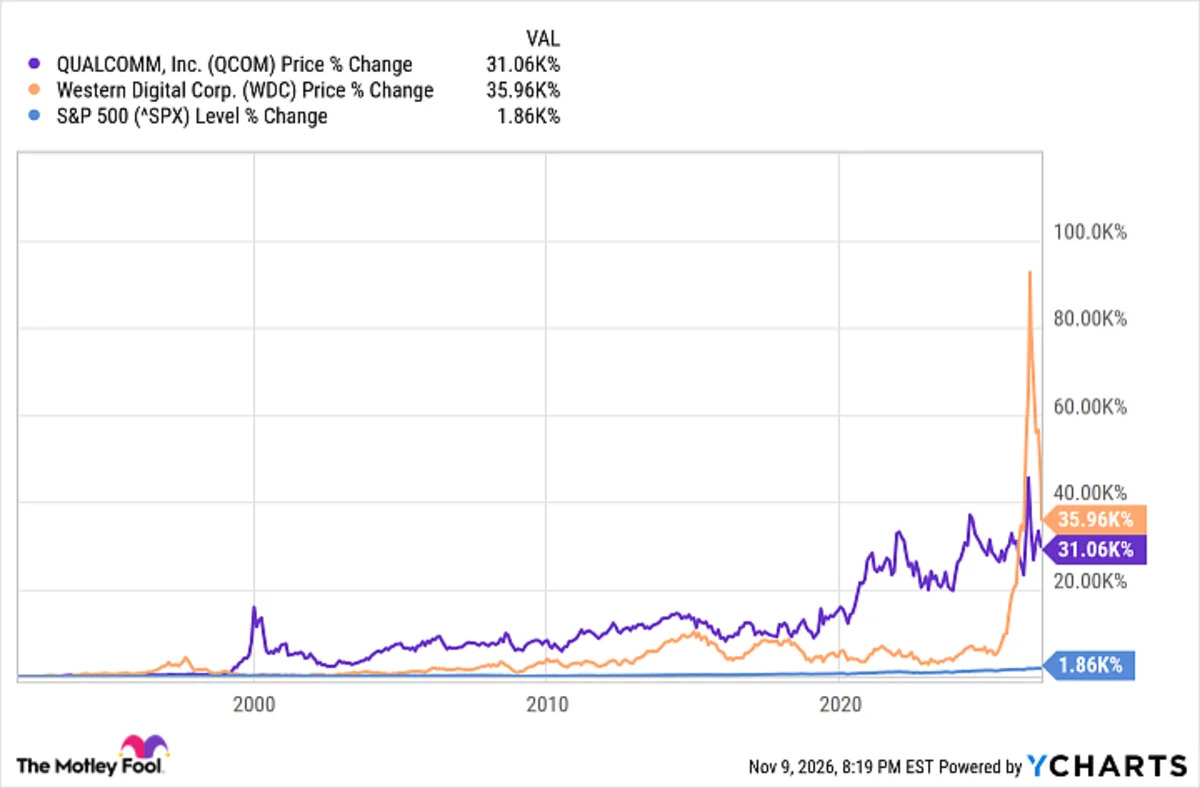
I think we've established I am a skeptic with some stocks (even a hater, perhaps). Western Digital has posted impressive growth recently, and yet. The data storage and memory markets are super cyclical, and right now data storage is trading at a wild premium. This long-term chart gives me pause, because WDC was plodding along for ages:
Furthermore, as you can see above, Qualcomm's and Western Digital's long-term returns aren't that far apart. In fact, Western Digital only really ran away with it in the last year or so:
I sometimes buy small positions in spicy, growth-y stocks just to expand my horizons. I don't feel inclined to think Western Digital is attractive in that way. Data and memory storage demand are so closely linked to AI demand right now that I think it's all just toeing the line between a boom and a bubble. Sign me up for boring smartphone chips; Qualcomm gets my vote.
The Motley Fool Stock Advisor analyst team just identified what they believe are the 10 best stocks for investors to buy now… and Qualcomm wasn't one of them. The 10 stocks that made the cut could produce monster returns in the coming years.
Consider when Netflix made this list on December 17, 2004... if you invested $1,000 at the time of our recommendation, you'd have $341,966!* Or when Nvidia made this list on April 15, 2005... if you invested $1,000 at the time of our recommendation, you'd have $1,146,819!*
Now, it's worth noting Stock Advisor's total average return is 852% — a market-crushing outperformance compared to 203% for the S&P 500. Don't miss the latest top 10 list, available with Stock Advisor, and join an investing community built by individual investors for individual investors.
*Stock Advisor returns as of November 10, 2026.
Erin Kennedy has positions in Apple and Taiwan Semiconductor Manufacturing. The Motley Fool has positions in and recommends Apple, Micron Technology, Qualcomm, Taiwan Semiconductor Manufacturing, and Western Digital. The Motley Fool has a disclosure policy.
Qualcomm vs. Western Digital: Which Tech Stock Is a Better Buy for 2027? was originally published by The Motley Fool