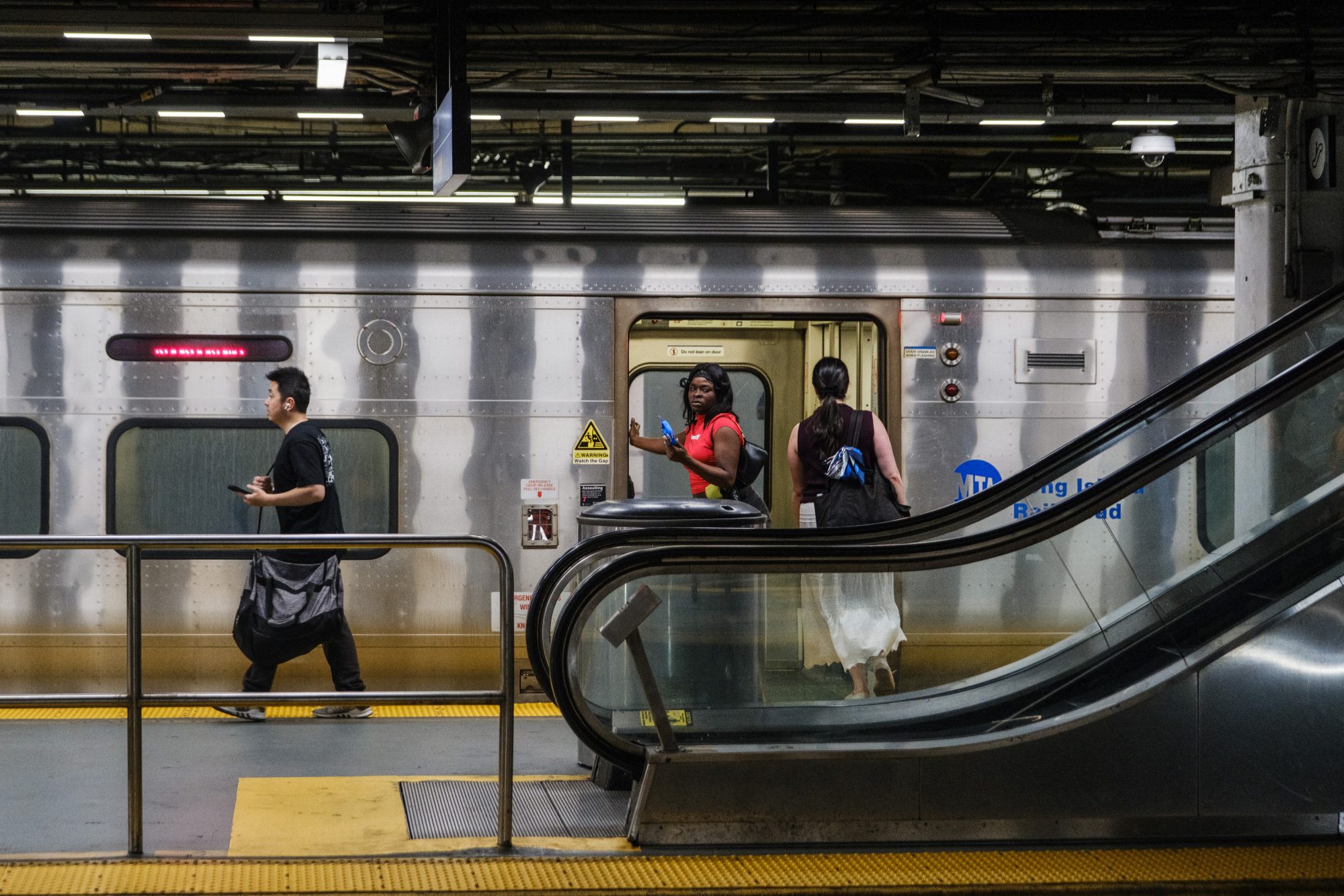
Penn Station in Manhattan as the Long Island Rail Road begins service after a strike that led to many concessions by Gov. Kathy Hochul. Stephen Yang for NY Post See more of our coverage in your search results.
Add The New York Post on Google This week’s Long Island Rail Road walkout holds a lesson for Gov. Kathy Hochul: We’re going to need a bigger strike.
And when this new agreement expires just 15 months from now, Hochul — assuming she wins re-election this fall — has the tools she needs to make a deal that finally addresses the railroad’s decades-old labor issues.
Last Friday, five LIRR unions walked off the job to protest the state-controlled Metropolitan Transportation Authority’s modest effort to hold the line on raises.
Hochul, to her credit, didn’t immediately cave just to keep the trains running.
She leveled with the public, treating riders as adults.
“These unions represent the highest-paid workers of any railroad in the nation, yet they are demanding contracts that could raise fares as much as 8%,” she said.
The impasse was over whether, after retroactive raises for three years, LIRR workers should get a 5% raise for the current year; the MTA offered 3%. (They settled on 4.5%.)
A higher raise, the MTA worried, could set a precedent for its bigger work forces, including subway and bus workers.
But the permanent crisis at the LIRR is its work rules, which push overtime to the stratosphere and thwart service.
The MTA didn’t even bother asking for work-rule changes this time around.
Under the LIRR’s antiquated work rules, engineers, for example, earn double pay if they operate two types of locomotives on the same day.
They get an extra payday for operating a train in a yard as well as one for passengers during a single shift.
Exorbitant OT rules mean the MTA can’t schedule regular-pay trackwork when it’s most convenient, at night and on weekends.
Overtime rules would cost the MTA millions to move more Mets fans on game days.
They’re why the LIRR will spend $214 million on OT costs this year — almost a quarter of its straight-time payroll costs.
By contrast, the MTA’s subway and bus division, hardly a font of fiscal rectitude, will spend “just” 14% of straight payroll costs on overtime.
As long as the federal law that covers the LIRR allows its workers to strike, holding out through a lengthy walkout is the only way the MTA will ever get the big work-rule changes it needs to put the railroad on a sound fiscal footing.
It took a six-week strike in 1983 — and several missed paychecks for workers — to achieve work-rule changes at Metro-North.
This week’s strike, then, was only a rehearsal for the real LIRR fight yet to come.
First, office workers’ ability to temporarily work from home means that a strike today causes far less pain than the transit walkouts of previous generations did.
Hochul told Long Islanders to stay home if they could on Monday, and they listened.
The picket lines brought disruption, but not chaos.
Second, the MTA can use technology to offer better service to riders who can’t work from home.
The shuttle buses it sent from points on Long Island to Queens subway stations worked reasonably well for a day or two — and ahead of a future strike, the MTA could create an app to assess shifting demand for such services, adding shuttles to meet passenger need.
Third, a long strike might not be the political disaster that previous governors have feared.
In past decades, Long Island has been a swing region, so neither party wanted to alienate its voters.
But Nassau and Suffolk counties voted heavily for Republican Lee Zeldin for governor in 2022 — and Hochul still won statewide.
She can afford to spend political capital there if necessary.
She could even offer temporary post-strike rebates to commuters, letting them share in the savings if a long strike wins work-rule concessions.
Finally, a couple of years from now, the governor may have no choice but to bring the matter to a head.
The MTA faces a $160 million deficit next year, increasing to $306 million by 2029.
Those projections already include money from scheduled fare and toll hikes.
Normally, governors would raise taxes and fees to cover that gap — as Hochul did with her MTA tax on businesses last spring.
But with New York’s economy stalled, Hochul can’t raise business taxes further — and she can’t go to the public to ask for a different revenue stream.
Why? Because she’s the same governor who launched congestion pricing, selling it as the toll that would save the MTA once and for all.
And the congestion toll is already set to go up on her watch, from $9 to $12 two years from now.
Hochul was made of malleable tin this time around.
But soon enough she’ll get another chance to stand firm as the Iron Lady of New York state.
Nicole Gelinas is a contributing editor to the Manhattan Institute.