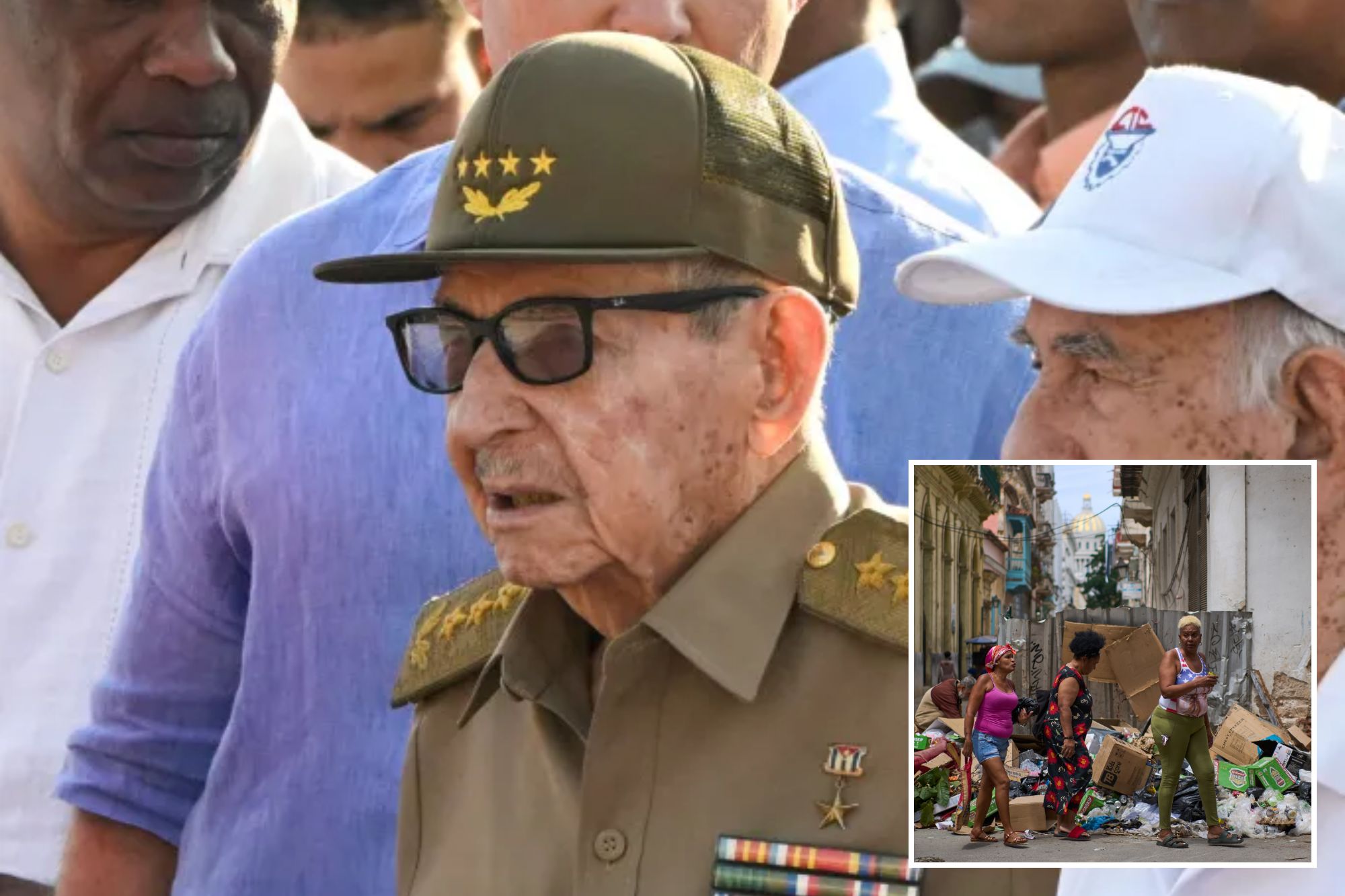
Add The New York Post on Google Many Cubans hope the US indictment against former president Raul Castro announced Wednesday will usher in the collapse of the entire Communist regime.
Dissidents on the island and exiles in the US welcomed the historic charges — for murder over the downing of two aid jets in 1996 — saying while most of the island starves under choking sanctions, the political elite and military continue to syphon aid and lead normal lives.
In Havana, Ranses Mones Quintero, 32, told The Post he welcomed the criminal charges, saying: “We are happy and hopeful. And if there has to be blood, if Cubans have to die to get rid of the government, then we’re prepared. People are just tired of waiting for change.”
In Havana, Ranses Mones Quintero, 32, told The Post he welcomed the criminal charges, saying: “We are happy and hopeful. And if there has to be blood, if Cubans have to die to get rid of the government, then we’re prepared. People are just tired of waiting for change.”
However, presently he’s most worried about where he’s going to find medication to treat his pneumonia.
“There’s nothing here,” he said, explaining he survives on remittances his family sends from the US, from which the government takes a portion of that cash.
“There’s no medication, no work and we only have electricity for a couple of hours a day.”
Castro, 94, was charged along with five others with seven counts of murder, conspiracy to kill US nationals and destruction of aircraft over the destruction of the Brothers to Rescue jets by Cuban MiG-29 fighter planes in 1996.
“Indicting Castro is not enough,” said Austin-based Cuban dissident Gabriela Blanco, who has been living in the US since she escaped Cuba in 2019. “They need to indict the whole government.”
Cuba has been under an oil blockade by the US for 119 days. It started January 29 after a raid on Cuban ally nation Venezuela by US Special forces, arresting leader Nicolas Maduro. Since then, Cuba’s nearly 11 million residents had endured daily blackouts and shortages of food and medicine.
Oil from Venezuela had supplied most of Cuba’s energy, but disappeared overnight, reinforced by an executive order from President Trump imposing tariffs on any country selling oil to the island. Since then, residents reported to The Post they are getting between one and six hours of electricity a day.
Since increased sanctions have been in place, only $22.4 million of aid has gotten through to Cuba, falling far short of what is needed to keep the country afloat.
Yesterday, US Secretary of State Marco Rubio promised Cubans $100 million in humanitarian aid, through a non-government channel, made in a direct address in Spanish via social media.
But Mones Quintero — who is currently unemployed but previously worked as a mascot for a local baseball team — is doubtful the current regime will allow the aid in, without taking a cut.
He added he doesn’t blame the US for the shortages and economic ruin which has plagued the island since the Soviet Union collapsed, leading to the end of much of its economic support in the early 1990s.
He blames the mismanagement and greed of the Cuban regime, explaining how the homes of high-ranking military personnel and government employees enjoy unlimited electricity and have access to special, well-stocked supermarkets.
The Cuban government heavily taxes certain wages. Government workers earn between $15 and $23 US (360-550 Cuban Pesos) per month, after a tax of 10%. Anyone working for a foreign company gets hit with a 90% tax on their wage, according to published reports.
Mones Quintero sent The Post videos of himself cooking over an open fire, and darkened homes and streets, lit only by the lights of passing vehicles.
Despite his daily struggle for survival, Mones Quintero said he hopes the indictment and US pressure on the Communist regime will finally bring change.
Another non-Cuba born longtime resident of Havana characterized the indictment as “symbolic” but said it could shake up the government, removing the old elites from power and making way for a new cadre of leaders, not in thrall to the Castro family.
“Right now, everything is silent, and everyone says the government is at an impasse,” she said, referring to the ruling elite.
“This is what usually happens when things change in Cuba. There’s silence and then there’s the surprise.”
Fidel Castro led the Cuban revolution which seized power in 1959 and remained in power until 2011, when he passed the torch to Raul. Fidel died five years later. Raul ceded power to current leader Miguel Díaz-Canel, who remains fiercely loyal to the family, in 2019.
US sanctions against Cuba began in 1960, shortly after the communist revolution.
The Havana resident, who mainly works with foreign investors, said she recently got “lucky” with six hours of electricity earlier this week, allowing her to do a load of laundry and charge her cell phone.
“We’re just going day by day,” the source, who did not want to be identified, said. “It’s like camping. I have to carry buckets of water up my stairs in order to do anything.”
Conditions in Cuba have been steadily worsening over the past six years with an estimated 2.5 million people — around 24% of the population — leaving the island between 2020 and 2024.
The country was then hit by Hurricane Melissa in October 2025 which displaced almost a million people and destroying an estimated 40% of national vegetable production, according to thinkglobalhealth.org.
Still, Cuba’s official newspaper, Granma, greeted the news of the indictment with a story about the Union of Young Communists calling for a day of special events to mark Raul’s 95th birthday next month.
“Raúl Castro personally ordered the killing of four unarmed humanitarian workers. Three of them were American citizens,” said Rosa Paya, 37, the leader of the Cuban dissident movement and daughter of Oswaldo Paya, who was killed on orders of the Cuban government in 2012.
“For 30 years, the families of these victims have lived without justice, while those responsible remained in power,” she continued.
“This indictment is an act of justice and solidarity with the victims, their families, and the Cuban people, who have endured decades of repression.
“It should also send a clear message to those inside Cuba’s security and political apparatus today: there is still time to stand with the Cuban people and be part of a peaceful and dignified future, rather than remain tied to a regime whose day of accountability has arrived.”
According to the indictment, Raul and Fidel Castro gave the order to shoot down the aid planes, resulting in the deaths of four civilian pilots — Carlos Costa, Armando Alejandre, Jr., Mario de la Peña and Pablo Morales.
They had flown rescue missions to help Cubans who set off on rafts to escape the Communist island in the 1990s.