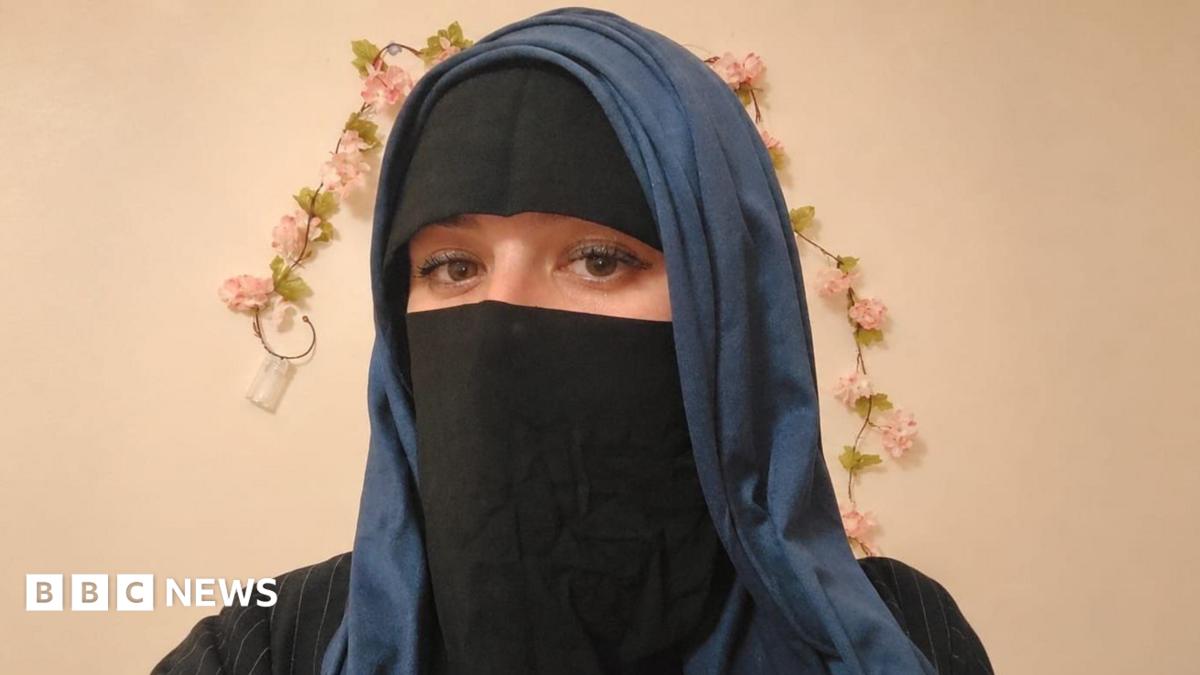
Image source, JaneImage caption, Jane said she was left feeling shocked and confused after the breakdown of her short marriage
Five days after her Islamic wedding, Jane received a text message which turned her life upside down.
"I divorce you and have divorced you," wrote her new husband.
Jane - whose real name the BBC has agreed not to publish - said she had met him on the Muslim marriage website Muzz 10 months earlier.
At the time, she believed he was called Adam and that he lived in Manchester.
"It's very hard for me. I thought I was getting into a marriage and instead I got into my worst nightmare," she said.
"It's just crazy. I don't understand why people do this kind of stuff for sex."
Jane said they spent six months chatting online together and on video calls before agreeing to meet in person.
She told the BBC she believed their relationship to be genuine and did not question what was happening when he subsequently proposed.
"He made me believe that he loved me and that he wanted to build a life with me, so I had no reason to really doubt him," she said.
She later discovered Adam's real name was different and that he was already married.
Adam's lawyers said he rejected Jane's allegations in their entirety.
Image caption, Jane met her future husband on the Muslim marriage website Muzz
On 2 June, Jane - a convert to Islam - went to Brierfield in Lancashire for a nikah - an Islamic marriage contract or ceremony under Sharia law.
Such contracts, however, are not the same as a civil legal marriage and are not legally recognised as marriage in England and Wales.
Jane said she wanted to get married in her home city of Glasgow, surrounded by friends and family, but said her future husband objected to a wedding in Scotland.
She now looks back on this moment as a warning sign.
"In Scotland, they asked for legal marriage and a nikah to be done at the same time," she explained.
"He said 'Why do they need to see my ID? I mean, nikah is very simple and they don't need to see my ID at all'.
"And so he was really upset about that."
Jane said the ceremony in Brierfield took place in the presence of two imams who acted as witnesses and the couple then spent two nights at a hotel.
Just five days after the wedding, however, Jane received the message informing her that their marriage was over.
Image source, JaneJane said she was left feeling shocked and confused, describing it as a "sham marriage".
Jane believes her "shocking" experience amounted to emotional and sexual exploitation.
The BBC understands he remains married to another woman, both legally and religiously.
In a detailed response through his lawyers, he said the allegations were part of a sustained campaign against him, were unsupported by evidence, and were false.
They told the BBC he had not deceived Jane about his previous marriage because he had not mentioned it.
He had also not hidden his identity during the ceremony with Jane because he provided his driving licence.
The BBC has seen a copy of Jane's Islamic marriage certificate provided to her by the mosque, which contains missing and incorrect details.
Mufti Adeel Zaman, the imam who conducted the ceremony, said the marriage had been between two consenting adults who appeared happy and that he did not consider it his responsibility to ask further questions.
"We are deeply saddened by the circumstances that have arisen," he told the BBC.
"Our intention throughout has been to provide appropriate support and assistance while remaining fair to all parties and limiting our comments to matters of which we have direct knowledge."
He acknowledged that mistakes had been made over checking identification but said he had helped uncover the true identity of the man that Jane had married.
The Lancashire Council of Mosques, which has been involved in mediation following the breakdown of the marriage, said those conducting such ceremonies had a responsibility to carry out appropriate checks.
Image caption, Bilal Brown said there were people "out there to deceive"
New Beginnings, a group based in Oldham, Greater Manchester, that provides services to people who have converted to Islam, said it had encountered cases involving people who sought to deceive others within the Muslim community.
"We know about these charlatans in our community, the Muslim community, and people they're out there to deceive," said founder Bilal Brown.
He said relationships or marriages that seem rushed or where extended family are not involved are clear warning signs that all may not be well.
Converts to Islam could be particularly vulnerable in such circumstances, he added.
Saima Afzal, a former assistant police and crime commissioner for Lancashire, told BBC North West Tonight the lack of legal recognition afforded to Islamic marriages could be a problem for some women.
"There is the nikah loophole that you hear about quite a lot around: 'Well, we can't do them for bigamy because nikah is not legally recognised in the UK'," she said.
"Putting that to one side about nikah, let's look at the behaviours here.
"So you've got trickery, manipulation and ensnaring really a woman.
Image caption, Saima Afzal said she was concerned about a "Nikah loophole"
An independent review presented to Parliament in 2018 found that a significant number of Islamic marriages were not followed by civil marriages, leaving people without the protections associated with legally recognised marriages.
Police Scotland said no criminality had been established in Scotland.
Greater Manchester Police confirmed it had been asked to investigate a complaint made by Jane.
Muzz said the man had been permanently blocked from its platform.
Its chief executive Shahzad Younas said: "We ask users to declare if they are married (legally or otherwise).
"If they are we block them from the app during sign-up."
He said the company carried out email, telephone number, device and selfie validation as part of its standard checks, while identity verification was optional.
Profiles indicate which checks have and have not been completed.
Jane said she wanted her case to help prevent other women from experiencing similar situations.
"It's an issue in the community," she added. "If I can help any other vulnerable woman like I was, it's a win."
Tell us which stories we should cover in the North West
Contact formContact formRead more stories from Cheshire, Lancashire, Greater Manchester and Merseyside on the BBC, watch BBC North West Tonight on BBC iPlayer and follow BBC North West on X, external.