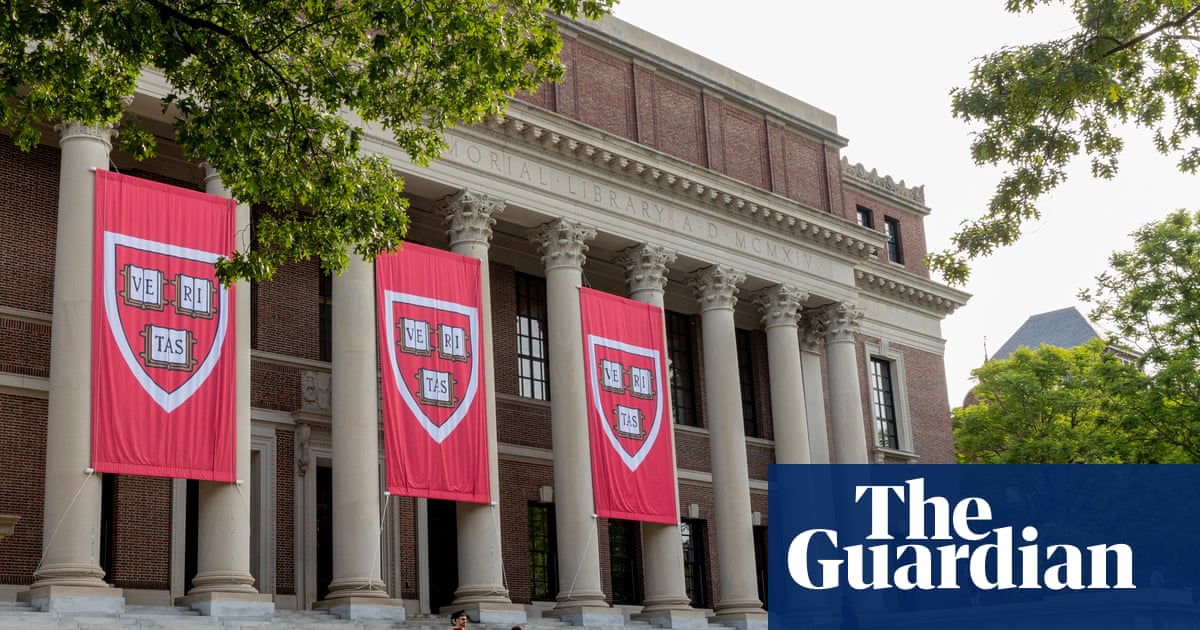
The Widener Library on the Harvard campus in Cambridge, Massachusetts. Photograph: Cassandra Klos/Bloomberg via Getty ImagesView image in fullscreenThe Widener Library on the Harvard campus in Cambridge, Massachusetts. Photograph: Cassandra Klos/Bloomberg via Getty ImagesHarvard College will limit the number of students who can receive A gradesMandatory cap on top grades at one of America’s most prestigious colleges will go into effect in fall of 2027
Harvard faculty has voted to impose a roughly 20% cap on A grades in an effort to curb decades of grade inflation that, the faculty argues, degrades the value of top-tier academic achievement at the college.
The mandatory cap on top grades at one of America’s most prestigious colleges will go into effect in the fall of 2027. Under an agreed “20 plus four” formula, the number of A grades awarded to a class of 100 undergraduates will be limited to 24 students.
The move comes after an October 2025 report sent to faculty and Harvard College students warned that the college’s evaluation system was “failing to perform the key functions of grading”.
The 25-page report found that more than 60% of grades awarded to Harvard undergraduates are As, compared with only a quarter of grades two decades ago, and concluded that the grading system was “damaging the academic culture of the College”.
Amanda Claybaugh, dean of undergraduate education, said that A grade inflation necessitated reforms to “restore the integrity of our grading and return the academic culture of the College to what it was in the recent past”.
Harvard’s faculty voted 458 to 201 to pass the first of three proposals limiting top grades, and a second to use average percentile rankings, rather than GPA, or grade point average, to assign internal awards and honors.
A third proposal, which would have allowed courses to petition to opt out of the A cap if they were graded as unsatisfactory, satisfactory and satisfactory-plus, was rejected.
The effort to winnow out exceptional students from the merely competent was broadly opposed by the student body. Nearly 85% of student respondents to a February survey said they disapproved of the proposals.
Some members of the Harvard faculty also argued that the grade-capping could heighten competition, discourage intellectual risk-taking, and infringe on their autonomy.
In a statement to the Harvard Crimson, Claybaugh called the vote an “important step” toward repairing Harvard’s grading system.
She added that the decision “will, I believe, strengthen the academic culture of Harvard; it will also, I hope, encourage other institutions to confront similar questions with the same level of rigor and courage”.
The subcommittee that drafted the proposals also said the A grade cap would restore the value of a Harvard transcript, or official academic record.
“This matters for our students above all. A Harvard A grade will now tell them, as well as employers and graduate schools, something real about what a student has achieved,” they wrote. “An A will once again be what Harvard’s guidelines have long said it is: a mark of extraordinary distinction.”
The Guardian has contacted Harvard for further comment.