play Live Sign upShow navigation menuplay Live Click here to searchsearchSign upEconomy|Israel-Palestine conflictWhy is Trump’s Gaza Board of Peace facing a funding shortfall?Experts say the lack of a political horizon and Israeli land grabs are deterring donors from funding Gaza’s reconstruction.
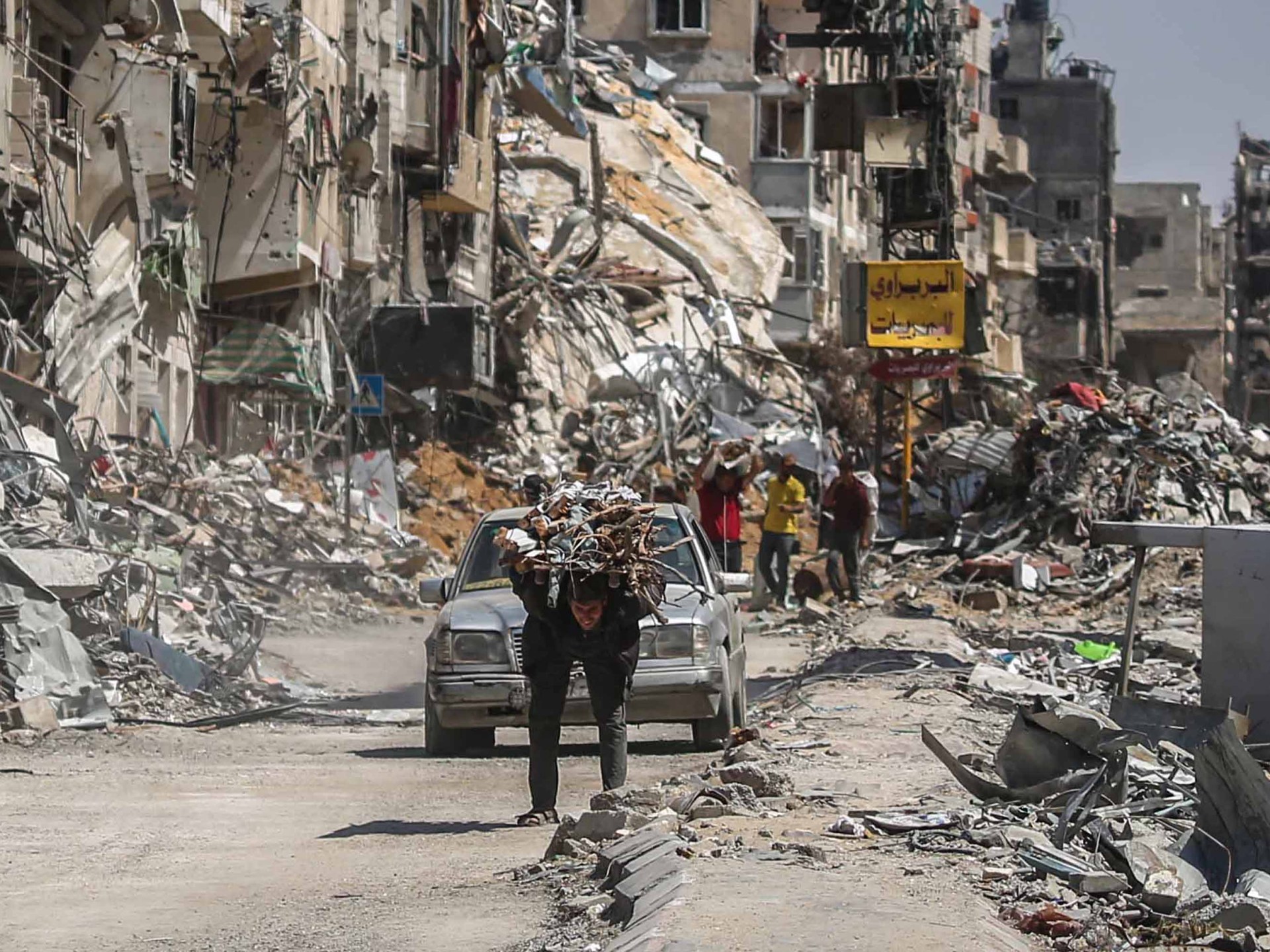
xwhatsapp-strokecopylinkgoogleAdd Al Jazeera on GoogleinfoA man carries items on his back as people remove possessions from their homes after Israeli air strikes in Khan Younis in southern Gaza [File: Ahmad Hasaballah/Getty Images]By Mohammad MansourPublished On 20 May 202620 May 2026The Board of Peace, which was founded by United States President Donald Trump in January to oversee the administration and reconstruction of the Gaza Strip, is facing a crippling cash crunch that threatens to derail its ambitious $70bn reconstruction plan for the devastated enclave.
The US-led board recently reported a critical gap between its financial commitments and actual disbursements, warning of an urgent liquidity crisis, according to the Reuters news agency.
However, experts tracking international aid to Palestinians said the funding shortfall is neither surprising nor purely administrative. Instead, they argued that the reluctance of Arab and European donors stems from the board’s controversial structure, a lack of a viable political horizon for a Palestinian state and Israel’s ongoing military expansion across the besieged enclave.
Moath al-Amoudi, an expert in international aid to Palestinians, told Al Jazeera that the heavily publicised pledges are closer to a “talk show” than a genuine humanitarian effort.
“Out of the $17bn pledged, the actual liquidity that has reached the ground is zero,” al-Amoudi said. “Donors are terrified of engaging with a board that carries no political vision and treats Gaza merely as an American security protectorate.”
The gap between pledges and actual disbursements is a historical constant in the Palestinian context, but the US has a particularly poor track record, al-Amoudi noted.
After the 1993 Oslo Accord, the international community fulfilled only 70 percent of its commitments. The agreement, brokered by the US, saw the Palestinians and Israelis agree to recognise each other for the first time and led to the creation of the Palestinian Authority, which governs the occupied West Bank. But over the years, successive Israeli governments tried to undermine the deal.
At the time, the US ranked third in disbursements, lagging far behind the European Union, which fulfilled more than 95 percent of its pledges, and Arab nations. Similarly, after the 2014 war on Gaza, only 46 percent of the $2.7bn pledged at a Cairo conference was disbursed after three years.
Today, the situation is far more complex. Unlike previous eras during which aid was directed towards a recognised political entity like the Palestinian Authority, the Board of Peace in effect sidelines Palestinian political aspirations.
Much of the international hesitation is rooted in the architecture of the Board of Peace itself.
Previous Al Jazeera reporting revealed that the board operates as a complex three-tiered governing structure heavily stacked with American billionaires and pro-Israel figures, such as billionaire Marc Rowan, US envoy Steve Witkoff, Secretary of State Marco Rubio and Trump son-in-law Jared Kushner.
Kushner played a role in the Abraham Accords, which saw the United Arab Emirates, Bahrain, Morocco and Sudan recognise Israel. He has suggested that Palestinians are incapable of self-governance. He described Gaza as having “very valuable waterfront property” at the height of Israel’s genocidal war on the enclave, which has killed more than 72,000 Palestinians.
The board’s charter includes a controversial clause: Countries can bypass the standard three-year term and secure a “permanent seat” on the board for a $1bn contribution.
Al-Amoudi described this “pay-for-influence” model as a form of “commercial guardianship” and “unethical extortion”.
“The US wants a donor community that acts like a broom to clean up the crimes, massacres and genocidal war committed by the Israeli occupation,” he said. “States have realised that the US is taking them into the illusion of development to fund a project that is unwanted by Palestinians and the international community.”
The board’s funding crisis is deeply intertwined with its strict political and security conditions. The three-phased US plan for Gaza explicitly demands the full disarmament of Hamas and all allied Palestinian factions as a prerequisite for reconstruction funds and the opening of border crossings while Israel has continued to violate the terms of an October “ceasefire”.
Former UN envoy Nickolay Mladenov has been leading efforts in Cairo under phase two of the US plan, which aims to replace Hamas, which has governed Gaza, with a technocratic administration. Mladenov, a former Bulgarian foreign minister and defence minister, was named as the director general of the Board of Peace in January.
Experts said linking humanitarian financing to military disarmament without offering an independent Palestinian state on the 1967 borders transforms aid into a weapon. The international community largely backs a Palestinian state based on Palestinian territory in 1967, comprising the West Bank, Gaza Strip and East Jerusalem. But Israel’s continued settlement expansion threatens the viability of a future Palestinian state.
“If the US were a fair mediator, it would offer a Palestinian state in exchange for disarmament. But offering only emergency relief in exchange for surrendering weapons is not a negotiation; it is subjugation by force,” al-Amoudi said.
He pointed to the history of US aid, which has often been marred by corruption and aligned with Israeli security interests rather than Palestinian needs. A prime example, he noted, was the US military’s floating pier built off Gaza’s coast during the war. The project, which was meant to facilitate the delivery of aid, cost an estimated $220m to $320m and was dismantled after just four months.
Meanwhile, basic emergency relief – such as providing clean water, medicine and pest control – has seen only a 30 percent fulfilment rate. Not a single temporary home has been brought into Gaza for the displaced since the US-brokered “ceasefire”.
Beyond the political and structural flaws of the board, the volatile reality on the ground makes meaningful reconstruction nearly impossible.
Despite a nominal “ceasefire”, Israeli forces have continued their near-daily violations. According to local medical sources, 828 Palestinians have been killed since the “truce” went into effect.
An Al Jazeera analysis of satellite imagery also recently revealed that Israel is systematically shifting the ceasefire-established Yellow Line, which demarcates land occupied by the Israeli military in Gaza. The analysis found that Israel has been repositioning cement blocks marking the line hundreds of metres into the area meant for Palestinians. Through this creeping advance, the Israeli military has expanded its control to 59 percent of the Gaza Strip.
Israel is supposed to withdraw its forces by the second phase of the truce. Reconstruction is to start in the third and final phase.
With 85 percent of Gaza’s buildings and infrastructure destroyed, donors are acutely aware that any infrastructure they fund could easily be bombed again, as happened during the second Intifada, a mass Palestinian uprising against the Israeli occupation in the early 2000s.
According to al-Amoudi, the combination of Israeli land grabs and the Board of Peace risks engineering severe demographic changes as the situation in Gaza remains dire.
The plan promises to rebuild Gaza from scratch and includes residential towers, data centres, seaside resorts, parks, sports facilities and an airport. An Al Jazeera analysis published in January showed how the plan treats Gaza as vacant beachfront property, proposing glass towers and industrial zones built over historic sites.
Referencing the Palestinian intellectual Khalil Nakhleh, who coined the “myth of development in Palestine under occupation”, al-Amoudi concluded that no true rebuilding can occur without political liberation.
“They want to place Palestinians in what resemble ‘modern ghettos’ – luxurious prisons under 24-hour electronic and security surveillance,” he said. “Any state with a minimum of ethics will not accept participating in the management of the largest prison in modern history. To fund this without a political path is to support what Hannah Arendt called ‘absolute evil’.”