Make New York Post a Preferred Source Theater review HERE THERE ARE BLUEBERRIES Ninety minutes, with no intermission, At the Ethel Barrymore Theatre, 243 W. 47th Street.
“Here There Are Blueberries” is a risky title for a commercial Broadway play. To the uninitiated, it suggests calmness and pastoral environs and doesn’t initially tell you much about what it’s labeling. “Death of a Salesman” does not have this problem.
But that seeming innocuousness, concealing something much darker and more horrific, is what’s so powerful about Moisés Kaufman and Amanda Gronich’s paralyzing show about the Holocaust that opened Monday night at the Ethel Barrymore Theatre.
Much like the film “The Zone of Interest,” it’s about how Nazis led happy home lives just feet away from the mass murder of Jews and other targeted groups taking place at Auschwitz in Poland.
Midway through, a black-and-white snapshot of beaming, young German girls is projected onto the Barrymore stage. The handwritten 1944 caption is “Here there are blueberries.” The chilling, unwritten addendum that we now know: “Over there is a concentration camp.”
Kaufman and Gronich’s riveting docu-drama concerns a 2007 donation of photos to the US Holocaust Memorial Museum. Much was unusual about the album. Pictures of Auschwitz are rare. The Nazis didn’t want the outside world to know about the crimes going on there.
Stranger still, these images did not depict the inmates of the camp or the atrocities that were happening. Rather they showed smiling Nazis and their families playing games, relaxing and partying. Often they’re posing on beautiful lawns, or snapped at a nearby river. The book was put together with care and affection by somebody who clearly wanted to remember that time in his life. Hard to imagine.
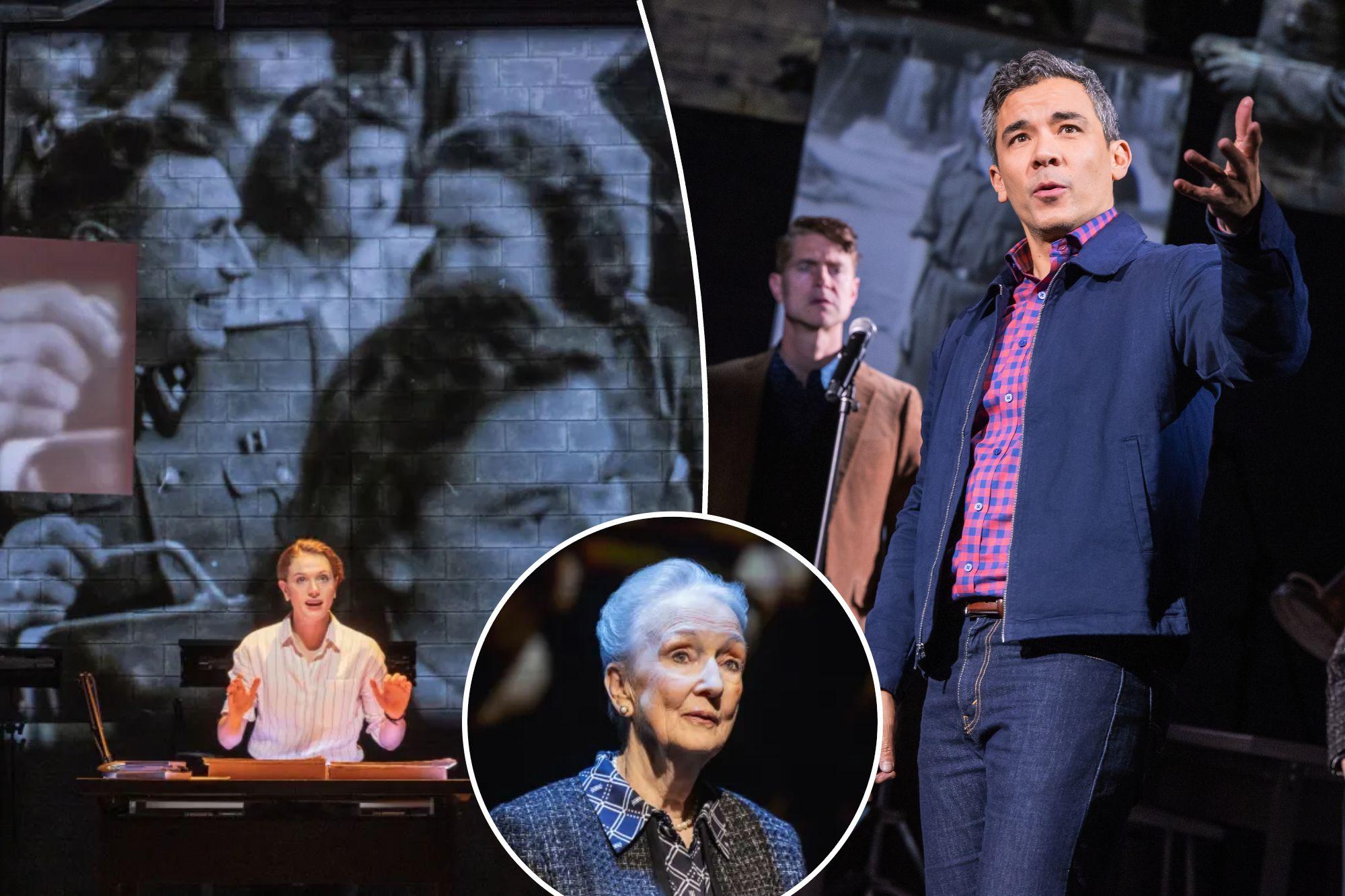
On Broadway, the stage is coldly covered in desks with lamps and magnifying glasses, and different surfaces become screens. Delia Cunningham plays Rebecca Erbelding, the museum archivist who is first presented with these photos, kicking off a controversy in her office.
These objects are extraordinary, no doubt, but isn’t the museum’s mantra to “focus on the victims, not the perpetrators”?
She counters: Isn’t it our job to present unvarnished history and allow people to wrestle with it and come to their own conclusions? Don’t these pictures say something vital?
When they’re ultimately displayed and become a worldwide headline, a shocked German man named Tilman Taube (Conrad Ricamora) recognizes his grandfather in several shots and, in an uncommon move for a Nazi relative, agrees to help the researchers.
And that begins a series of mysteries. Who was Karl Höcker, the man who the book belonged to? And why were the Auschwitz SS officers appearing to have a great time just weeks before the camp was to be shut down? Majdanek had just been liberated by the Soviets, and it was only a matter of time. And, most upsettingly, what did all these casually unwinding people really know?
Gronich and Kaufman, who of course created “The Laramie Project” with the Tectonic Theater Project, choose a clinical and incisive approach — donning the hats of analysts who keep at an emotional remove from their difficult subject in order to better illuminate it.
Playing them, as well as Nazi descendants and Auschwitz workers (through transcripts of post-war testimony), the cast is superb. Cunningham plays Rebecca with a journalistic doggedness and an open heart, much like Holly Hunter in “Broadcast News.” Though, unsurprisingly, there is no humor in “Blueberries.” Kathleen Chalfant lends gravitas to her smart colleague Judy Cohen, and as Taube, Ricamora is world weary and layered as man questioning his memories of his grandfather. Ricamora is an actor who’s always had a skill for naturally traversing different times, places and cultures.
Such is the caliber of this heavy-hitting ensemble that it also includes Michael Cerveris, Montego Glover, Michelle Beck, Brandon Flynn and Scott Barrow.
While “Blueberries” is by design not a World War II drama of giant feelings, there is a moving speech toward the end from Lili Jacob, a Holocaust survivor who also stumbled on a collection of photos — these ones harrowingly depicting the day she arrived at Auschwitz at the exact same time as the idyllic pictures in Höcker’s album.
It was surely on the minds of Kaufman and Gronich that giving the victims a strong voice in the story was necessary. And Jacob’s difficult recollection of seeing the faces of the family she lost adds a sense of completeness to the play.
That moment again speaks to the power of photography, memory and history. And that confronting a painful past — even in an office using meticulous, small and methodical ways, even with photos of little boys in toy cars and girls eating blueberries — is essential to not repeating it.