Nvidia Stock’s (NVDA) Sell-Off Looks Overdone Ahead of Q3 TipRanks Mon, November 9, 2026 at 4:17 PM EST 5 min read NVDA -4.44% Trade NVIDIA on Coinbase Trading disclosure Trading disclosure The above button links to Coinbase. Yahoo Finance is not a broker-dealer or investment adviser and does not offer securities or cryptocurrencies for sale or facilitate trading. Coinbase pays us for certain activity generated through this link. Prices displayed are informational.
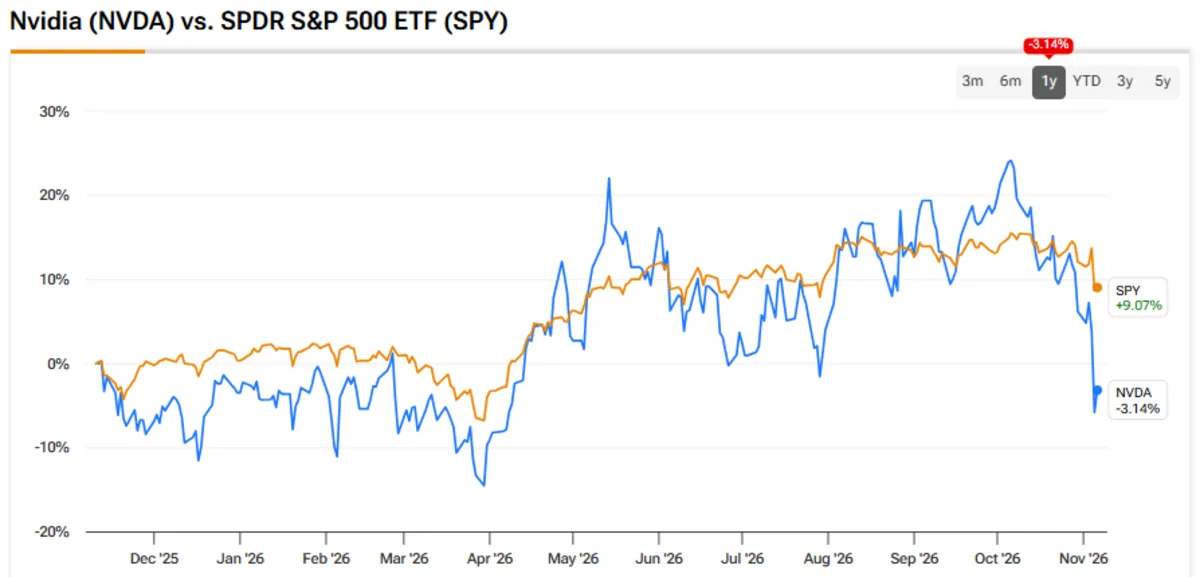
Nvidia (NVDA) stock's sell-off looks overdone to me, ahead of Q3 earnings. The artificial intelligence (AI) computing giant remains about 22% below its 52-week high after Friday's premarket rebound. Yet CEO Jensen Huang reminded us just two weeks ago that "Demand is extraordinary. Capacity is the constraint." That hardly describes a business losing any momentum.
I believe political uncertainty deserves attention, but recent deployments suggest the global buildout continues. With Fiscal 2028 earnings valued around 12x at today's share price, I think the decline offers an unusually attractive entry point. Thus, my NVDA stock forecast remains bullish.
Nvidia's Q3 could deliver another beat when it reports on November 17. Consensus calls for $108.8 billion of revenue and $2.47 earnings per share (EPS), against management's $108 billion revenue midpoint, plus or minus 2%. Q2 revenue surged 106% to $96.2 billion, with Data Center increasing 117% to $89 billion. Consensus sits less than 1% above guidance, leaving room for stronger deliveries.
Get 75% Off TipRanks Premium and unlock powerful investing tools to make smarter, more confident investment decisions
Blackwell continues serving cloud giants while Vera Rubin adds another source for sales growth. Nvidia held about $32 billion of inventory while preparing for Rubin's launch. Converting that investment into system deliveries could help revenue beat guidance. Production shipments began during Q3, and management expects Rubin to contribute about 20% of quarterly Data Center revenue.
We are also looking at Neoclouds expanding to serve enterprises and sovereign customers. Management expects those buyers to drive sequential growth, with hyperscaler growth reaccelerating afterward as Rubin supply improves. I'll be watching shipment conversion closely because customers can't generate revenue until Nvidia delivers the equipment.
Gross margins need attention too. Management expects 74% in Q3, down from 75%, as memory costs surge. Q4 could fall to 71%–72%. Those remain exceptional margins, and higher volumes can support earnings despite the pressure.
Guidance also assumes no China Data Center compute revenue. Any permitted sales could help, although I wouldn't rely on them.
Now, I believe Nvidia's growth will extend beyond this upcoming quarter. Several recent announcements point in that direction. Oracle's (ORCL) October 27 expansion targets multi-gigawatt Vera Rubin infrastructure. Google's (GOOGL) A5X infrastructure is designed to scale to 960,000 Rubin graphics processing units (GPUs) across multiple sites, with general availability planned this month. These are long-term deployment plans.
Meanwhile, Meta (META) is expanding Rubin and Vera central processing unit (CPU) deployments around Muse. Those plans support demand beyond training. Running agents and improving models through reinforcement learning require substantial compute. Physical AI also adds robotics workloads. Nvidia also captures spending on networking and CPUs alongside GPUs, while Compute Unified Device Architecture (CUDA) supports customers across hardware generations.
The physical rollout should improve too. DSX POD modular factories can be installed in as little as 14 days, with deliveries planned for early 2027. That applies to prepared sites with supporting infrastructure. Of course, it doesn't eliminate permitting or power requirements. Still, faster installation helps turn spending into usable capacity.
Management expects roughly 70% Fiscal 2028 revenue growth, with supply constrained through that year.
It's also worth mentioning that October's capacity agreements target a 2.5x substrate expansion over three years. Manufacturing partners are making long-term commitments to meet Nvidia's requirements. Expansion is increasingly global. Google is adding European availability, while Saudi Arabia's HUMAIN plans further Blackwell and Rubin deployments. I believe this gives Nvidia customers outside the U.S. a construction cycle.
Now, to be fair, the Democratic congressional sweep has intensified regulatory fears. This is especially true around electricity costs and development restrictions. However, Congress generally doesn't approve individual data centers. Zoning decisions usually sit locally, while environmental permitting and grid connections involve separate authorities. State leadership therefore matters.
So, sure, Texas governor-elect Gina Hinojosa wants development paused pending protections, and local ballot measures favored restrictions. Delays could hurt deliveries, including contracted projects. However, I think markets are assuming too much demand disappears.
Developers can relocate projects, although that takes time. Meta's Prometheus first phase is already complete. Existing infrastructure and international projects leave considerable demand moving forward.
Nvidia's valuation looks increasingly attractive after the recent sell-off. At today's price, Fiscal 2027 consensus EPS of $9.31 implies 20.04x earnings. Fiscal 2028's $15.91 estimate brings that to roughly 12x. Forecasts of $21.34 for Fiscal 2029 and $25.98 for Fiscal 2030 imply 8.74x and 7.19x. Expected EPS growth slows from roughly 95% this year to 71%, then 34% and 22%.
Those are demanding forecasts, especially further out. Nevertheless, even, say, a 30% shortfall against Fiscal 2028 consensus leaves $11.14 EPS and a 17.1x multiple. Of course, such a misstep is highly unlikely. Regardless, I find even that multiple reasonable for Nvidia's competitive position. Its net-cash balance sheet supports continued investment.
CUDA and its networking platform help customers deploy whole systems efficiently. Earnings growth can support returns without a higher multiple. Better shipment execution could also raise estimates.
In any case, there are a number of risks to keep in mind. Hyperscalers could moderate capex if AI returns disappoint. Google and Amazon's (AMZN) custom accelerators threaten some workloads, while AMD (AMD) competes for customers.
Memory inflation could exceed current assumptions. Nvidia's enormous expected scale also makes shares sensitive to any disappointment. A strong quarter alone cannot remove those risks.
Nvidia stock has a Strong Buy consensus, based on 33 Buy ratings. The average price target of $323.45 implies 73% upside from today's share price.
I remain bullish ahead of Q3. Political obstacles can slow construction, but customer deployments suggest the compute shortage persists. Around 12x Fiscal 2028 earnings looks unusually attractive to me. Nvidia can deliver compelling returns through earnings growth, provided customers keep converting their AI ambitions into operating capacity.