“With Gilligan…the Skipper too…the Millionaire…and his Wife…the Movie Star…….and the rest…” So ran the original theme song for the archetypal boob-tube sitcom Gilligan’s Island, back when the Professor and Mary Ann weren’t considered important enough to mention. It took Gilligan himself, actor Bob Denver, throwing his weight around to get the studio to include them in one of the most famous sitcom themes of all time.
Anyway, the third installment of Paradise’s three-episode Season 2 premiere is the “…and the rest” portion of the proceedings. In episode one we met a brand new character played by a movie star, hanging out in the real world. In episode two we caught up with our charismatic hero, Xavier Collins, joining her in the real world. In episode three we’re back in the Colorado bunker, with various politicians and citizens and Secret Service agents, just sorta leaning how things are going.
It’s less flashy work, that’s for sure. That extends to the visuals. Director Ken Olin presents a marked contrast with the golden glow of the Glenn Ficarra and John Requa–helmed first two episodes: Down underground, the sunlight is flat and artificial, the indoor lighting harsh and almost whited out. It feels like being trapped forever in a Volume soundstage.
The characters are a sight less charismatic than Xavier and Annie, though that’s certainly by design. Nicole Robinson (Krys Marshall), who grew close to Xavier before he escaped and who’s wise to at least some of what’s going down, spends her off hours tending to Xavier’s two children, budding political activist Presley (Aliyah Mastin) and her good-hearted but meddling little brother James (Percy Daggs IV). She’s also gotten a much better haircut.
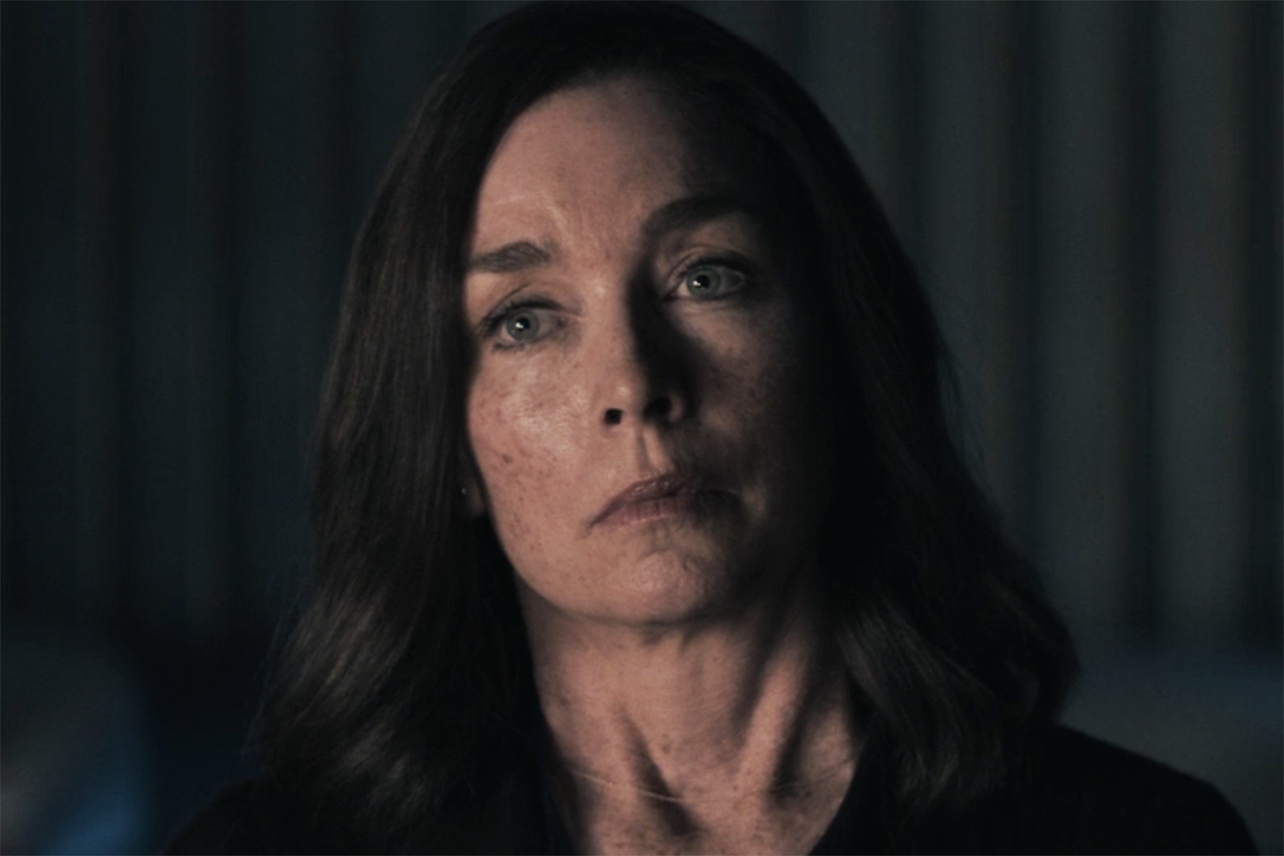
In her day job, Nicole has been demoted to driving around Jane Driscoll (Nicole Brydon Bloom), the Secret Service agent credited for thwarting Xavier’s assassination of Sinatra (Julianne Nicholson), the billionaire who brainstormed the bunker. In fact it was Jane who shot her: Jane works for her as an assassin, and the gunshot kept her from spilling the beans on her plans to Xavier without killing her.
Indeed, Nicole is suspicious of Jane, whom she also suspects was involved in the death of her boyfriend and fellow agent Billy Pace (Jon Beavers). Another hitman in Secret Service clothing, Pace was poisoned to death by Jane to keep him from spilling the beans on his role in Sinatra’s big scheme, which was murdering expeditions sent to the surface so they can’t report back that it’s habitable. Breaking into his sealed-off home, Nicole gathers enough information to realize Jane’s official statement on his suicide is bullshit.
Meanwhile, a new power has arisen, and not a moment too soon. President Henry Baines (Matt Malloy) has taken advantage of Sinatra’s hospitalization, as well as the murder of his predecessor, Cal Bradford (James Marsden, marvelous as always in his flashback appearance), to seize power in the bunker. Baines puts up Trump-style banners of himself and has his militarized police carry off dissenters to a secret prison camp. Meanwhile, he sputters and rages anytime he’s challenged, while his every utterance displays unbelievable delusions of grandeur. The metaphor here is not subtle, folks!
Unfortunately for Baines, he acts like a cult-of-personality authoritarian while neither having built the actual cult of personality. He also failed to secure the support of the security forces. Sure, he’s got cops rounding up protestors like Cal’s rabble-rousing son (and Presley’s sorta boyfriend) Jeremy Bradford (Charlie Evans). He’s having dissenting scientific voices like Anders (Erik Svedberg-Zelman), the man Sinatra duped into building the bunker, hauled off too.
Then Baines tries to bigfoot Sinatra herself in an memorably staged interrogation scene set between infinitely reflecting mirrors. (The shot looks like something from a ‘70s political thriller). At the end of the interrogation, Sinatra gives Jane the signal — “that man needs a breath mint” — to assassinate the President. She slits his throat, then frames Nicole for the killing by putting her in a sleeper hold and planting the knife in her hand. Seems to me this plan would make a lot more sense if she just killed Nicole so the innocent party could never give her side of the story, but hey, what do I know.
What’s this all about? Why the dissension between Baines and Sinatra? It’s not just a matter of Who Runs This Town, though that’s obviously part of it. (Note: Always bet on the billionaire to be the bastard in charge.) It’s also a question of Sinatra’s second secret world-saving project, one not even her closest confidante and friend, Dr. Torabi (Sarah Shahi), knows about. In fact, Torabi straight-up washes her hands of her former client, who’s been lying to her for years.
So who does know the secret? Sinatra, for one. Bradford’s late father Kane (Gerald McRaney) knew.Perhaps Dr. Louge (Geoffrey Arend), the scientist who first warned the world about the coming Antarctic supervolcano and global apocalypse, had an idea about it. In a flashback, we watch as Sinatra listens to his warning that after the ash cloud dissipates, the world will superheat until all life collapses under the new high pressure of its atmosphere. Sure, people will survive on the surface, and may even think the worst has passed, but Louge says that sooner or later they’ll wish they died the day it all first happened.
The secret involves siphoning a massive amount of energy from the bunker, enough to prevent Baines from employing his cockamamie scheme to warm things up about ten degrees so the “pacified” population can enjoy a summer for the first time in years. Unlike our own dictator, this one recognizes you actually need to do nice things for people once in a while to remain popular, instead of just traumatizing children and starting wars. Alas, the moment he learns Sinatra is responsible, his fate is sealed. Again, always bet on the billionaire.
Whatever the secret is, a man had to die for Sinatra to get ahold of it. The scientist who invented it (the great Patrick Fischler) is murdered by Billy in a flashback when he won’t sign over his company to the billionaire. (It’s Billy who gives Sinatra the “breath mint” code phrase.) The scientist’s death scene is haunting, moving, and a bit bizarre, the way any emotional scene involving a David Lynch alumnus takes on some of the director’s weird luminous energy. Fischler’s character euthanizes his wife, who’s dying of Huntington’s disease, then submits to his execution on one condition: that Billy spare his protégé, a brilliant young man whom we recognize as Annie’s babydaddy, Link. The plot, as they say, thickens.
The whole episode feels like a necessary course correction for some of the weaker elements of the story so far. Dr. Torabi spent Season 1 as a cypher; now we get to see how she really feels about being deceived by someone who was more than a client or a meal ticket to her, someone she considered a friend. It’s Shahi’s best work on the show so far.
Baines may be dead now, meanwhile, but his brief reign of terror is exactly what Paradise needed to stay current. The first season’s confidence that the American government would maintain some kind of continuity in the face of disaster, with a handsome young president in charge and a hypercompetent sphere of scientists, capitalists, politicians, and security forces keeping the wheels rolling indefinitely, simply couldn’t survive exposure to the actual Trump regime, which (among other things) has partially destroyed the actual White House building and taken a wrecking ball to scientific research. The norms aren’t intact now, let alone after a global tsunami. Having a loser like Baines run amok until someone gets fed up and kills him feels more like how things would actually work.
I’m sure that in the wake of the federal government’s assault on Minnesota, the show’s portrayal of a resistance movement will also seem outdated. But it’s admittedly inspiring watching the kids pass samizdata notes to each other through a copy of The Catcher in the Rye in a Free Little Library, and to see Jeremy ask Anders to help him take the place down from within.
The acting is solid where it needs to be. Shahi does series-best work, Nicholson is always watchable despite her character’s taciturn unpleasantness once she turns heel, Beavers looks like he’s lived ten thousand hard days as he portrays Billy’s mercenary persona, Malloy and Bloom are having a whale of a time playing true shitheels, and it honestly may be the new hairstyle talking, but Marshall’s white hat agent now feels much less like a TV character and much more like a real person working a job.
And hey, I even liked the hAuNTiNg cOvEr VeRsIoN of “Another Day in Paradise,” which goes absolutely balls-to-the-wall by the end. Paradise isn’t great art, but it’s enhancing its strengths and shoring up its weak spots. The result is an entertainment juggernaut.
Sean T. Collins (@seantcollins.com on Bluesky and theseantcollins on Patreon) has written about television for The New York Times, Vulture, Rolling Stone, and elsewhere. He is the author of Pain Don’t Hurt: Meditations on Road House. He lives with his family on Long Island.