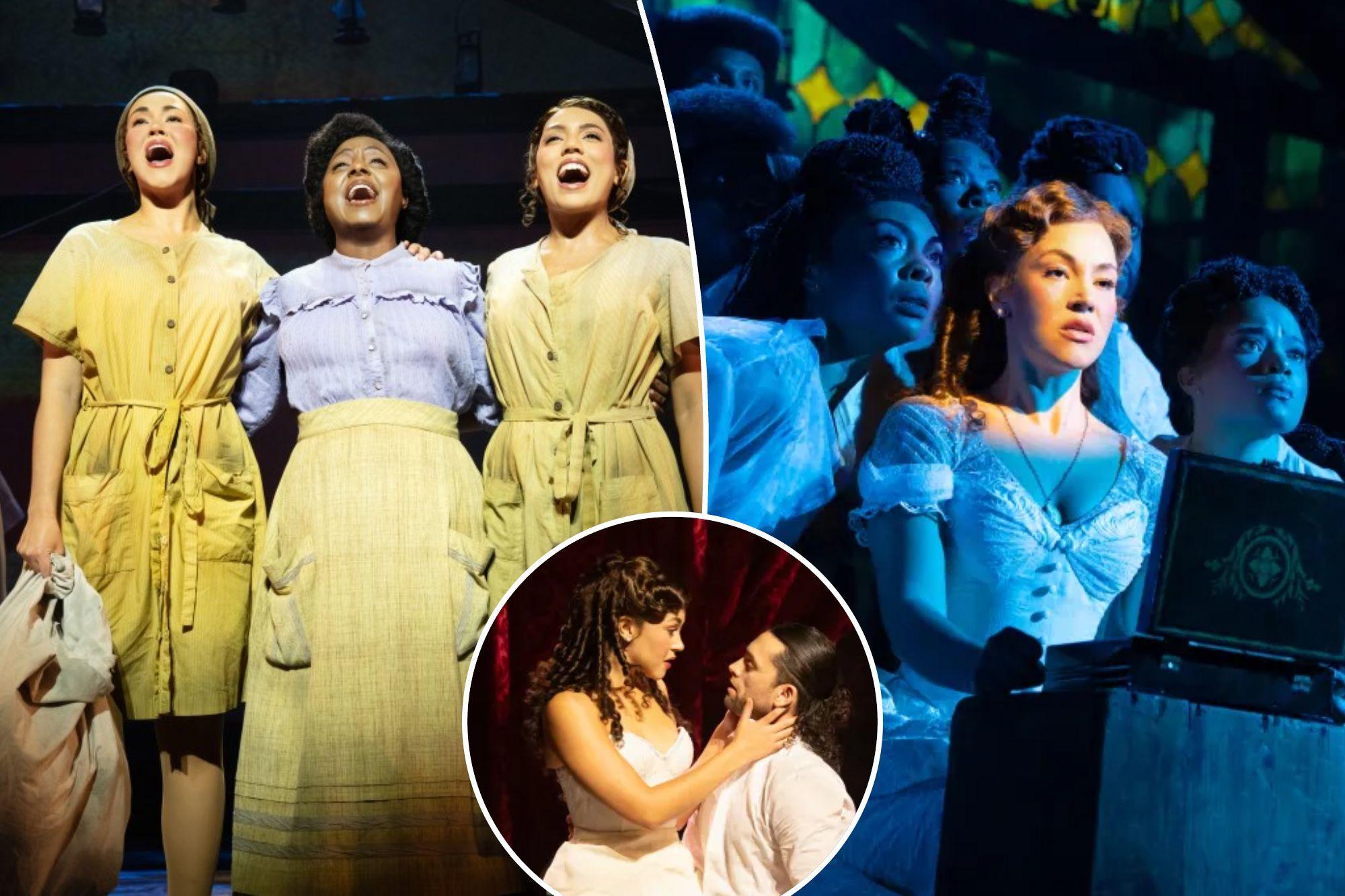
Make New York Post a Preferred Source Theater review WANTED Two and a half hours, with one intermission. At the James Earl Jones Theater.
Much like “Thelma & Louise,” the new female bandit duo musical “Wanted,” which opened Sunday night at the James Earl Jones Theater, drives off a cliff.
But at least Susan Sarandon and Geena Davis waited until the end!
At every step, the Broadway show by Ross Baum and Angelica Chéri squanders what’s good about it — namely an enticing premise and a cast of powerful singers — and instead churns out a gaudy, uninvolving slog in which plot movements are at the same time bonkers and blasé. This exhausting and confusing journey through Texas made me blue, all right.
Often plays and musicals turn out to be much better than their plain descriptions would suggest. “Maybe Happy Ending” and “Oh, Mary!” come to mind. But “Wanted” is far, far worse.
Chéri based the story on two of her ancestors: Mary and Martha Clarke, black sisters who were able pass as white, and advantageously used that quality to go on a crime spree in the Lone Star State during the late 1800s.
That should make for a delicious combination of pieces: A classic Western; R&B, blues and gospel music; and the Harlem Renaissance sensibility of Nella Larsen’s novel “Passing” (which was made into a very good movie starring Tessa Thompson and Ruth Negga).
Unfortunately Chéri, Baum and director Stevie Walker-Webb’s efforts instead collide into a stodgy wannabe Frank Wildhorn show, in both aesthetic and attitude, as it garishly, loudly and routinely stomps through history.
Thinly drawn Mary (Solea Pfeiffer) and Martha (Liisi LaFontaine) at least have a strong initial thrust to their motivations. Their sharecropper mother Tallulah (Ledisi) is about to lose their home, and the girls set off to legitimately make $200 to save it.
But not so fast. Worried about her daughters’ safety on the dangerous road, she hands them a gun and insists, “You gotta be prepared.”
Whelp, they soon find that the firearm is useful for quite a few more tasks than just mere protection, such as holding up a train full of white people and taking their money. Ditto at the Daughters of the Confederacy’s Annual Affluence Auction.
The unspoken motto here is Robin Hood-esque: Steal from the bad and give to the us. But a musical can’t be built on robberies alone. And so the way Chéri and Baum seek to deepen and complicate the tale is by having the girls join the world of Southern white wealth and, in the case of Mary, luxuriate in it.
The tale is told, in part, by the Kinfolk, a Greek-slash-gospel chorus in flowy white fabric who sound like a million bucks. But frequently their vocal theatrics obscure whatever it is they’re belting about.
That’s also half-true of Pfeiffer and LaFontaine. Both — especially the sumptuous-voiced Pfeiffer — are knockout singers. Their material, though, is overabundant, pops out of nowhere and goes there, too. Pleasant, if blaring, the nebulous songs stop the action in its tracks like the show is being held up at gunpoint.
Mary has a peculiar number called “Real Woman” that made me think less of her euphoria after getting engaged and more about Shania Twain going “Oh! Oh! Oh! Totally crazy! Forget I’m a lady!” Another of hers, in which she declares “Daddy was a Frenchman,” is again impressive, but all notes, no substance.
More posh than her sister, Mary falls for a rich white guy named Jesse (Bradley Jaden), who looks like the vampire Lestat and instantaneously summons your friend’s awful boyfriend you wish she’d break up with. Soon she becomes the lady of the house. The trouble is Jesse thinks she’s white, which gives their whole relationship a soap opera heaviness. Susan Lucci could storm in and blow her cover at any moment.
British Jaden, who was a strong Javert in the “Les Miserables” concert this summer, is a splendid crooner. (Do you sense a theme?) But when he speaks in a Texas drawl, the actor coldly and monotonously races through dialogue. His character is flat, even by the standards of hopped-up stage villainy.
That Jesse is such a clear-cut dirtbag gives the show nowhere to go for more than half its length other than the obvious conclusion. When a detail about the man’s past is revealed with the importance of Darth Vader saying “I am your father,” the audience reacts nonplussed because, well, he sucks.
While increasingly off-putting Mary (and the show!) loses sight of the original mission and gets waited on hand and foot, determined Martha grows closer to the servants on the grounds, especially Elijah (Luke James), and they confide in her why Jesse should not be trusted. Yeah, no kidding.
Their whispered conspiring leads to the kind of overwrought climax that Hollywood would order up to leave open the possibility of a sequel, only here it’s a side effect of yet more narrative messiness.
At Jesse’s home also reside the two best parts of “Wanted” — the hysterical maids Flo (Awa Sal Secka) and Sissy (Aurelia Williams). Never have two actors so put the “relief” in comic relief. Their glances, asides and cackles liven up a plodding musical.
Sissy and Flo are “Wanted” at its most confident. That makes sense as humor is a sweet spot for Walker-Webb, who did a bang-up job directing the comedy “Ain’t No Mo” a few seasons back.
Yet laughter is the only sensation of feeling the musical manages all night long. How can that possibly be true in a story about identity, self-worth, belonging and righteous revenge?
They definitely want it to be emotional and try to send us away wiping our eyes with a shameless company finale called “All of Me.” The women return home and Mary at this point has not a single likable trait left. Everything with mom is magically fine, and the entire cast rises up in a generic feel-good gospel tune to declare that who we are is “in the blood.”
That’s all well and good. But I sat there wishing that during “Wanted”’s decade of development and multiple major regional productions, the writers had addressed the countless problems in the book.