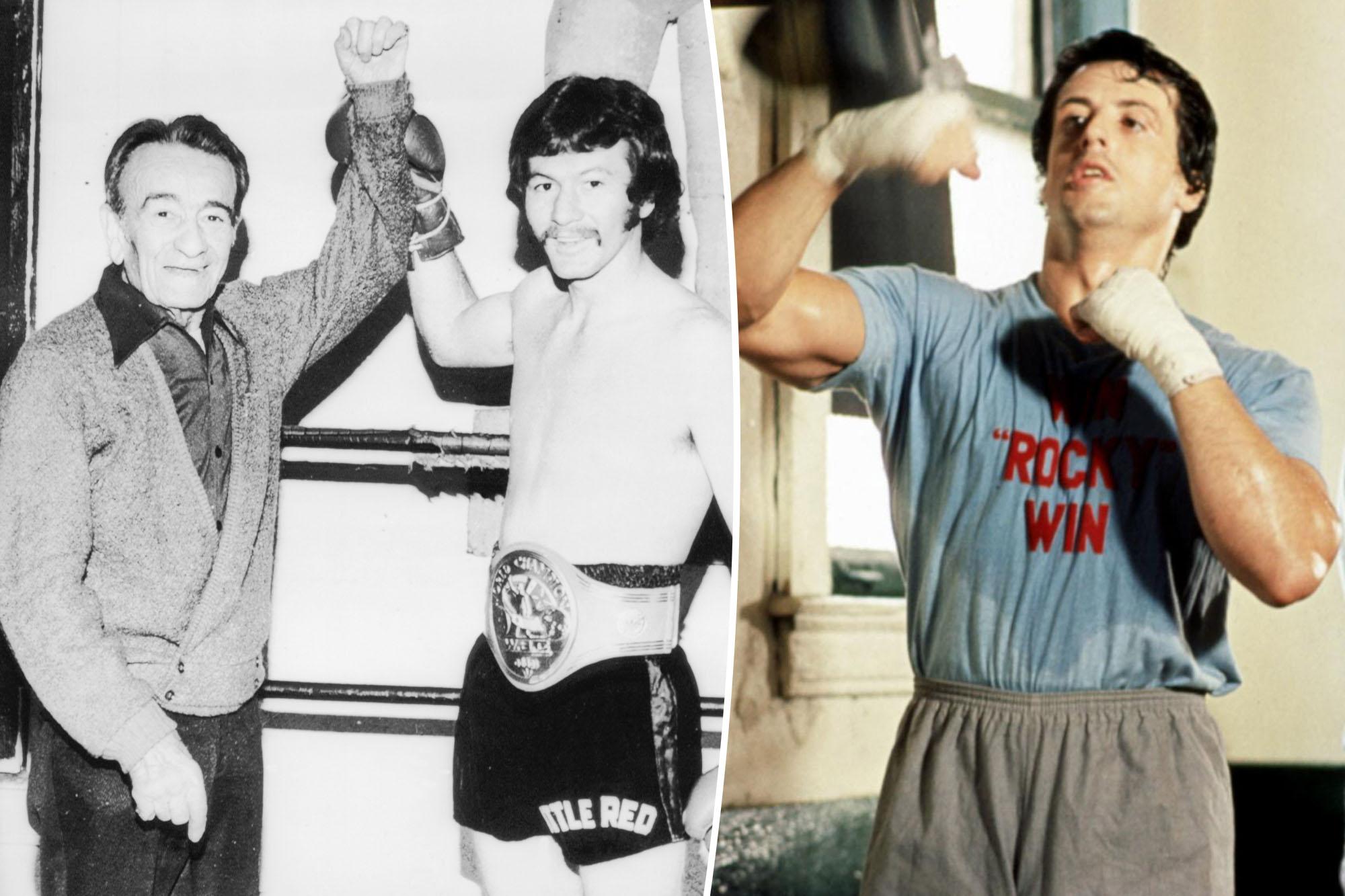
Boxing trainer Howie Steindler was murdered shortly after "Rocky" hit theaters. Bettmann Archive At the same time Oscar contender “I Play Rocky” hits screens, a new book on the famed fictional fighter lifts the lid on the unsolved murder of an important contributor to the 1976 movie.
This past weekend, Amazon MGM Studios released its own Oscar contender, “I Play Rocky,” in seven strategically selected theaters before its wide bow on Nov. 20. (It earned $345,000 for a pumped up per-screen average of nearly $50,000.)
Tomorrow, St. Martin’s Press drops “Going the Distance,” another making-of-Rocky take from Philadelphia Inquirer sports columnist Michael Sielski.
Of the two behind-the-scenes projects, “Going the Distance” delves into a little-known subplot that might be unfamiliar to even the most hardcore Rockyphiles. Howie Steindler, an important contributor to the original 1976 movie, was murdered months after “Rocky” hit theaters. The case remains unsolved to this day.
Sielski reports that Steindler — who owned the LA gym where “Rocky” filmed its interior scenes, and who served as the main inspiration for Burgess Meredith’s coach character Mickey Goldmill — may have been the victim of a targeted killing rather than a random incident initially suggested by cops at the time.
“I think the chances are decent that it was planned; that it was not the road rage/robbery-style incident that the police made it out to be,” Sielski tells Page Six Hollywood. The sports journo interviewed Steindler’s daughter Carol, Steindler’s apprentice and fellow trainer Rudy Tellez and others familiar with the gym owner’s life and came away convinced that investigators may have suspected particular individuals without ever developing a prosecutable case.
One detail especially troubles him: Nine months after the killing, Steindler’s wallet and other belongings were sent back to his wife. The package contained no signature or fingerprints. “That’s a telltale kind of detail that lets you know this was not random,” Sielski says. “What random person [who’s] just robbing someone and killing them because they put up a fight sends stuff back?”
Steindler’s impact on “Rocky” extended beyond providing a setting. The gym hosted the film’s training scenes, and Meredith spent time with Steindler while developing the iconic Mickey role. Ironically, he was killed less than three weeks before the Oscars ceremony where best supporting actor nominee Meredith may have given Steindler a shoutout had he won.
Sielski cautions that the character was likely a composite of boxing trainers and managers, but says Steindler’s influence on Meredith’s performance was significant.
Yet the murder appears to have drawn little public attention, and Sielski found no evidence that anyone from the film’s cast or crew attended Steindler’s funeral, despite spending months with him in his gym on Main and Third.
Other revelations in “Going the Distance” include:
– Sylvester Stallone, the sole writer of “Rocky,” rips several people for taking credit for their contributions to the film. (Stallone complained in emails to Sielski about the film’s Oscar-winning editors, Richard Halsey and Scott Conrad, in particular.) “He’s very protective, even defensive, even angry over the idea that someone else contributed meaningfully to this movie,” Sielski says. The two editors won Academy Awards for their work, but Stallone claimed in his emails that he had to redo everything they did. The author says Conrad theorized that Stallone still resented not winning an Oscar himself for acting or screenwriting.
– Sielski debunks a story that Stallone has allegedly been telling for years about “Butkus,” his real-life bullmastiff, who also played Rocky Balboa’s sidekick in the movie. The star has said that he was once so broke, he sold the mammoth pooch for $40 when he was trying to make “Rocky,” and that he later bought the dog back for $15,000. The story has been told so many times that it even winds up in “I Play Rocky.” But Sielski reports that it’s likely an apocryphal Hollywood tale.
– Jennifer Peterson, one of the late Carl Weathers’ three former wives, refutes any notion that Stallone and the original Apollo Creed were pals. (Peterson worked on a DVD featurette commemorating Rocky’s 25th anniversary.) “Were Sly and Carl close friends? Hell, no, they were not close. Never,” Peterson says in the book.
As for Sielski’s thoughts on “I Play Rocky” — the author gives it a thumb’s up.
“I really enjoyed it. I thought it was generally very accurate,” Sielski says. “And I think everyone in the greater Philadelphia area is going to go see it.”
Your voice matters. Discussions are moderated for civility. Read our guidelines here
Community Guidelines Welcome to the Page Six Community! Our community is about connecting people through open and thoughtful conversations. We want our readers to share their views and exchange ideas in a safe space.
In order to do so, we've created a simple set of rules that will improve your experience.
Your post will/might be rejected if it contains:
User accounts will/might be blocked if we notice:
Thanks for reading our community guidelines. Don't forget, freedom of speech is not the freedom of reach!