A 68-Year-Old Swapped His Bond Funds for DIVO and GPIX in a $1.1 Million Portfolio. Here’s What Happened to His $6,700 Monthly Paycheck David Beren Sun, November 8, 2026 at 1:37 PM EST 6 min read ^GSPC +0.31% BXSL -0.33% DIVO +0.13% EDF +1.26% EPR -0.47% Explore stocks on Coinbase Trading disclosure Trading disclosure The above button links to Coinbase. Yahoo Finance is not a broker-dealer or investment adviser and does not offer securities or cryptocurrencies for sale or facilitate trading. Coinbase pays us for certain activity generated through this link. Prices displayed are informational.
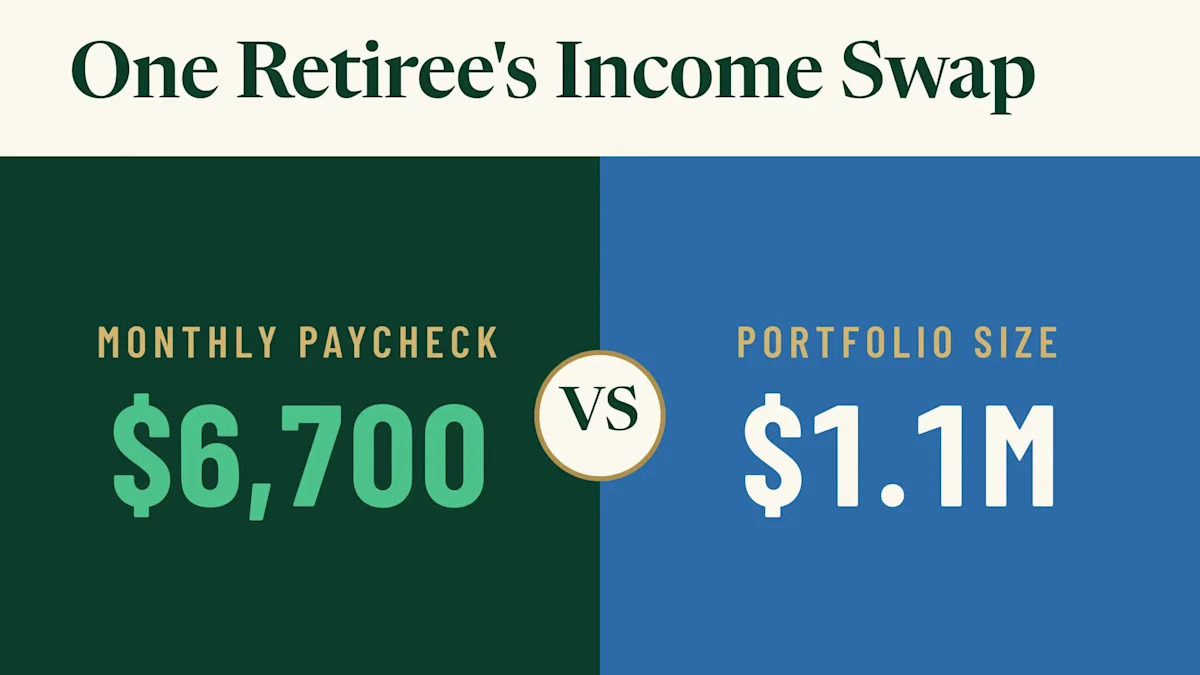
Swapping bond funds for DIVO and GPIX lifted the retiree's monthly income from about $6,620 to about $7,560, a combined yield near 8%.
Higher income carries risk: he lost the bond buffer, and BXSL is already cutting its quarterly payout from $0.77 to $0.60.
Over the past month, the S&P 500 fell about 5% while bonds gained 3%, and GPIX dropped about 5% too.
The biggest 401k decisions tend to get made once and never revisited: when to roll it over, what to hold inside it, and when to start taking money out. That is exactly what the report: 401k & IRA Tips and Answers was created to address, and it is free today. Read more here. (Sponsor)
A 68-year-old retiree, an example case, reviews what his bond funds pay and decides it's too little to generate the $6,700 a month he wants from his $1.1 million portfolio. He sells those broad, high-quality bond funds. Then he puts 20% into Amplify CWP Enhanced Dividend Income ETF (NYSEARCA:DIVO) and 20% into Goldman Sachs S&P 500 Premium Income ETF (NASDAQ:GPIX). His five other income holdings stay put. Every yield here shows current prices and payouts.
We'll use a broad U.S. investment-grade bond index fund to show what core bond funds pay. It yields about 4.3%. On the money he moved, that's roughly $1,560 a month. Before the trade, his whole portfolio paid about $6,620 a month, so he was just short of his goal. It now pays about $7,560 a month, for a combined yield near 8.3%. DIVO and GPIX alone send him about $2,500. He nets $6,700.
For many Americans, funding a 401(k) only leads to more retirement questions. Should you roll your 401k into an IRA, and when? What's the tax impact if the rollover check gets made out to the wrong name? When do required withdrawals begin, and how much do you have to take?
Fisher Investments put the answers in one place. 401k & IRA Tips and Answers is free, and it covers rollovers, contribution limits, required withdrawals, and what actually belongs inside the account once the balance gets serious. Read More Here ›
DIVO has a short list of blue-chip dividend stocks like Caterpillar, Apple, and JPMorgan and sells covered calls on a few of them. With a covered call, the fund gets cash today for agreeing to sell a stock at an agreed-upon level if the stock rises past it. DIVO makes up 20% of his portfolio, yields about 4.9% and supplies 12% of his income. Last December's oversized $0.95 payout makes its trailing yield look higher than what the monthly checks actually pay.
GPIX holds S&P 500 stocks and sells index options for extra monthly income. It's 20% of the portfolio, yields about 8.7% and delivers 21% of his income, the biggest share of any holding. Payments vary from month to month. Even so, it rises from $0.30 in late 2023 to about $0.39.
EPR Properties (NYSE:EPR) is a real estate investment trust, or REIT. It has theaters, attractions, eat-and-play venues, and gyms, and it passes most of the rent to shareholders. It's 15% of his portfolio. It yields about 6.3% on its $0.31 monthly dividend and supplies 11% of his income. EPR stopped paying from spring 2020 to summer 2021. When it resumed, it paid $0.25, down from $0.3825 before the pause. Some of those payments have included a return of capital, meaning part of the cash distributed may represent investors getting their own invested money back rather than income earned by the fund.
As a business development company, or BDC, Blackstone Secured Lending (NYSE:BXSL) lends money to private companies. Its loans are 96% first-lien, which means it gets paid back first if a borrower fails. It's 15% of its portfolio, yields about 10% on its new payout, and supplies 18% of its income. Earnings covered only 88% of the dividend, so it's cutting the quarterly payout to $0.60 from $0.77 in 2027.
Energy Transfer (NYSE:ET) is a pipeline partnership running about 140,000 miles of pipe. It's 15% of his portfolio, yields about 7.3% and covers 13% of his income. Its payout has gone up every quarter since early 2023. Back in late 2020, it was cut to $0.1525 from $0.305.
It sends a K-1 tax form, which is messier than a 1099. If he holds it in an IRA, his share of the partnership's business income counts toward unrelated business taxable income (26 U.S.C. § 512(c)(1)). An IRA with $1,000 or more of that income must file Form 990-T, and the IRA custodian typically handles the filing.
Virtus Stone Harbor Emerging Markets Income Fund (NYSE:EDF) buys emerging-market debt. It's a closed-end fund: it has a fixed number of shares that trade on an exchange, so the share price may trade above or below the value of the bonds it holds. Funds like this can also borrow to boost income, which makes losses bigger too.
It's 10% of his portfolio, pays about 16% and supplies 20% of his income. Its monthly payout has shrunk from $0.18 before 2020 to $0.06.
Invesco Preferred ETF (NYSEARCA:PGX) holds preferred stock, mostly from financial companies. Preferred stock is a hybrid that pays a fixed dividend, and those dividends get paid ahead of common shareholders. It's 5% of his portfolio, yields about 7.3%, and supplies 4% of his income. Preferreds trade like long-term bonds, so their prices drop when rates rise. PGX is down about 8% over the past year.
Bond funds usually soften the blow when stocks fall. Over the past month, the S&P 500 dropped about 5% while the bond index fund gained about 3%. GPIX fell about 5% too. DIVO held up better and slipped less than 1%. He gave up that buffer in exchange for income that rises and falls with stocks. He also took on credit risk in BXSL and EDF, plus a dividend cut that's already been announced.
The trade raised his paycheck from about $6,620 to about $7,560 a month. Anyone thinking about the same move should work through three steps first:
Figure out how big a portfolio drop you could sit through without selling. This question matters more than any yield.
Build the budget around BXSL's lower $0.60 payout.
Ask a tax preparer whether Energy Transfer belongs in an IRA or should be held outside one.
(sponsor) 401(k)s are powerful retirement tools. But even savvy savers can make mistakes that quietly cost you money for decades. Choosing the wrong fund, ignoring small fees nobody adds up, rollover steps done in the wrong order, the list goes on.
These sort of mistakes is exactly what 401k & IRA Tips and Answers was created to help prevent. It is a free guide from Fisher Investments on rollovers, contributions, required withdrawals and the mistakes that do the most damage to a retirement account. Learn More Here ›
Contact editorial@247wallst.com for any questions or corrections.