Researchers have discovered the mechanism behind hidden barriers that stop earthquakes from snowballing. AFP via Getty Images They can have their quake and beat it too.
Researchers have identified the mechanism behind hidden underwater “brake zones” that stop earthquakes in their tracks, per a groundbreaking study published in the journal Science.
“We’ve known these barriers existed for a long time, but the question has always been, what are they made of, and why do they keep stopping earthquakes so reliably, cycle after cycle?” said head author Jianhua Gong, Assistant Professor of Earth and Atmospheric Sciences in the College of Arts and Sciences at Indiana University Bloomington.
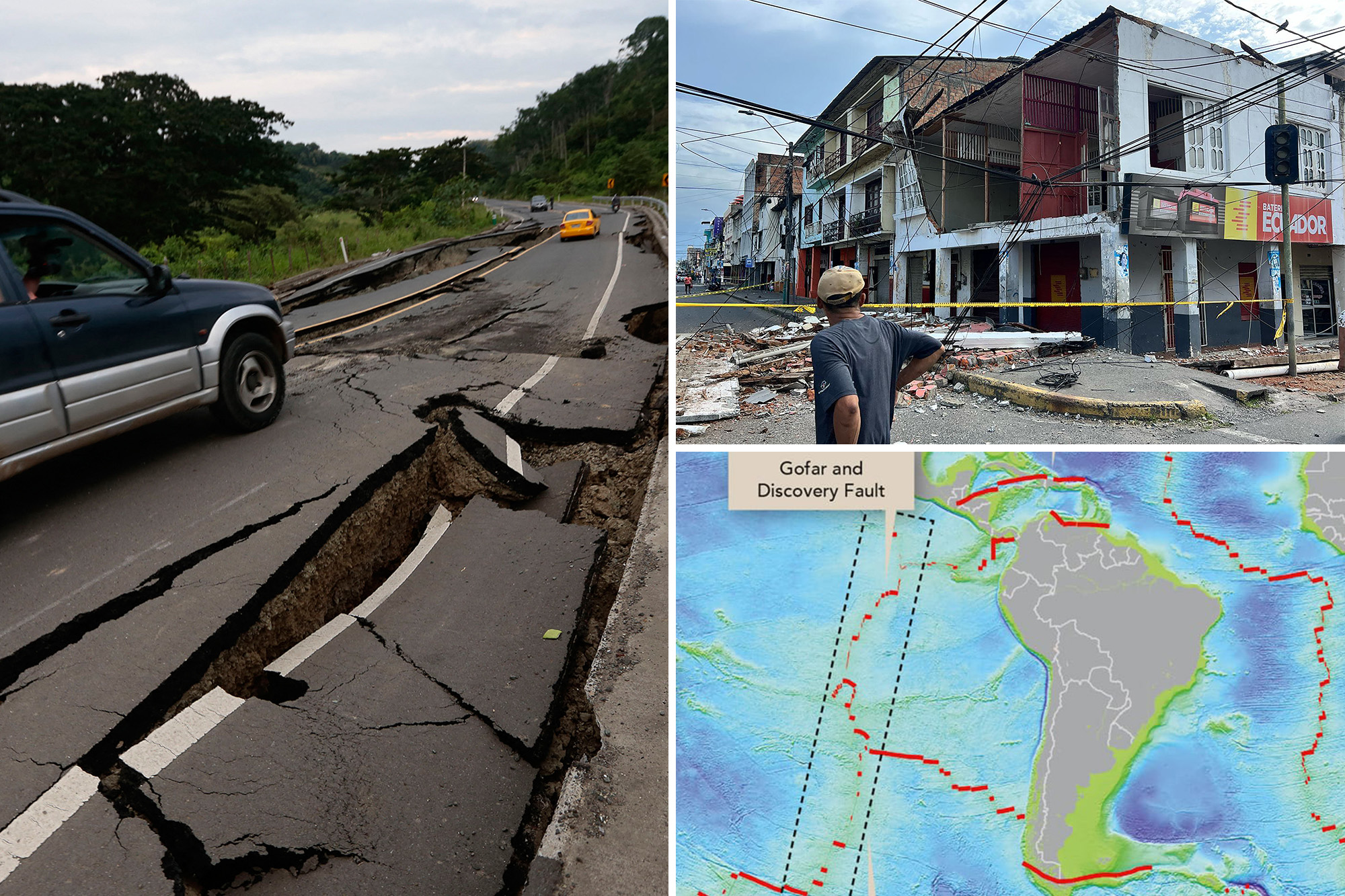
The researcher was referring to the Gofar fault, a seafloor fracture located 1,000 miles off Ecuador in the Pacific Ocean that has been producing nearly-identical earthquakes at regular intervals over the last three decades.
Researchers speculate that these quake brake zones riddle the sea floor throughout the globe. Dr. Meng Wei/University of Rhode Island During this time frame, magnitude six tremors have occurred in the same spots every five to six years — a statistically significant consistency.
This phenomenon eluded scientists until recently, when they discovered the mechanism behind these buffer zones — seawater and rocks that work together to nip earthquakes in the bud.
To get to the bottom of the brake zones, Gong and other researchers analyzed data from two major ocean-floor experiments: one conducted in 2008 and another that ran from 2019 to 2022.
A man stands in front of a damaged house after the earthquake that struck the city of Esmeraldas, Ecuador on April 25, 2025. AFP via Getty Images During these tests, scientists had affixed special seismometers to the sea floor on two separate parts of the Gofar fault.
These picked up thousands of tiny earthquakes in the weeks and months on either side of of the faults two magnitude six ruptures, allowing them to understand how the fault behaves before and after major ruptures.
They found that both the brake zones displayed intense tremor activity in the period preceding the earthquake, but then fell silent immediately after the subterranean shakefest.
That’s because, as the researchers found, the barriers aren’t stationary rock structures but rather intricate regions where the fault fans out into multiple branches, forming precise openings.
These cracks take on sea water and, in the event of a large earthquake, the porous rock seizes up, stopping the tremor in its tracks like a built-in kill switch.
Gong explained that the brakes aren’t “passive features,” but rather “active, dynamic parts of the fault system.”
“Understanding how they work changes how we think about earthquake limits on these faults,” he declared.
In fact, researchers suspect that these quake brakes are located throughout the world’s oceans, and that by studying them, we could improve our methods of predicting when and where seismic activity will occur.
This is especially important given that one of the US’ most dangerous fractures, the Hayward Fault, is overdue for an earthquake, potentially threatening millions of people across California.
This fault regularly generates magnitude 7 earthquakes — more powerful than the 1989 Loma Prieta quake that killed 63 people and injured 3,757 in the Bay Area.