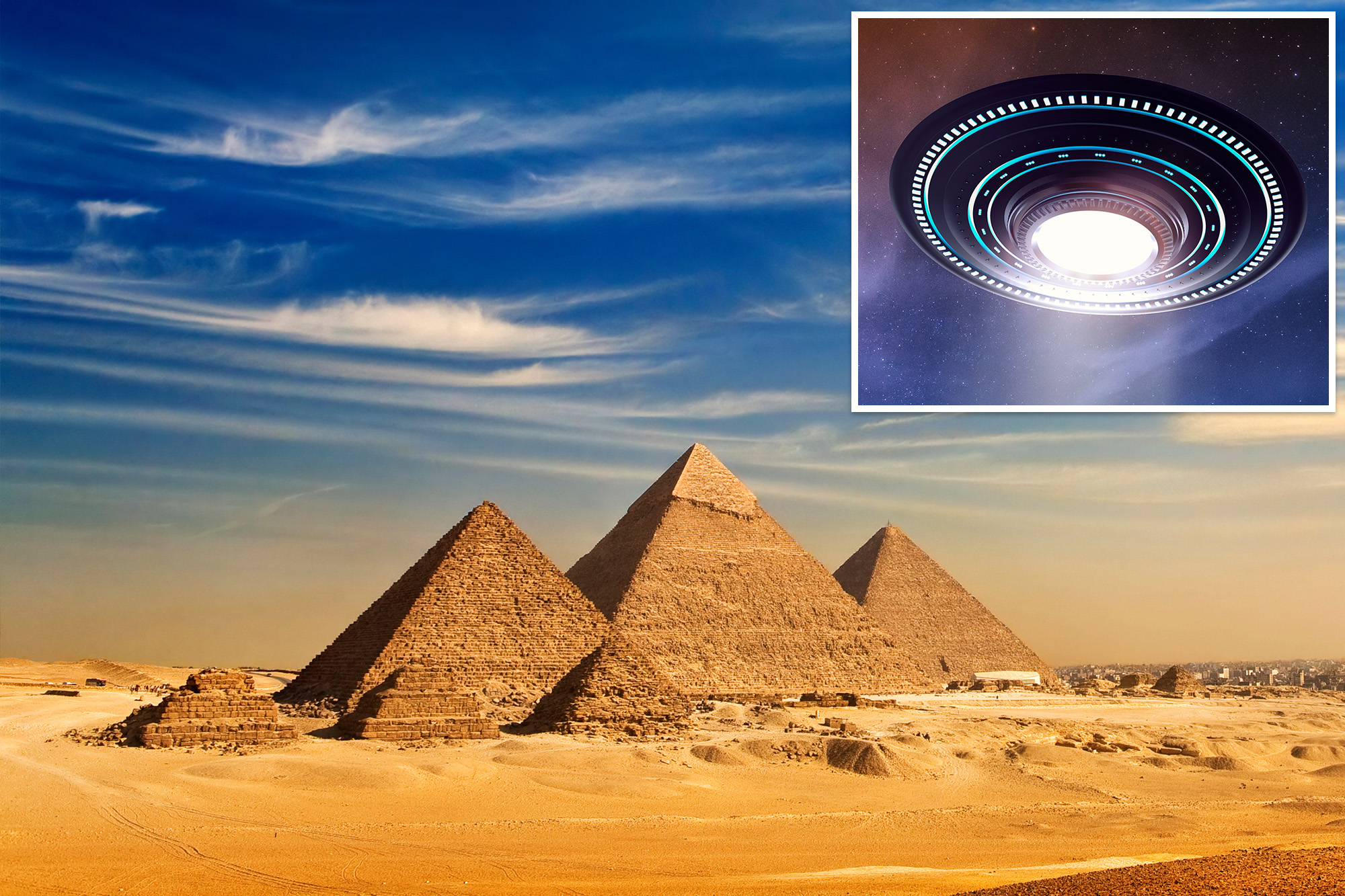
Iranian scientist Jala Jafari claims that the pyramids may have been celestial transmitters used to communicate with intelligent extraterrestrials. unlimit3d - stock.adobe.com When ET phoned home, was he using the Great Pyramid?
Aliens might not have built the pyramids, but they may have communicated with them. An Iranian scientist has proposed the Pyramid Of Khufu may have not been a royal tomb, but rather a celestial beacon that was potentially used to commune with extraterrestrials, per a yet-to-be-peer-reviewed study.
“The pyramid could serve not only as an architectural marvel, but also as a geospatial marker, potentially functioning within a broader system of gravitational communication,” asserted Jalal Jafari of the Laser and Plasma Institute at Shahid Beheshti University in Iran.
Traditionally, archaeologists believe that these structures severed as monumental tombs for the pharaoh and their consorts during the Old (2649–2130 B.C.) and Middle Kingdom (2030 to 1650 B.C) eras.
However, as Jarafi pointed out, “modern theorists have proposed that the unique dimensions and placement of the pyramids may reflect more than just symbolic or funerary intent.”
“Instead, these features could be part of an encoded system designed to communicate information about the Earth’s position, rotation, or relationship with cosmic constants such as the speed of light,” he wrote.
In the paper, he argued that the Great Pyramid’s has several characteristics that suggest that it served as a “gravitational transmitter” of interstellar proportions.
One of the main traits? Its coordinates. sandy prism is situated at 29.979234 degrees north latitude, a number that’s a dead ringer for the speed of light — 299,792,458 meters per second — when the decimal point is moved.
“The match between these two values is accurate up to the first seven digits,” Jafari exclaims, dubbing this phenomenon “statistically extraordinary.”
He believed that this may have been an attempt to embed Earth’s geography with spatial or mathematical data “in a format recognizable to any intelligent observer familiar with physics and astronomy.”
In turn, any mathematically literate civilization would be able to deduce our planet’s position in space like an intergalactic GPS.
The researcher also noted that Khufu and the other two pyramids on the Giza Plateau — Khafre and Menkaure — are aligned in a precise Northwest-to-Southeast direction.
This precision seemed to indicate, per the researcher, that the ancient Egyptians had an advanced grasp of geometry, astronomy and other complex subjects, meaning that concocting an interplanetary road map would not be beyond their expertise.
One of the more high-falutin assertions was that the Great Pyramid’s precise position and significant mass could impact Earth’s gravity.
To shed light on this idea, he compared the Sun’s gravitational pull on Earth with its affect on the pyramidal structure.
Jafari argued that while Khufu’s gravitational influence was “negligible” given Earth’s total mass, it still played an important role during our planet’s orbit.
Specifically, while Earth serves as a giant carrier signal when circumnavigating our solar star, Khufu’s movement through the daily rotation subtly modulates the transmission over time.
Ultimately, Jafari declared the idea is theoretical and requires more data to support it. Meanwhile, physicists have noted that there wasn’t any tech back then that would allow the pyramids to broadcast this cosmic correspondence.
Nonetheless, this hasn’t stopped people from drawing parallels between the pyramids and outer space.
In the 1980s, researcher Robert Bauval asserted that the pyramids served as a “gateway to the stars” and were constructed based on the constellation Orion, according to Astronomy.org.
Dubbed the “Orion correlation theory,” this bold hypothesis was based on the so-called similarities between the layout of the triangular trio and the relative separation between the three stars on Orion’s Belt.
However, archaeologists pointed out that there is no evidence to support this claim and accused him of pareidolia — the human penchant for applying patterns and meanings to objects when there are none.