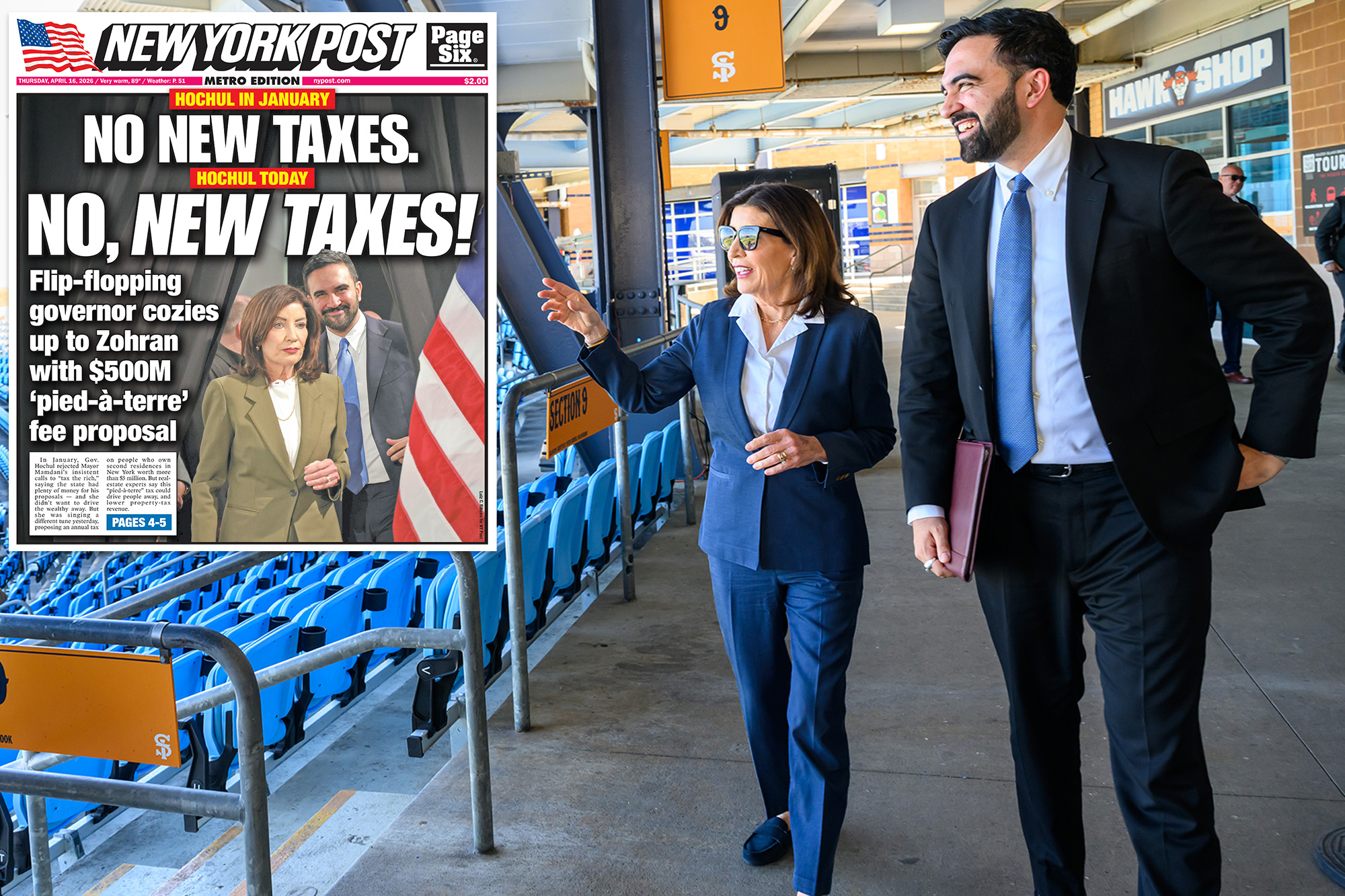
New taxes targeting the rich pushed by Gov. Kathy Hochul this week may appease socialist Mayor Zohran Mamdani in the short-term, but insiders warned they are so slapdash they’ll open cans of worms for the Big Apple’s future.
Hochul floated a proposal for a pied-à-terre tax on luxury second homes and entered discussions on a transfer levy on $1 million residences bought with cash as she and state lawmakers entered their sixth week of overtime haggling over the Empire State’s next budget.
But the 11th-hour pitches require sweeping changes to New York City’s famously convoluted property tax system that raised alarm bells with experts such as Andrew Rein, president of the Citizens Budget Commission.
“Should we rationalize our property and transfer tax system? Yes,” he said. “Should we do it piecemeal, 45 days into the state fiscal year based on unvetted proposals? No.
“That’s not the way for a good outcome.”
Mamdani has pushed to “tax the rich” not only to help close a reputed $5.4 billion budget shortfall for the city, but also to inject fairness into a system he contends is skewed toward favoring the wealthy.
The governor, however, firmly opposed Mamdani’s pitch to tax on the city’s millionaires, arguing it’d only drive them out of the city.
But Hochul, who is courting Mamdani’s progressive allies as she runs for re-election this fall, ended up partially flip-flopping as she backed a pied-à-terre tax on rich homeowners.
Mamdani quickly declared victory by shooting one of his trademark slick social media outside billionaire Ken Griffin’s $268 million Manhattan penthouses, declaring “Today we’re going to tax the rich.”
“The two fundamental facts here are that the mayor is unwilling to control spending and separately wants to be seen taxing the rich. And the practicality or sustainability of his solutions look to be afterthoughts,” Ken Girardin, a fellow at the Manhattan Institute, told The Post.
The controversial video infuriated Griffin, who pledged to add more jobs to Miami rather than New York as a “direct consequence.”
As the dustup and fears over a billionaire exodus, the actual details on the pied-à-terre tax remained murky.
Hochul cleared up some confusion Thursday when her office spilled that she envisions taxing second homes in condos and co-ops with assessed values exceeding $1 million and one- to three-family homes assessed at over $5 million.
The scheme would clamp down hard on condos and co-ops, which under city’s current assessment system are valued based on their potential rental value — a quirk that leads them to be substantially undervalued.
The plan would initially hitting those units that have an “assessed value” of $1 million — which officials contend is generally equivalent to a $5 million sales price — with the tax for the next five years.
After two years, the proposal envisions that the city would come up entirely new system of valuing condos and co-op properties that will lead to them being taxed the same as family homes.
Abir Mandal, a senior policy analyst at the Tax Foundation, generally agreed the city’s assessment system is broken, particularly for condos and co-ops.
But he argued there were too many unknowns in how Hochul’s proposal would shake out.
“Imposing a tax on top of that flawed assessment system, it’ll lead to a higher deadweight loss,” he said.
“Do I support New York City going through a better assessment system? Yes,” he went on. “But we’ll just have to take a look at and see exactly what they come up with. It’s like if we don’t have details yet, they could come up with something that’s even worse than what they have right now.”
A proposed transfer tax being discussed by Hochul and lawmakers on cash purchases of homes worth more than $1 million is expected to raise another $160 million to help the city’s budget problems, Bloomberg reported.
A spokesperson for Hochul confirmed that she’s continuing to discuss the transfer tax proposal, but has yet to reject it like she has some other sweeping measures like income and corporate taxes.
Mandal dinged the tax, contending it’d make it more expensive to buy, and effectively sell, a property.
“They’re economically even more harmful because they decrease the liquidity in the market,” he said. “If you really want a freer market for housing available for people increasing the transfer tax is not a good proposal.”
The proposals unfolded against the larger backdrop of expanding spending in the city.
Mamdani’s executive budget hit $124.7 billion, buoyed by cash from Albany.
Hochul is pumping another $2 billion into the city to prop up an expansion of childcare services for two years, theoretically leaving the city on a cliff to backfill the funding on its own by then.
Big Apple taxpayers could also get walloped with northwards of $100 million in new pension costs alone if Hochul agrees to a sweetheart deal for New York’s powerful unions.
“Revenues are not a problem either for New York City or for New York State,” Mandal said.
“It’s the fact that spending has grown even faster than the revenues have grown, which have grown pretty rapidly.”
Republican and conservative pols roundly ripped the tax proposals.
“This is exactly how ‘tax the rich’ turns into taxing everybody else,” said City Councilman Frank Morano (R-Staten Island).
Start your day with all you need to know Morning Report delivers the latest news, videos, photos and more.
“A lot of middle-class New Yorkers bought modest co-ops or condos decades ago that now fall into these thresholds because of the insanity of the real estate market. They’re not oligarchs. They’re retirees, small business owners, and families who worked hard and played by the rules.
“And let’s be honest: if Albany and City Hall keep moving the goalposts from $5 million down toward $1 million assessments, people are right to wonder who gets targeted next,” he added.
Councilwoman Joann Ariola (R-Queens) argued that pied-à-terre owners already pay enormous sums in property taxes. She said when they leave, their tax burden will be shifted to other New Yorkers.
“There’s this mistaken belief out there that people will never leave New York no matter how high taxes go because ‘it’s New York,'” she said. “But people can easily move right across the river to Hoboken, take their tax dollars with them, and still be minutes from Manhattan.
“What we are seeing here is a short-term solution from the governor in an election year that will have long-term consequences for New Yorkers.”
The added taxes will add to New York’s poor tax standing among the states, said Heather Mulligan, president and CEO for The Business Council of New York State.
“We are already in last place in tax competitiveness. What are we trying to do, be in super-duper-extra last place?” she lamented.