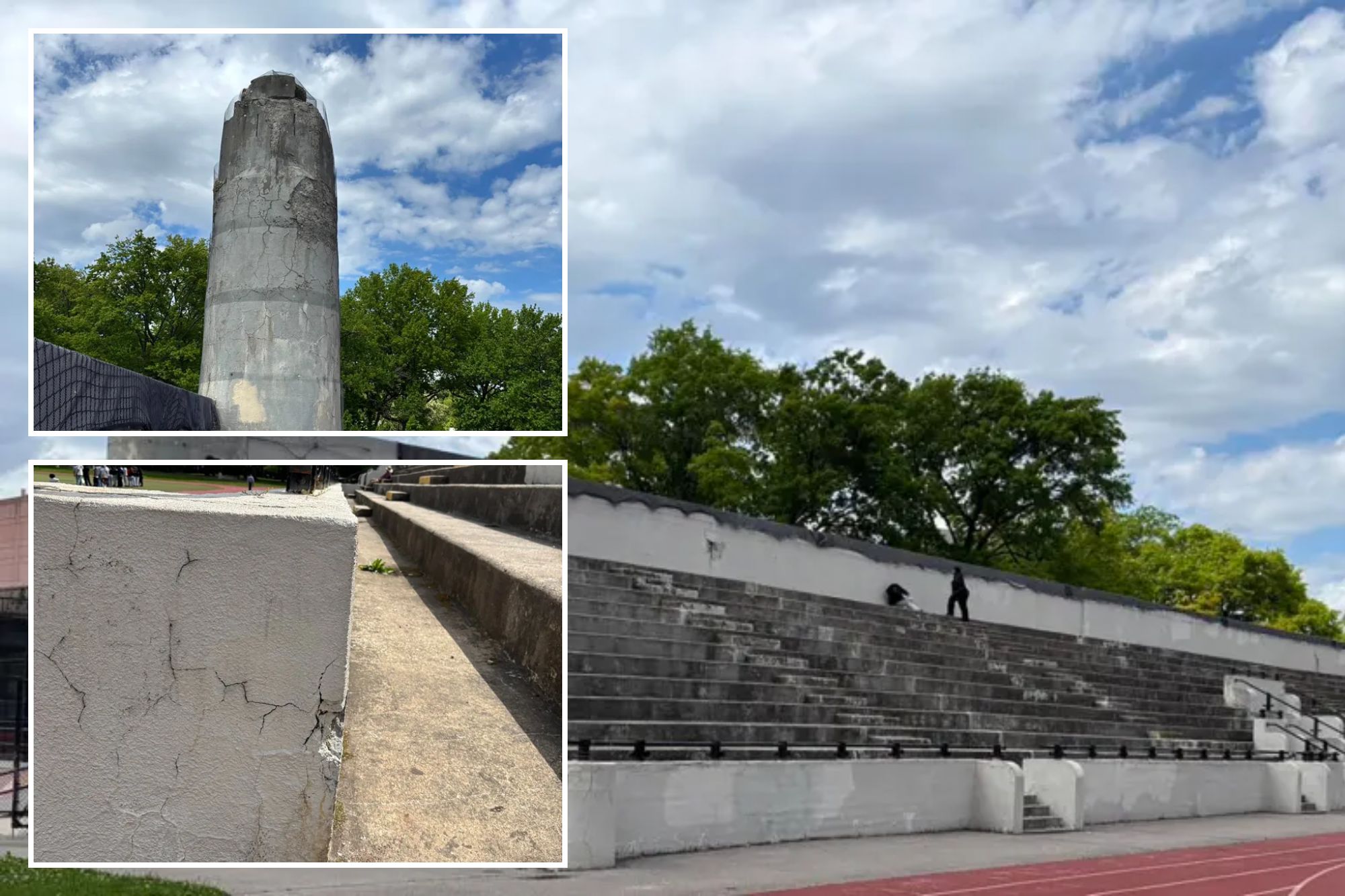
A Bronx athletic stadium that has ties to a silver-screen cult classic and has been left to deteriorate for years will soon be razed to the ground.
The Parks Department signed the death certificate for Van Cortlandt Park Stadium last month after a year-long study determined that the integrity of the asbestos-filled venue was “beyond repair” — and had actually been doomed from the start.
“It is too far gone,” Marlisa Wise, the Park Department’s director of architecture, told The Post Friday.
“The structure of the building is compromised beyond repair. We are seeing the failure of the concrete material itself, and this is due to the materials that were originally used when it was built in the 1930s.”
The Van Cortlandt Park Stadium Master Plan was contracted last summer in a last-ditch effort by Parks to restore the venue, which served as the backdrop for a high-stakes football game in the 1979 film, “The Wanderers,” though it wasn’t actually filmed there.
But engineers found that the 3,000-seat venue was built with outdated methods and that its foundation is entirely too shallow to withstand the swampy wetland it sits on.
The “high water-to-cement ratio” does not allow for thermal expansion in the concrete — meaning the water was infiltrating the entire structure and causing deterioration of the concrete and steel from the inside, Wise explained.
Cracks throughout the building sprout so frequently that repairs would be needed every four to five years if the building were permitted to stand, the survey noted.
“We would need to literally replace all the walls, beams, columns and the foundation, at which point you are looking at a new building,” Wise said, noting that the structure doesn’t pose an immediate danger, but is not made to last.
The venue has a litany of other issues, including the presence of asbestos, lead-based paint, toxic materials and mold throughout the building.
The study also found that the mechanical, electrical and plumbing systems — which were almost all original to its 1939 design — were in poor condition and no longer compliant with modern-day codes.
Those issues could have been corrected, but the deteriorating structural integrity ultimately destroyed any hopes of saving the venue, said Wise.
There is no documentation that the stadium has received any restoration since it was constructed in the 1930s, according to the survey, but Parks said any prior efforts would have been for naught.
“It might be easy to jump to the conclusion that if investment had been made earlier, the building could have been saved — the foundation was never going to be made suitable for these soils without being demolished, so ongoing investment would likely have prolonged its use, but it would have eventually suffered further damage and deterioration,” said Wise.
Van Cortlandt Park was named after the Van Cortlandt family, who occupied the area from 1699 to 1888.
The good news is that the Parks Department is advocating to replace the stadium.
There is no word yet on what the new facility might look like, but Wise said the city would look to locals for inspiration on amenities.
A demolition date for the beloved stadium has not yet been set, with Parks saying it needs to garner the funds to rip down the stadium.
In the meantime, Wise promised that the handball courts will remain open for as long as possible and that the future demolition will not impact neighborhood use of the fields or track.
“We really want to make sure the community understands that there is no danger of access being lost to those rec amenities,” said Wise.