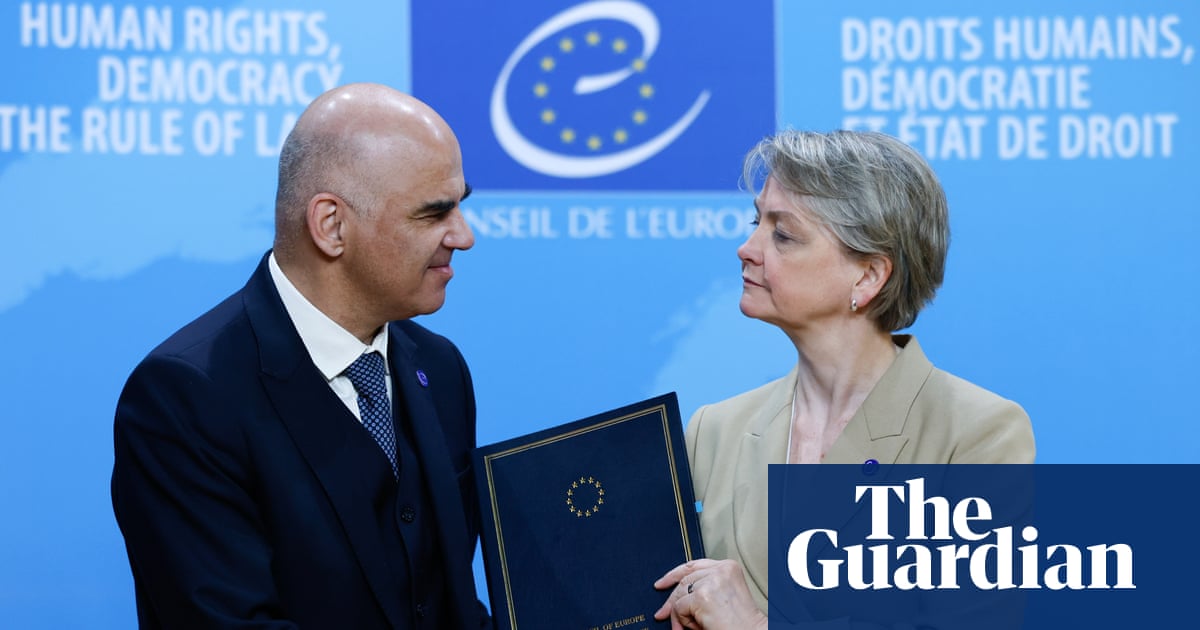
Yvette Cooper, the UK foreign secretary, and Alain Berset, the secretary general of the Council of Europe, attending the document signing ceremony in Chişinău, Moldova, on Friday. Photograph: Dumitru Doru/EPAView image in fullscreenYvette Cooper, the UK foreign secretary, and Alain Berset, the secretary general of the Council of Europe, attending the document signing ceremony in Chişinău, Moldova, on Friday. Photograph: Dumitru Doru/EPAUK joins European deal to send rejected asylum seekers to third-country hubsAll 46 Council of Europe members sign agreement ‘deplored’ by human rights organisations
The UK and 45 other European countries have signed an agreement that explicitly endorses plans to send unwanted asylum seekers to third country hubs.
A political declaration from the 46 members of the Council of Europe, the body that oversees the European convention on human rights (ECHR), said states have an “undeniable sovereign right” to control their borders.
It is understood that the UK is now seeking a deal with an unnamed third country, similar to the Italy-Albania agreement that allowed Rome to place detention centres in Albania.
In that deal, the hubs were initially intended for asylum seekers from countries considered safe while their applications were processed. Giorgia Meloni’s government has since used them to hold people to be deported whose applications have been rejected.
According to the seven-page document, countries should be free “to address and potentially deter irregular migration”.
It said: “Amongst the forms of new approaches that have been envisaged by several member states are processing requests for international protection in a third country, third country ‘return hubs’, and cooperation with countries of transit.”
The agreement also attempts to give more scope for countries to deport people to places where they may be in danger of inhuman or degrading treatment, and to limit courts’ powers to intervene.
Ministers have claimed that articles 3 and 8 of the convention – the right to live free from torture and the right to family life – have been used to prevent people with no right to be in the UK from being removed.
“Caution should be exercised … when assessing whether the expulsion or extradition of an individual to a non-state party would violate a state’s obligations under article 3 of the convention,” the agreement said.
The convention has become a significant point of contention between the main political parties. While Keir Starmer backs ECHR reforms, the Conservatives and Reform UK have pledged to leave.
One leading migration specialist said she was not convinced that a political agreement would have a significant effect on immigration cases.
Madeleine Sumption, the director of the Migration Observatory at Oxford University, said: “It’s not clear how much impact a political declaration makes given that judges’ decisions are also driven by domestic and international case law, which this declaration does not change. How much concrete difference it will make remains to be seen.”
Yvette Cooper, who finalised the agreement at the high-level meeting in Chişinău , Moldova, is expected to discuss hubs over the next two days. The foreign secretary told the Guardian: “Reform and the Conservatives have called for the ripping up of international law altogether – even though those same international laws are essential to our law enforcement cooperation against the criminal smuggler gangs, or to upholding pillars such as the Good Friday agreement.
“The Greens have called instead for the ripping up of border controls – damaging our national security. Neither of their approaches delivers for our national interest. That is why Labour is reforming the ECHR with partners from across the continent, because we know the relationships we build abroad make us stronger at home.”
Alain Berset, the secretary general of the Council of Europe, said discussions about removing people who arrived in Europe by irregular routes would take place during the conference “at a multilateral level”.
Keir Starmer’s government has promoted setting up return hubs as a possible deterrent to irregular migration. Shabana Mahmood, the home secretary, told MPs in November that the Home Office was in “active negotiations” with several countries, but no deals have been confirmed.
The previous government’s plans to send people arriving by small boats to Rwanda, which cost £715m by 2024, was cancelled after failing to send a single person. The supreme court ruled that the policy was unlawful because Rwanda was not a safe country.
The EU has voted to allow the possibility of return hubs, with Denmark, Austria, Greece, Germany and the Netherlands involved in talks. Discussions have reportedly centred on 11 countries – Rwanda, Ghana, Senegal, Tunisia, Libya, Mauritania, Egypt, Uganda, Uzbekistan, Armenia, and Ethiopia. Montenegro has denied reports that it is considering housing unwanted asylum seekers.
Prof Eirik Bjorge KC, a legal academic at Bristol University, also questioned the effect of the declaration, but “deplored” attempts to modify human rights protections.
“Article 3 is an embodiment of the very object and purpose of the convention and as such cannot be modified through political declarations. In that regard, I deplore the attempt to relativise the notion of inhuman and degrading treatment.”
Human rights organisations said they were concerned by the declaration. Akiko Hart, the director of Liberty, said: “The Chişinău political declaration on the ECHR is a hugely significant moment. We are deeply concerned that changing how the ECHR is used by UK courts will open the door to a gradual weakening of human rights protections.”