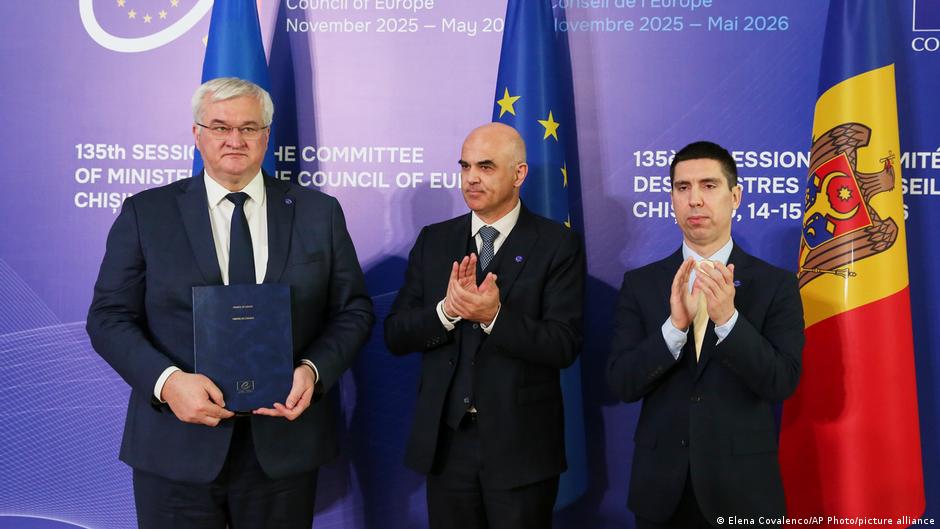
At talks in Moldova, more than 30 countries have said they will join a future special tribunal for Ukraine prosecuting Russia over its invasion. How the body will force Russians to stand trial is not clear.
https://p.dw.com/p/5DocCUkraine's Foreign Minister Andrii Sybiha (left in picture) attended Friday's meeting in Chisinau, MoldovaImage: Elena Covalenco/AP Photo/picture allianceAdvertisementThirty-four European countries plus Australia, Costa Rica and the European Union as an entity on Friday signed up to a future special tribunal that will seek to prosecute Russia for crimes committed during its invasion of Ukraine.
The plan has been in the works since soon after Russia's full scale invasion in 2022, Ukraine's President Volodymyr Zelenskyy signed an agreement with the Council of Europe last year seeking to implement it.
Most of the 46 member states of the Council of Europe, a France-based body focused on safeguarding human rights and democracy with a larger membership than the EU that's not to be confused with the European Council, approved a resolution laying the groundwork for the future tribunal, the Council said in a statement. Ukraine is a member state.
"The time for Russia to be held to account for its aggression is fast approaching," the organization's secretary general Alain Berset said. "The special tribunal represents justice and hope. Action now needs to be taken to follow up on this political commitment by securing the tribunal's functioning and funding."
"Today, we are taking responsibility to ensure that aggression does not go unanswered," Berset said, inviting other countries to join the initiative.
Ukraine's Foreign Minister Andrii Sybiha was among the participants on Friday, calling the event "a historic day."
"Just like the Nuremberg tribunal 80 years ago, this Special Tribunal in the Hague will restore justice from the ruins of war," Sybiha said, referencing the trials of some surviving senior Nazis after World War II.
"We are creating an infrastructure of accountability with three pillars: the Special Tribunal, the Register of Damages and the Claims Commission. Let me also emphasize that accountability will never be up for compromise."
The Netherlands' Foreign Minister Tom Berendsen said that his country had agreed to "host the initial phase" of the special tribunal in The Hague, home to several other international legal institutions and procedures, most notably the International Criminal Court.
"The road to justice for Ukraine is long and far from easy, but this does not stop us from doing everything in our power to help achieve this," Berendsen said.
Critics have asked how such a tribunal will be able to prosecute alleged Russian war criminals or the state itself, given how unlikely it seems that President Vladimir Putin's regime would cooperate or agree to its sanctions.
Russia was once a Council of Europe member but was expelled in response to its invasion of Ukraine in 2022.
The International Criminal Court (ICC) in The Hague has already issued arrest warrants against Russian President Vladimir Putin and other senior officials, often tied to specific alleged crimes like child abduction or deliberately targeting civilians. Russia is not a ratified member of this tribunal either, and generally does not extradite its citizens for trial in other countries.
However, the Council of Europe's tribunal is designed to be able to prosecute issues that the ICC deems to be beyond its jurisdiction, such as the more fundamental decision to launch the invasion of Ukraine or questions like reparations.
Twelve member states have not signed up as yet, including EU members Hungary, Slovakia, Bulgaria and Malta. Balkan countries Serbia, Bosnia and Herzegovina, North Macedonia and Albania have not joined, and neither have Armenia, Azerbaijan and NATO member Turkey.
EU underscores need for Russian war crimes tribunalTo view this video please enable JavaScript, and consider upgrading to a web browser that supports HTML5 video
The decision comes a day after a Russian missile strike on an apartment building in the capital Kyiv killed 24 people. President Zelenskyy laid red roses amid the rubble on Friday and said Ukraine would not allow such attacks to "go unpunished."
"We are entirely justified in our responses against Russia's oil industry, weapons industry, and those directly responsible for committing war crimes against Ukraine and Ukrainians," Zelenskyy said.
Foreign Minister Sybiha similarly referred to this strike from the meeting in Chisinau.
The tribunal is "not an abstract idea," he wrote. "Yesterday, a Russian strike on Kyiv killed 24 people, including 3 children. Their relatives are watching. We have no moral right to fail. They deserve justice. Today's agreement, approved by 37 states on three continents, makes justice inevitable."