play Live Sign upShow navigation menuplay Live Click here to searchsearchSign upFeatures|Al-NakbaNakba: Jewish voices are challenging the stories Israel tells about itselfA film director, historian and Holocaust survivor speak to Al Jazeera as opinions shift.
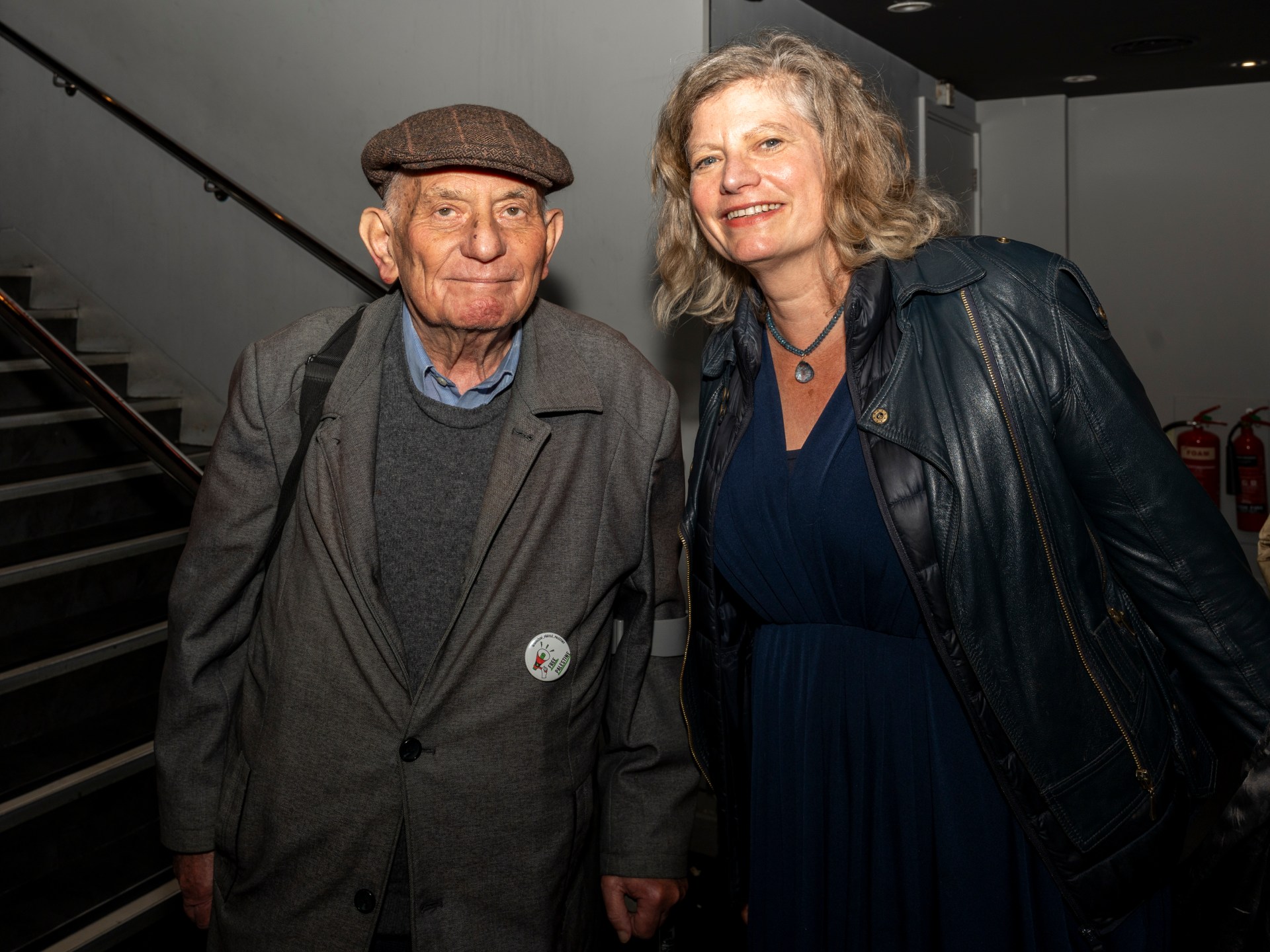
xwhatsapp-strokecopylinkgoogleAdd Al Jazeera on GoogleinfoStephen Kapos and Gillian Mosely at the London screening of Planet Israel [Beardvoyage]By Indlieb Farazi SaberPublished On 15 May 202615 May 2026London, United Kingdom – The lights come up slowly inside a cinema in London’s buzzy Soho district, but nobody rushes for the exit.
As the credits roll, one woman lowers her face into her hands. A couple sit motionless. In the row ahead, someone exhales and says “Free Palestine”.
This screening of Planet Israel: A Cautionary Tale took place on the eve of Nakba Day, the annual commemoration of the 1948 forced displacement of more than 750,000 Palestinians and the killing of thousands more during the creation of the Israeli state.
The documentary, which explores how trauma, nationalism and militarisation have shaped Israeli society after October 7, 2023 and during the genocide in Gaza, arrives as old political certainties around Israel are fracturing, increasingly among Jewish and Israeli intellectuals, artists, rabbis and historians themselves. In it, historians, experts and everyday Israelis are interviewed.
“The media has not reported this,” the film’s director Gillian Mosely told Al Jazeera from her London home, days before the screening. “British Jews are being treated as a monolith, which I think is fuelling anti-Semitism.”
According to polling from the Institute for Jewish Policy Research, which researches the state of contemporary Jewish life in the UK and across Europe, British Jewish opinion is divided over the war in Gaza and the direction of Israeli politics.
Forty percent of British Jews said Israel’s conduct in the Strip had weakened their attachment to the country, while more than a third said they no longer identified as Zionists. Only 12 percent expressed approval of Benjamin Netanyahu.
These shifts are visible across publishing and religious life. New books, including Israel: What Went Wrong? by Omer Bartov, a former Israeli army officer and professor of Holocaust and genocide studies at Brown University, and Here Where We Live Is Our Country: The Story of the Jewish Bund by American writer Molly Crabapple, revisit questions of Zionism, diaspora and Jewish identity in the wake of Gaza.
Britain’s Movement for Progressive Judaism, which represents about a third of UK synagogues, recently published a book arguing that criticism of the Israeli government is “a Jewish obligation”. Its co-leaders, Rabbi Charley Baginsky and Rabbi Josh Levy, warned that Israel’s political direction risks becoming “incompatible with Jewish values”.
Historian Avi Shlaim, who is featured in Planet Israel, spoke of a rupture between Israel and Jewish communities around the world.
“A growing number of Jews, not only intellectuals, are challenging the Israeli narrative because Israel’s conduct in Gaza has made it a pariah and a war criminal state,” Shlaim, who is Israeli, told Al Jazeera. “The argument of self-defence no longer serves as a cover for Israeli atrocities and indeed genocide.
“Israeli brutality in the war in Gaza, the ethnic cleansing of the West Bank, and the destruction of southern Lebanon have created a crisis between Israel and world Jewry. More and more Jewish groups around the world have come out openly against Israel. They all say: ‘Not in our name’.”
Mosely, a British American Jewish filmmaker who used to believe in Zionism, says her documentary is about how a people shaped by historical persecution can become attached to a permanent narrative of victimhood, and what happens when that victimhood becomes politically weaponised.
“Also, being Jewish, I understand that Jews are raised to feel they’re victims,” Mosely said. “I mean, we were victims [of the Holocaust]. It’s just part of what happened, which is something that I’ve personally long railed against, because I don’t think that’s a way to exist.”
Raised in a family steeped in Sephardic Jewish history stretching back centuries across Spain, the Netherlands, the UK and the United States, her lineage includes rabbis, chief rabbis and Jewish communal leaders. She grew up surrounded by stories of exile, persecution and migration – but also a pro-Israel worldview.
Her understanding of Israel and Palestine shifted after forming a bond with a Palestinian friend at university.
“By the time I heard of the Nakba, I was already down the road,” she said.
Learning about Palestinian history unsettled the assumptions she had inherited, an internal reckoning that would eventually shape her body of work.
Before Planet Israel, Mosely produced and directed The Tinderbox (2022), exploring Israeli violations in Palestine, and later directed From the Nakba to Camp David (2026) for the Britain Palestine Project, tracing the conflict from the displacement of Palestinians in 1948 through the decades that followed.
“When I made The Tinderbox, I really thought that was all I had to say on the subject,” Mosely said. “But things have just gone from bad to worse. I can’t believe how poorly served we’ve been by mainstream media in terms of context and deeper understanding. That really shocked me after October 7.”
At first, “a red mist of fear and hatred had descended over most Israelis,” she said.
“It’s … the feeling that ‘we need to kill them all,’” she said, quoting an Israeli interviewed in her film. She argued that Israeli institutions have “whitewashed” the country’s formative history, leaving many Israelis disconnected from Palestinian claims to land, identity and statehood.
The documentary also explores how “Greater Israel” ideas have entered mainstream political discourse. Interviewees describe education systems that minimise or erase the Green Line separating Israel from the occupied Palestinian territory.
“What was quite shocking to me were the academic studies showing the level to which [the ideology] had infiltrated the education, military and media systems in Israel,” she said.
“And then the religion, I hadn’t expected to be quite as affronted by what’s happened to the religion.”
She contrasted a long ethical and diasporic Jewish tradition centred on justice and the protection of strangers with a hardline nationalism visible in Israeli politics.
“To me, watching what looks like bloodlust by the likes of (Israel’s National Security Minister) Ben-Gvir and (Finance Minister Bezalel) Smotrich, particularly, feels like it is mocking my ancestors who kept Judaism safe for over 1,200 years,” she said.
“The core values of Judaism are truth, justice, and peace,” he said. “The present Israeli government is the antithesis of these core Jewish values.”
He said Gaza has “generated a shift” in how people regard Israel, “for its brutality and sadism”.
But the way the Nakba is viewed has not changed “fundamentally”, he added. “Ordinary people’s perceptions have changed more about the present than about the past.”
Inside the cinema hall, there are many unnerving noises. A distorted electronic hum, like a radio struggling to find a signal, drones, pulses during scenes of bombardment and testimony. On screen, fractured visuals and AI-assisted animation interrupt the flow of interviews.
“It’s subliminal,” Mosely said of the film’s sound design. “This is not a war game.”
Holocaust survivor Stephen Kapos, 88, who was in the audience, said the unflinching portrayal of destruction felt necessary.
“We can’t have enough illustrations of what is going on and the impact it has on the people and children,” he told Al Jazeera. “It’s important to keep seeing the totality of the devastation so we don’t forget that it’s not over. Palestinians are living in impossible conditions.”
“I still remember everything that happened to my friends. That in no way excuses or explains – let alone actively perpetrating – what’s going on in Gaza.”
While Planet Israel focuses on Israeli psychology and Jewish trauma, the film also returns to the material consequences of those narratives for Palestinians: Occupation, displacement, siege and military violence.
But Mosely is careful not to position herself as speaking for Palestinians.
“I made a point of staying away from Palestinian trauma because I’m not Palestinian,” she said. “I don’t feel I’m the person to talk about it. It’s very obvious that trauma is colossal.”
As audience members slowly filter out into the London night after the screening, some stay in the foyer to debate history as others discuss propaganda, trauma, nationalism and media failures. One viewer quietly wonders whether films like this can still matter while bombs continue to fall.
“Politicians are very slow to turn their back on what has been consensus public opinion,” she said. “But the Gaza war has dramatically changed that consensus, both here and in America. The politicians haven’t caught up with it yet.”
“Is this the world we want to live in?” she asks. “And if it isn’t, what are we going to do about it?”