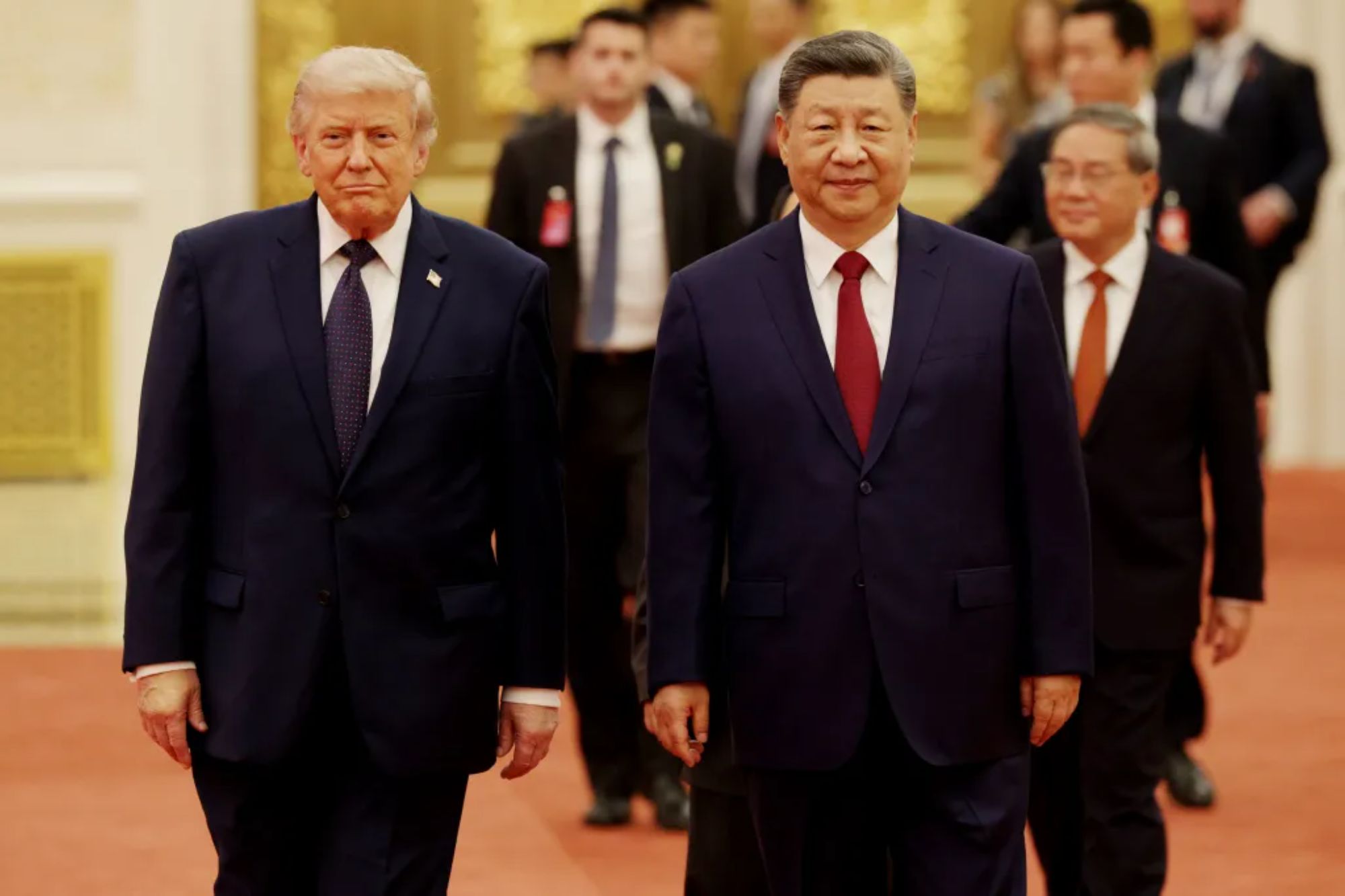
Trump and Xi met face-to-face, but their minds are worlds apart.
Both sides described this week’s summit as constructive and there were no major surprises, but based on initial readouts, the two leaders seemed to be talking “strait” past each other. China says President Xi Jinping spoke about “peace and stability across the Taiwan Strait” while simultaneously suggesting “conflicts” and “clashes” if the U.S. challenges Beijing’s views on Taiwan.
President Trump pushed his own concerns about Iran. The official White House statement was only 163 words long, but the Strait of Hormuz — which has been shut down by Iranian missiles and drones – was mentioned three times.
China has been buying more than 90% of Iran’s sanctioned oil, while Hong Kong shell companies and banks have been essential to laundering the money for the Iranian regime, but China’s official description of the discussions doesn’t mention Iran once, only vaguely referring to “the Middle East situation.”
With reports that China plans to re-arm the Iranian military, China’s role in sustaining Iran is critical to Trump, but it appears that Xi isn’t listening.
For Xi, China has big concerns closer to home, with an economy that is overproducing cars, but is still underproducing jobs. The Chinese economy that is a lot weaker than its misleading statistics suggest. Xi may be talking tough on Taiwan to bolster domestic support and distract from economic issues.
If this is more than tough talk, however, the risks to American interests from a Chinese invasion of Taiwan are tremendous. Taiwan is a vibrant democracy, a critical ally, and is the only producer of the most advanced semiconductors, essential for America’s booming AI industry.
With the midterms approaching, President Trump hoped to use the trade talks to score domestic wins as well. While China has not confirmed any specific agreements, President Trump said “we’ve made some fantastic trade deals,” saying that China had agreed to buy 200 Boeing aircraft — a point that the Chinese spokesman declined to confirm.
Two leaders, one room, and apparently two very different conversations.
These competing narratives are a powerful illustration of the divergent interests between the United States and China. It also is an indication of how difficult it will be to make progress on the relationship’s thornier issues.
For instance, China produces most of the world’s supply of several critical minerals and rare earths that are essential for U.S. military and tech companies — and Beijing has imposed export controls that threaten to choke of American access to those minerals.
The United States, in turn, has restricted the export of advanced semiconductors, limiting China’s ability to keep up in the AI arms race. More broadly, the Chinese and American economies are increasingly in direct conflict, with China trying to flood the world with heavily subsidized, underpriced goods that destroy competition at the same time the U.S. is trying to rebuild its industrial base.
Despite these long-term issues, an uneventful summit is a good thing for America. The U.S. needs time to break China’s critical mineral monopoly and move its vulnerable supply chains out of China. And with global trade already constrained by the closed Strait of Hormuz, American consumers don’t need more trade disruption.
The biggest takeaway is that the leaders from the world’s two most powerful countries sat across from each other and talked rather than issuing ultimatums. Trump also announced that Xi would come to America in September for another summit — another chance for the leaders to see eye-to-eye. They may be talking past each other, but at least they are talking.
Josh Birenbaum is deputy director of the Center on Economic and Financial Power at the Foundation for Defense of Democracies, where Daniel Swift is a research analyst.