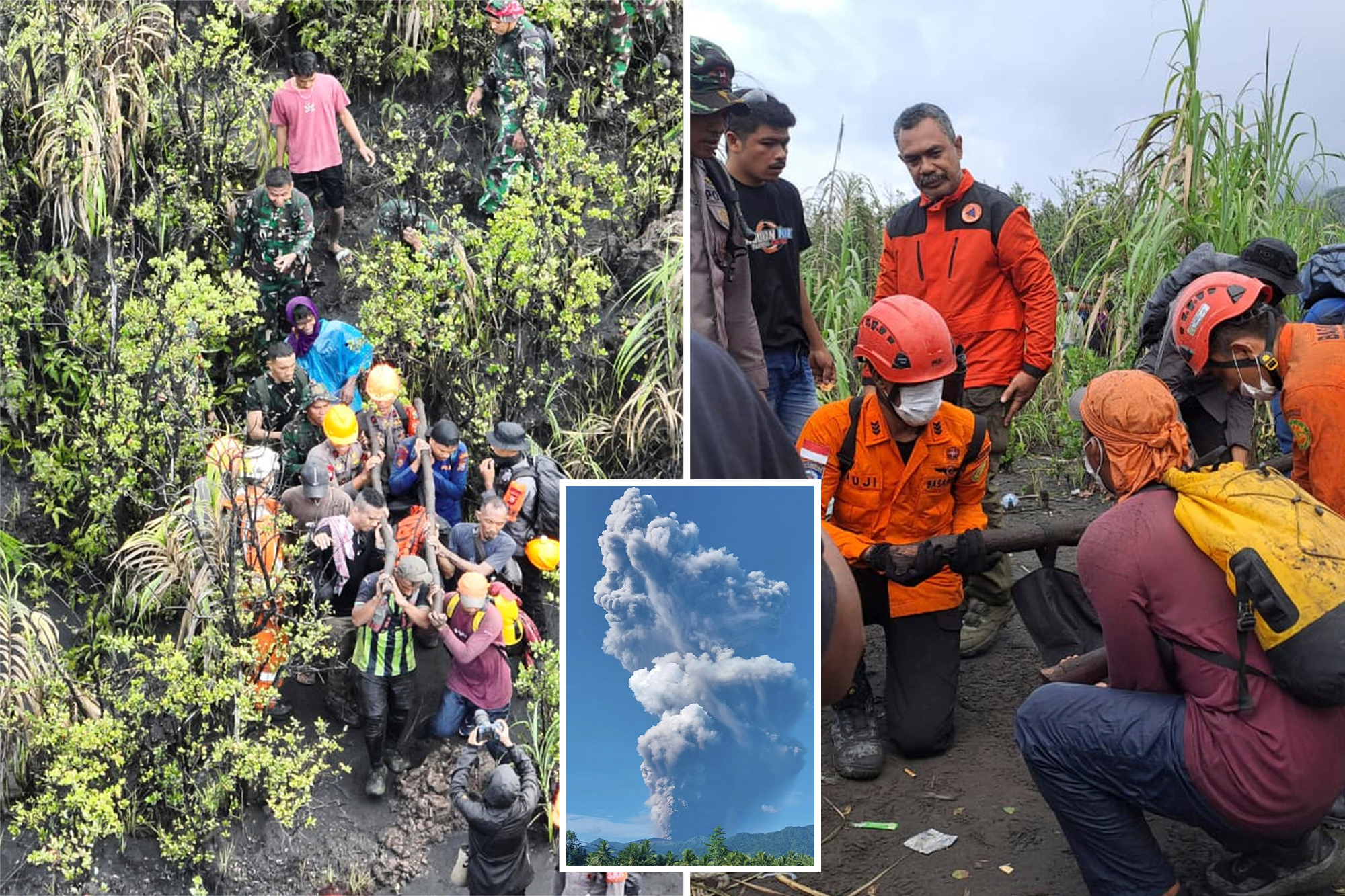
The guide who led a group of tourists to Mount Dukono on Halmahera Island in Indonesia’s North Maluku Province has told how the trip of a lifetime ended in tragedy when the active volcano fatally erupted — killing three hikers.
Speaking to news.com.au, Indonesian guide Reza Selang said he felt like a failure after the hiking expedition to the crater of Mount Dukono left two Singaporeans and one Indonesian dead when they were crushed by burning rocks ejected from the volcano.
“I was the person responsible for the trip, so I feel like I failed. I failed to bring them home safely,” Reza said.
The trip took a deadly turn when the group of 20 hikers, made up of nine Singaporeans, three Indonesians, and eight guides and porters, reached the summit of Mount Dukono on the morning of May 8.
Reza said he was operating a drone close to the lip of the volcano crater when suddenly, without any warning, Mount Dukono erupted with terrifying force – spewing rocks, ash, and debris high into the air.
“I immediately knew it was an extremely dangerous situation, and I kept operating the drone so that I could see what was happening. From the drone footage, I saw that someone had collapsed close to the crater.”
Reza shut off the drone and sprinted towards the summit.
Ahead of him, a Singaporean hiker who had been fleeing down the mountain, 30-year-old Timothy Heng, suddenly turned back and also started running to the crater. He had realised his hiking partner, 27-year-old Shahin Muhrez bin Abdul Hamid, was lying on the ground on the slope of the belching volcano.
“Timothy got to Shahin before me and started doing CPR and was able to revive him,” Reza said.
Timothy grabbed Shahin by the shoulders while Reza carried him by his feet to evacuate the semi-conscious man from the fiery mountain.
Following the initial eruption of smoke and ash, the volcano continued to spew projectiles, including gigantic fiery rocks.
“The boulder was so big that it covered them completely. I knew at that moment there was nothing I could do. I knew it was hopeless.”
Reza added that, as the huge boulder flew towards the men, Timothy saw it coming and sprang into action.
“He grabbed Shahin in his arms and hugged him tight, trying to cover his body and protect him.”
Unable to help, Reza sprinted down the mountain, screaming to the rest of the group that two people had died, and to call the police and the Indonesian Search and Rescue Agency.
When they arrived, another hiker, Indonesian national Angel Krishela Pradita, was found dead on the mountain, and it took several more days for rescuers to finally retrieve Timothy and Shahin.
According to Dr. Iwan Aflanie, an Indonesian forensic doctor at Lambung Mangkurat University, volcanic eruptions can be fatal in a number of ways.
“Causes of death can include inhalation of hot air resulting in swelling of the airways, inhalation of toxic gases, exposure to volcanic material causing burns, and burial by volcanic material,” he told news.com.au.
He added that, in the Mount Dukono incident, it was possible that all four causes could have occurred simultaneously due to the intensity of the eruption.
Iwan also said high temperatures around volcanoes and hot volcanic debris hitting victims presented challenges for doctors and first responders.
“I once performed an autopsy on a victim of a volcanic eruption at Mount Merapi [a volcano in Central Java]. Initially, his body was intact but, when he was evacuated, his arm became separated due to the fragility of the tissue.”
He added that, due to the temperatures involved, bodies caught in volcanic eruptions could sometimes appear “pressure-cooked.”
Asked why he had led the group to such a dangerous location, Reza said that visitors regularly hiked Mount Dukono and that it was rare for such a violent eruption to happen.
However, the Indonesian authorities disagreed and said signs had been erected to warn hikers not to summit the mountain. Reza said he had no idea about these warnings.
Since March, the volcano had erupted over 200 times, and climbing permits had been banned since April 17. There was also a ban on members of the public going within 4km of the crater.
This is not the first time an Indonesian volcano has claimed a life. Brazilian hiker Juliana Marins died in June last year after she fell while climbing Mount Rinjani in Lombok.
Ridho Alsyukri, an emergency responder and guide at Mount Marapi, a volcano in West Sumatra, told news.com.au that there were many warning signs tourists could look for when hiking near a volcano.
“It is not fortune-telling. There are a number of things, such as official announcements by the authorities and warnings in the local area,” Alsyukri said.
“Guides or porters with experience will know to listen for rumbling sounds getting louder or the smell of gases getting sharper. Another symptom is increased or black smoke coming from the volcano. You can also sometimes feel the ground shaking or see small projectiles.”
He added that much depended on the type of eruption, distance from the crater, and wind direction.
“It is not always best to immediately descend,” he said, adding that, if the way down the mountain was also the same as the wind direction, hikers should delay descent in case they became trapped in the path of a deadly ash cloud.
“However, if it is a small eruption with not much smoke, it is better to try and leave immediately as there can be a buildup of poisonous gases near the crater and projectiles.”
“But if there is a large and explosive eruption with no visibility, you need to find a safe place to shelter, for example, behind a large rock.”
He added that it was important to find an experienced guide with local knowledge of the area and clear standard operating procedures in cases of emergency.
Back in North Maluku, guide Reza said it was only when he descended that he found out that climbing Mount Dukono was restricted.
Reza has since been questioned by the Indonesian police, who have launched an investigation into the incident, and mooted the possibility of arrests if it is found that there was “negligence that led to death”. No charges have been laid.
For his part, Reza told news.com.au he felt “very guilty” about what happened and wanted people to remember Timothy for his bravery during those final terrifying moments on Mount Dukono.
“He was such a nice person and a strong leader. He was also a great friend. He protected Shahin right until the end. Until it was all over.”