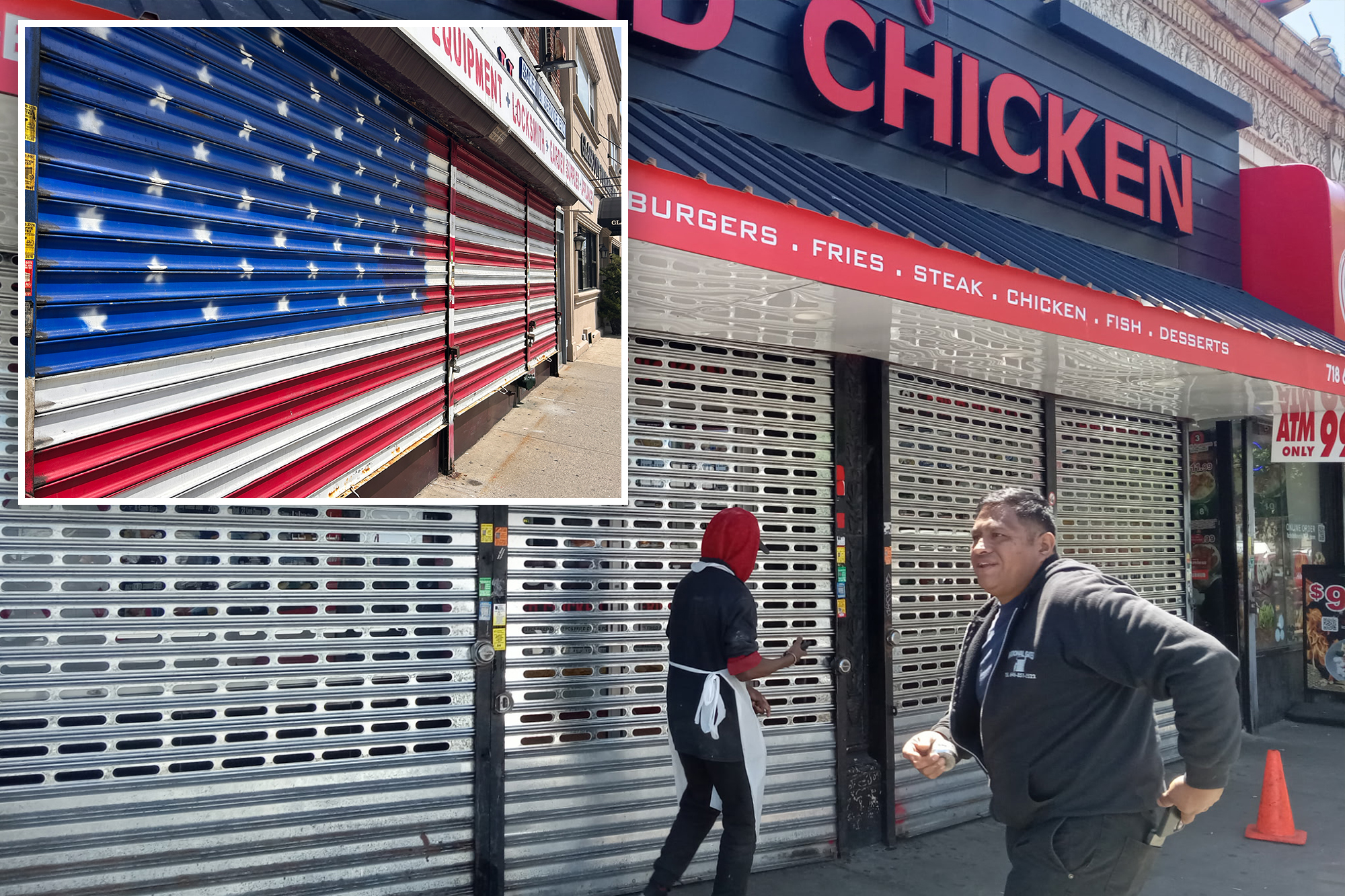
Big Apple retailers are fearing they will be forced to shell out tens of thousands of dollars in upgrades to their roll-gown gates — as the city is set to begin enforcing an obscure, decades-old law mandating changes to the security barriers this summer.
The 17-year-old measure, passed as an anti-graffiti tactic by the City Council in 2009, requires storefronts to replace solid security grilles with gates that are at least 70% transparent – or else face up to $1,250 in penalties starting July 1.
The new mandate would allow passersby to window shop and deter would-be vandals from defacing the gates, lawmakers argued at the time.
But Khalil Ahmed, the owner of the US Fried Chicken chain of restaurants in the Bronx, believes the modification will leave his business more susceptible to lurking thieves.
“These are much lighter to break than the other [gates],” lamented Ahmed, who said he recently spent up to $3,000 a pop on new gates across his five locations. “People see through the glass. If they see something … they’re going to break [into] the store.”
Prince Ali, a manager at Yankee Convenience near the Bronx Bombers’ home stadium, said he similarly fears break-ins, but still plans to change the store barriers within the coming weeks to avoid risking fines from the Department of Buildings.
“It’s not a matter of money, it’s just a matter of security,” he said. “You never know what kind of nights people might have, and we’re surrounded by bars and clubs in the middle of the Yankee season.”
“The fact that the gates are going to be clear gives [owners] a vulnerability of making sure that they can’t have their valuable products laid out,” said Allied Universal security guard Alfonzo Carrillo, who works at a Chase Bank near Yankee Stadium.
“You’re able to see inside their businesses after hours when nobody’s around.”
“It’s a burden,” fumed Daniel Gordon, a manager at Bronx-based restaurant Eating Tree, who hadn’t heard of the mandate before a Post reporter inquired about it.
“I already have a full gate,” he said. “There’s nothing wrong with it. So, if I have to change it, I have to spend [money] to change it.”
Several City Council members agree the measure will only burden or even shutter small businesses – with Brooklyn Council member Chris Banks going so far as to call the law a “poison pill.”
“There remains little clear evidence of the specific problem this legislation was meant to solve, or whether it has effectively done so,” said Council member Althea Stevens, who said she is introducing a bill Thursday to exempt existing businesses with traditional grilles from the city’s enforcement.
“Today, we are in a very different economic reality,” she added:
“Small businesses, especially mom and pop shops, are still recovering from the lasting impacts of the COVID-19 pandemic, while also facing rising rents, increased utility costs, and inflation. Requiring business owners to replace their existing roll-down gates at an average cost of nearly $10,000 is not just burdensome; it is unrealistic.”
The Department of Buildings said that, while it intends to begin enforcement in July, the introduction of a Stevens’ bill may delay penalties in the boroughs.
“If a new bill is introduced, and the City Council informs us that the proposed legislation is likely to pass, the Department will exercise discretion in delaying enforcement,” DOB spokesperson Andrew Rudansky told The Post.
If new legislation is not introduced, the agency said it will commence enforcement in July.
Even so, as the visibility requirements are “not an immediately hazardous public safety concern,” the department will not be performing inspections of grilles to check for compliance.
Instead, the department will rely “100%” on 311 complaints indicating requirements aren’t met.
Violations will also be considered “curable,” meaning that business owners who replace grills within 90 days of a violation being issued will have the case dismissed without penalties.
—Additional reporting by Jordan Donegan.