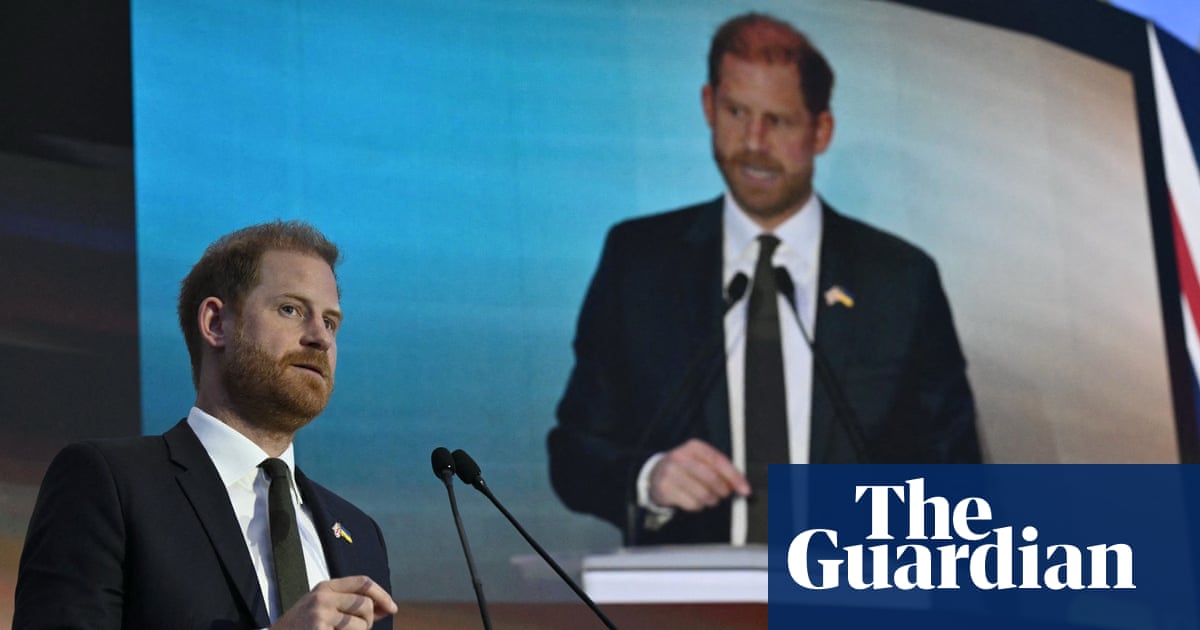
Prince Harry: ‘I am acutely aware of my own past mistakes.’ Photograph: Genya Savilov/AFP/Getty ImagesView image in fullscreenPrince Harry: ‘I am acutely aware of my own past mistakes.’ Photograph: Genya Savilov/AFP/Getty ImagesPrince Harry calls rising antisemitism in Britain ‘deeply troubling’Duke of Sussex says legitimate concerns over situation in Middle East should not lead to hostility toward Jewish community in UK
Prince Harry has described rising antisemitism in Britain as “deeply troubling”, saying that while people were entitled to feel anger over events in the Middle East, there could be no justification for hostility towards individuals or faith communities.
The Duke of Sussex appeared to make a veiled criticism of the Israeli government, while stressing that legitimate protest should never tip into hatred.
“Across the country, we are seeing a deeply troubling rise in antisemitism,” Prince Harry wrote in the New Statesman. “Jewish communities – families, children, ordinary people – are being made to feel unsafe in the very places they call home.”
The number of antisemitic hate crimes recorded in April in London was the highest in two years, recent data showed, as the Metropolitan police committed to deploying 100 extra officers to protect Jewish communities.
Among the offences were attempted arson attacks at Finchley Reform synagogue on 15 April and at the former premises of the charity Jewish Futures in Hendon three days later. A further attempted arson attack targeted a memorial wall in Golders Green on 28 April. Golders Green was also the scene of a double stabbing on 29 April that is subject to a terrorism investigation.
Some politicians and Jewish community leaders have argued that antisemitism has been inflamed by extremist rhetoric at some pro-Palestinian protests, and called for the marches to be banned.
In his article for the New Statesman, Prince Harry, wrote: “There is deep and justified alarm at the scale of loss in the Middle East. Images from Gaza, Lebanon and the wider region – of devastated communities and entire neighbourhoods levelled and reduced to rubble – have shaken people to their core. For many, the instinct to speak out, to march, to demand accountability, to call for an end to suffering – is both human and necessary.”
But, he added, “these two realities are being dangerously conflated. We have seen how legitimate protest against state actions in the Middle East does exist alongside hostility toward Jewish communities at home – just as we have also seen how criticism of those actions can be too easily dismissed or mischaracterised.”
The prince also condemned rising Islamophobia, writing that when anger leads to attacks on “communities – whether Jewish, Muslim, or any other – it ceases to be a call for justice and becomes something far more corrosive.”
The prince, who now lives in California, has been criticised in the past for wearing a Nazi uniform to a costume party 20 years ago. In 2009, he was also criticised for describing a Pakistani member of his platoon while serving in the army as “our little Paki friend”.
In his article, he acknowledged these mistakes, writing: “I am acutely aware of my own past mistakes – thoughtless actions for which I have apologised, taken responsibility and learned from. That experience informs my conviction that clarity matters now more than ever.”
Harry’s intervention comes as the archbishop of Canterbury used a visit to the Sternberg Centre for Judaism to warn of a “horrifying increase in antisemitic violence over the past few weeks, months and years” in Britain, saying it was “completely unacceptable” that Jewish communities lived in fear and with heavy security.
Speaking at the centre, Sarah Mullally said it was “it was impossible to ignore the distressing truth about Jewish life in Britain today.”
She added: “This is not a problem for the Jewish community to solve. It’s on all of us – every single member of our society – to call out antisemitism whenever we see it, and to oppose it without hesitation or qualification.”
The Church of England, Mullally said, knows acts of solidarity must also mean action, as well as words. “We are committed to serve the whole nation by working together to tackle hatred in all its forms, knowing that violence against one group wounds us all.”