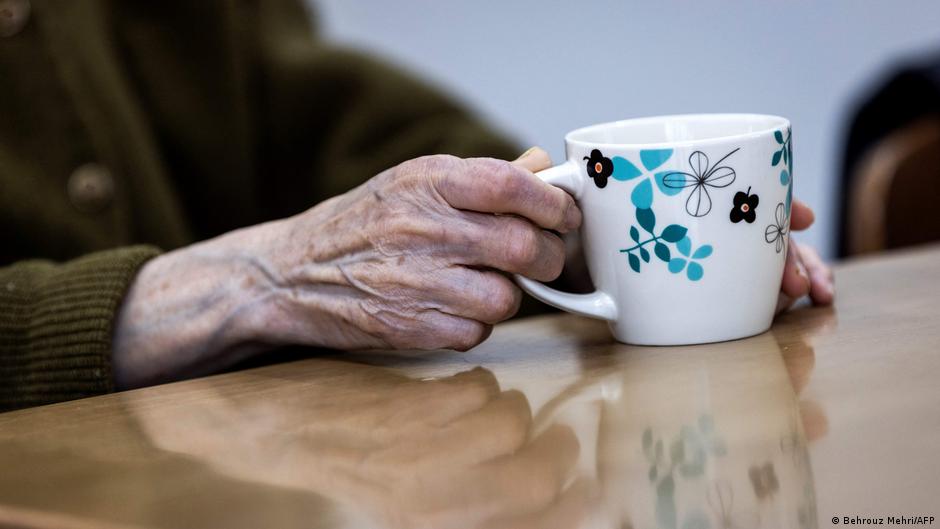
As Japanese society changes, many elderly people find themselves isolated and facing a "lonely death." Government agencies and private groups are working hard to give them a new lease on life.
https://p.dw.com/p/5Dl44Nearly 77,000 people died in isolation in the 12 months preceding April 2025, according to the Japanese governmentImage: Behrouz Mehri/AFPAdvertisementJapan is facing a rising number of "lonely deaths," or people dying in isolation, despite government efforts to stem the tide. The issue has become such a part of modern society here that it even has its own term, "kodokushi" — making up close to 5% of Japan's overall death rate.
Statistics released by the government and police in late April showed that 76,941 people died "lonely deaths" across Japan in the 2025 fiscal year, which ended on March 31. That is 921 cases more than the previous year.
Authorities estimate that 22,222 of the total "lonely deaths" were also "koritsushi," meaning that the person's body was not found for at least eight days. In 7,148 incidents, approximately 9% of the total, the body was not discovered for more than one month.
Elderly people accounted for the vast majority of "lonely deaths," although the statistics included 57 teenagers and 753 people in their 20s. The rise has prompted a debate about loneliness and isolation in modern Japan.
"Japan's society has changed a lot in a very short space of time," said Izumi Tsuji, a professor of the sociology of culture at Tokyo's Chuo University.
"There are many contributing factors, but I feel the biggest has been the end of the traditional nuclear family and the shift that we have seen towards individualization, or people living alone," he told DW.
For at least three decades, Japan has been experiencing a decline in its rural population as young people left villages and small towns for greater education opportunities and, subsequently, better job prospects. The communities they left behind now have few young residents. Elderly people are increasingly isolated and many of them are dying alone.
Akashi: Japan's family-friendliest cityTo view this video please enable JavaScript, and consider upgrading to a web browser that supports HTML5 video
"When I was a child, I grew up in a house with my parents and two of my grandparents," he said. "And it was perfectly normal to be in a home with multiple generations of the family. That was only a few decades ago, but that sore or living arrangement is rare now and virtually unheard of in the cities."
Life in Japan's big cities carries its own problems, Tsuji points out, as people typically move into apartments in tall accommodation complexes and are only on nodding terms with their neighbors, at best.
"Japanese people never used to live in tower blocks," he said. "We lived in communities where houses were surrounded by open areas where all the children played together and you spoke with your neighbors every day. You knew these people and, if someone in the community was in need of something, there was always a support mechanism in place."
Tsuji says human connection is critical to mental health.
"Now, anyone living in a apartment block is closed off and isolated," he said. " I do not think humans are meant to live like that; I think we need relationships with the people around us, to speak and interact with people."
Japanese 'cafe movement' tackling loneliness, povertyTo view this video please enable JavaScript, and consider upgrading to a web browser that supports HTML5 video
The professor proposes a radical solution — he calls for residential blocks to be knocked down and for the people to return to more close-knit community living. While that is likely to be a very tough sell for the Japanese government, the authorities also acknowledge that "kodokushi" is a problem that needs to be addressed, and quickly, as Japanese population continues to age.
In 2021, the government created the post of minister for loneliness and isolation, with the task of fighting against stubbornly high suicide rates and mental health issues among both children and adults.
In April 2024, the government enacted the Loneliness and Isolation Countermeasures Act to encourage local authorities to establish specialist agencies with trained staff to reach out to people living alone and to make them feel part of their community. A key element of that is breaking the stigma surrounding the problem and encouraging seniors to accept help, even if they insist on living independently and not relying on others.
The campaign has triggered the creation of residents' associations that look in on vulnerable neighbors, events where seniors can socialize, cafes specifically for people suffering from dementia or similar age-related complaints, as well as specialist NGOs and welfare support organizations.
On March 11, 2011, the coastal city of Ishinomaki was devastated by the largest earthquake to strike Japan in recorded history and a series of powerful tsunamis, which also affected the power plant in Fukushima. The quake and the flooding destroyed much of Ishinomaki, Thousands died, businesses and homes were destroyed, and much of the local infrastructure, including transportation services, was simply washed away.
15 years on: Fukushima's radioactive legacyTo view this video please enable JavaScript, and consider upgrading to a web browser that supports HTML5 video
The following month, Katsuyuki Ito started driving elderly residents of Ishinomaki to banks, hospitals, the city hall, and the few remaining supermarkets. His volunteer effort has since grown into an NGO called Rera.
"We now have six vehicles and a team of eight volunteers," said Kei Ueno, 50, a volunteer who moved to Ishinomaki soon after the disaster.
"Most of the people that we help are elderly or disabled and they need help to get around," he said. "For many of them, their families have died so they are forced to live alone and they have little contact with other people for much of the time."
"The oldest person that we help is 94 years old and I often hear that the best part of their day is when Rera's volunteers come to pick them up," he said.
"So we help by taking them to the places they need to go, but I think it is more than that," he said. "These people are old and by themselves, so the companionship and conversation that we provide is just as important."