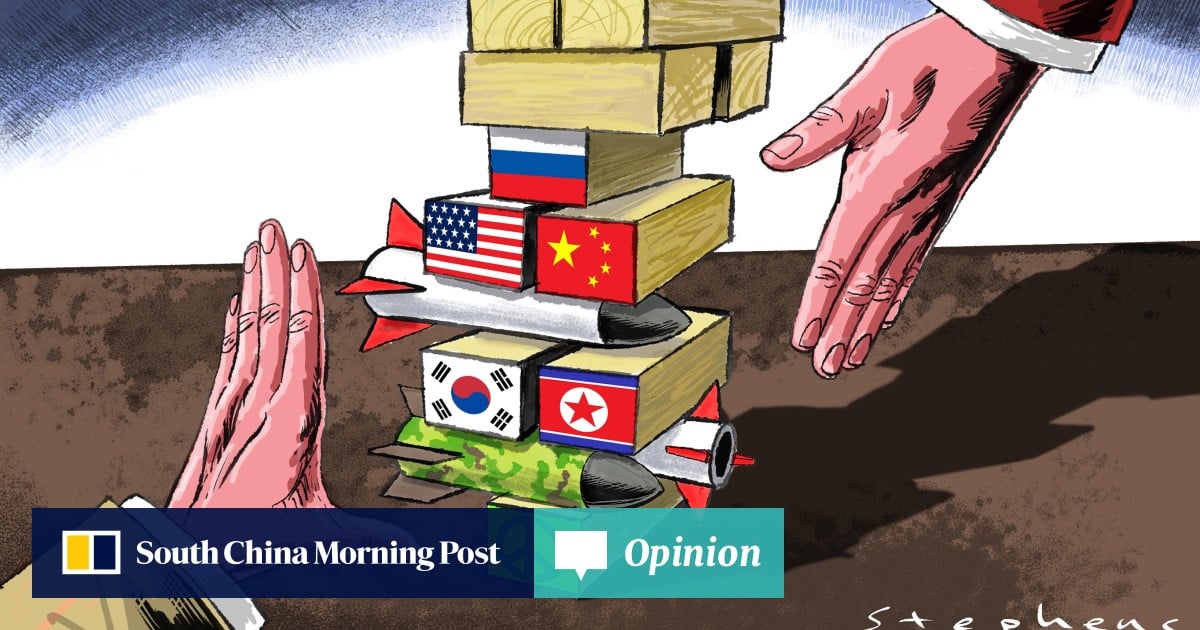
North Korea’s nuclear reality and the overlapping interests of the US, China and Russia make tension reduction a prerequisite
3-MIN READ3-MINLee Min-YongLee Min-Yong is a visiting professor in the School of Global Service at Sookmyung Women’s University, South Korea and a former adviser (foreign affairs and national security) to the Presidential Office of the Republic of Korea. Published: 5:30am, 14 May 2026The US strikes on Iran sent a clear signal to Pyongyang. But rather than retreat or show renewed interest in denuclearisation, North Korea has doubled down on deterrence. In recent weeks, Pyongyang has tightened security around its leadership and continued its missile launches, underscoring its sensitivity to Washington’s military posture.From Pyongyang’s perspective, these moves are meant not only to gauge how far US military pressure could one day extend, but also to signal that North Korea’s deterrent is fundamentally different from anything Iran ever had.
Comparisons between North Korea and Iran have important limits. Geopolitically and militarily, the Korean peninsula presents a vastly different environment. Applying military pressure to a nuclear-armed North Korea would be far riskier and less predictable. North Korea is widely believed to possess at least 50 nuclear warheads. That reality puts the peninsula beyond the point where military pressure alone can produce manageable outcomes.
An Iran-style model is therefore unlikely to provide a workable solution for North Korea. Military options pursued in the Middle East cannot simply be replicated on the Korean peninsula, where different security dynamics could produce far more dangerous consequences.
More importantly, the peninsula has long been governed by an informal logic of escalation control. Despite recurring crises and periods of confrontation, both Koreas maintain an implicit understanding that full-scale war must be avoided. The current impasse looks less like a crisis than a prolonged condition in which rivalry persists but escalation is still managed – a form of “unstable coexistence”. This logic may be becoming more explicit in North Korea’s strategic posture.