To play this video you need to enable JavaScript in your browser.This video can not be played
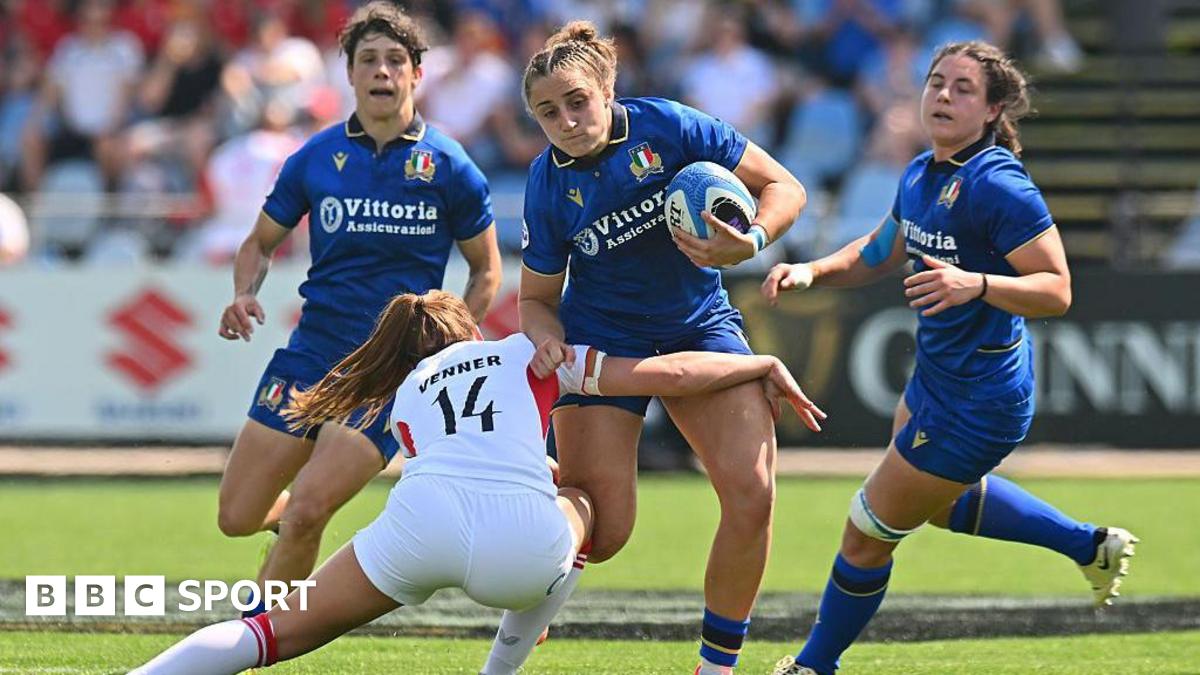
England beat Italy to set up Six Nations Grand Slam decider
Before last year's Women's Six Nations Grand Slam decider, England had conceded 29 points in four games.
The world champion Red Roses, who are on a record 37-game winning run, travel to Bordeaux on Sunday for this year's finale against France having conceded 76 points.
In their past two games, Wales and Italy - neither of whom reached the Rugby World Cup quarter-finals - scored nine tries between them, with both earning a rare try bonus point.
France, who scored 42 points but still lost last year's Grand Slam decider at Allianz Stadium, bagged 69 points on Saturday to punish Scotland's leaky defence.
England's attack remains slick and worthy of a fifth straight Grand Slam but their defence has come under scrutiny, giving Sunday's showdown a sense of jeopardy that few predicted at the start of the championship.
England started the campaign by conceding 12 points against Ireland at Allianz Stadium and seven against Scotland at Murrayfield.
Their defence remained hard to beat until injuries continued to mount for head coach John Mitchell, who was already without four World Cup winners because of pregnancy.
Thirty players have featured - five of whom have earned their first caps.
A shortage of locks has seen 19-year-old Haineala Lutui, usually a back rower for club side Loughborough Lightning, step into the second row, while flanker Abi Burton, who was capped last year, has also filled in out of position.
Nine of the forwards who played in the World Cup final were unavailable against Italy in Parma.
"We are going through a lot of changes and the players are still learning and growing," Mitchell said on Saturday.
"I am trying to explain to the younger players how important it [learning new positions] is, and they are only growing. They don't understand how important it is at this point in their careers."
It takes time to learn individual roles within a defensive system and mistakes have resulted in England conceding, on average, 4.8 more points per game and 0.8 more tries than in last year's campaign - which includes the epic 43-42 Grand Slam decider.
Before England's toughest fixture against their title rivals, missed tackles are up by 3.45 per game, while only 5.5 tackles per match have been dominant this campaign, down from 12.4 last year.
The improvement of the other teams in the championship has also played a part.
"We have conceded more points than probably we wanted to," said Burton.
"We just need to tighten up those little leaky holes that we had against Italy.
"We know that France are going to come at us in any which way, shape and form.
"Naturally when there is change, there will be more knowledge in some places than the others, so it about bringing everyone up to speed."
The Red Roses' defence, coached by former captain Sarah Hunter, may be down in the key scoreboard statistics, but it has improved in other areas.
Compared with last year's championship, England have conceded 1.3 fewer line breaks per game.
Ordinarily, conceding fewer line breaks should lead to fewer points being scored, but Mitchell's side have instead been punished for defensive lapses.
Debutant Haidee Head was too slow to react as Italy broke clear from a ruck to score their fifth try on Saturday, while their third score also came directly from a clean break at a breakdown.
Full-back Kayleigh Powell slipped through a number of Red Roses tackles to help set up Wales' fourth try in round three, while Rhona Lloyd streaked clear of Jess Breach to score Scotland's only try at Murrayfield.
Given France's ability to attack from deep, England will need to improve their scramble defence after line breaks.
Four-try Packer 'doesn't go away' as England set up Grand Slam decider
Attack the best form of defence?Les Bleues have conceded 49 points across four rounds - the best defensive record in this year's championship.
Usually, it is England, who have not been beaten in the tournament since 2018, topping the statistics heading into the Grand Slam decider.
Scrum-half Pauline Bourdon Sansus remains instrumental to France, joint-leading the combined standings for tries and assists, with seven in this year's championship.
Wales scrum-half Keira Bevan sniped and scored to exploit England's pillar defence around the ruck - an area Bourdon Sansus will certainly look to target after Italy also scored twice directly from breaks at the breakdown.
The 30-year-old, who is second for break assists with eight, remains a livewire in attack after starring for France across a number of campaigns.
Full-back Pauline Barrat trails only England star Ellie Kildunne for metres gained in the competition, with the pair the only players to have registered more than 400 metres.
The 21-year-old has made seven line breaks - four fewer than leader Kildunne - and tops the standings for break assists with 11.
If France are to exploit England's vulnerable defence, then Bourdon Sansus and Barrat could be the players to do so.
The electric pace of Lea Murie, who scored a stunning try against Scotland, could also be a major threat on the left wing - if given space.
For Mitchell's side, Kildunne, 26, continues to shine at full-back and on the left wing, where she has started two games.
Harlequins' Kildunne has made the most carries (58), gained the most metres (477), produced the most line breaks (11) and made the most offloads (10) in the competition.
With a large crowd expected at the 42,115-capacity Stade Atlantique, and given the history of the fixture, a high-scoring game that does not rely on watertight defence could suit both sides.
That would certainly favour Kildunne, who has scored three tries in this year's championship, and may also offer the Red Roses a way around their shaky defence amid ongoing personnel changes.
To play this video you need to enable JavaScript in your browser.This video can not be played
France hammer Scotland to go level on points with England