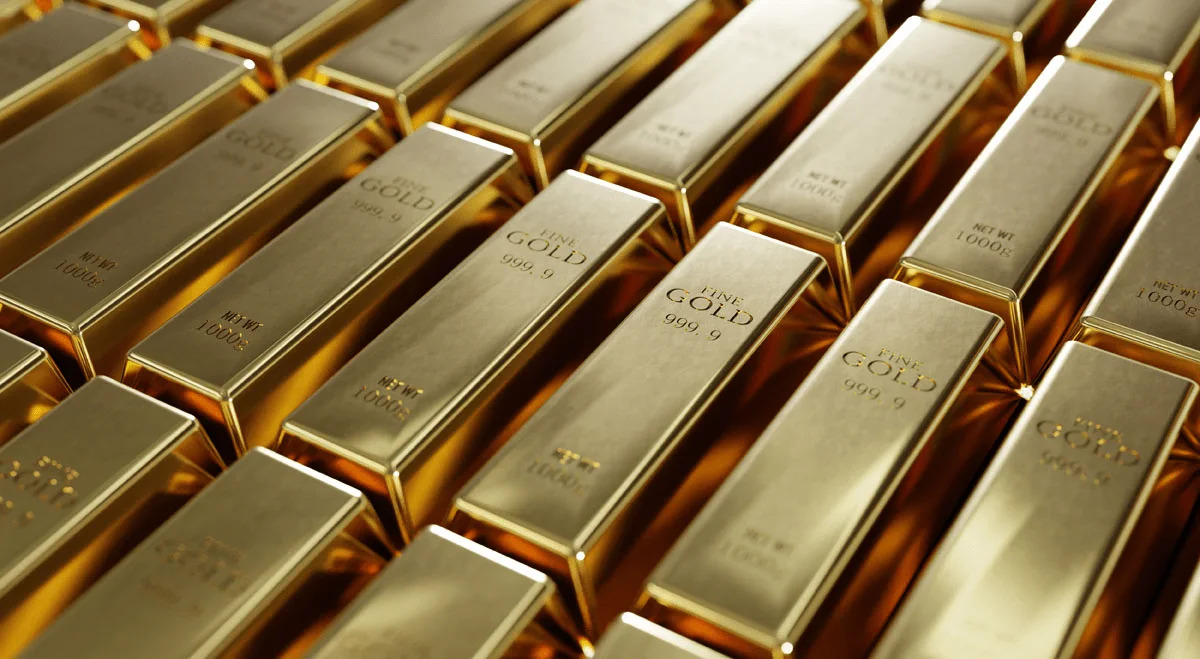
Gold Slips Below $4,050 as US Dollar Recovers, but Weekly Gains Remain Above 5% Fiona Craig Fri, November 6, 2026 at 5:26 AM EST 5 min read GC=F -0.93% DX-Y.NYB +0.41% SI=F -0.90% PL=F +0.07% Gold bars ©Adobe Stock Images Gold prices declined on Friday, November 6, as a recovery in the US dollar prompted investors to take profits following a strong rally driven by the US midterm election results and falling Treasury yields.
Spot gold fell 1% to $4,048.97 per ounce at 01:24 ET (06:24 GMT), while US gold futures declined 1.4% to $4,057.95 per ounce. Despite the retreat, bullion remained on course for a weekly gain exceeding 5%, supported by changing expectations for US fiscal policy and increased demand for safe-haven assets.
The US Dollar Index advanced 0.2% to 101.80, recovering some of its earlier losses and making dollar-denominated precious metals more expensive for buyers holding other currencies.
Selling pressure extended across the precious metals market as the dollar regained ground following its post-election weakness.
Silver fell 0.5% to $51.5215 per ounce, while platinum declined 0.6% to $1,510.78.
Spot palladium dropped 0.9% to $1,025.70 per ounce, while palladium futures lost 0.8% to $1,025.25.
Gold's decline followed a period of substantial gains, with the metal having traded near $4,090 per ounce during the recent rally.
The stronger dollar reduced demand from some international buyers, while profit-taking contributed to the retreat across precious metals.
Nevertheless, gold remained significantly higher for the week, reflecting continued investor interest in defensive assets amid heightened financial market volatility.
Gold's weekly advance followed the Democratic Party's victory in the US midterm elections, which resulted in the party gaining control of both chambers of Congress.
The political shift prompted investors to reassess the outlook for government spending, borrowing and fiscal policy under President Donald Trump's administration.
Expectations that a Democratic-controlled Congress could impose greater constraints on fiscal expansion contributed to falling US Treasury yields.
The decline in yields supported gold because the precious metal does not generate interest income, making it relatively more attractive when returns on government bonds decrease.
US Treasury yields fell to their lowest levels since early September as investors increased their holdings of government debt.
The dollar also weakened following the election results, providing additional support for bullion before Friday's modest recovery.
The rally in gold also coincided with a sharp decline in US technology shares, as investors reassessed the regulatory outlook for artificial intelligence companies.
Technology stocks extended their losses for a third consecutive session on Friday amid concerns that Democratic control of Congress could lead to stricter oversight of the sector.
Growing public opposition to the expansion of data centres, particularly because of their substantial electricity and water requirements, added to uncertainty surrounding future AI infrastructure investment.
The resulting decline in equity markets encouraged investors to seek comparatively defensive assets, including US government bonds and gold.
However, gold remained vulnerable to short-term selling as investors facing substantial equity losses liquidated other holdings to raise cash or meet financial obligations.
Such activity can temporarily weigh on bullion even when broader market uncertainty supports demand for safe-haven investments.
Analysts at ANZ said expectations of tighter fiscal constraints following the Democratic takeover of Congress had contributed to the decline in US Treasury yields.
Lower government borrowing requirements could reduce upward pressure on bond yields, potentially supporting gold by lowering the opportunity cost of holding a non-yielding asset.
However, the analysts also noted that reduced government borrowing could weaken one of the factors supporting demand for bullion.
Despite this potential limitation, physical gold demand remained strong, particularly among central banks seeking to diversify their reserve holdings.
ANZ highlighted the scale of recent official-sector purchases, stating:
"Central banks increased their reserves by a net 321 tonnes during the third quarter, marking the fastest pace of accumulation since late 2024."
The figures indicated continued institutional interest in gold amid geopolitical uncertainty and concerns surrounding fiscal discipline.
Central bank purchases have provided an important source of underlying demand, helping support the precious metal despite fluctuations in currencies, bond yields and equity markets.
Investors are now awaiting the latest US nonfarm payrolls report, scheduled for release later on Friday.
The employment figures are expected to provide fresh indications of the strength of the US economy and the potential direction of Federal Reserve interest-rate policy.
A stronger-than-expected labour market could reinforce expectations of tighter monetary policy, potentially supporting Treasury yields and the dollar.
Such an outcome could place additional pressure on gold, as higher yields increase the relative appeal of interest-bearing assets.
Conversely, weaker employment figures could strengthen expectations of a less restrictive monetary policy outlook, potentially supporting bullion.
The report will therefore be closely monitored for its implications for interest rates, currency markets and demand for precious metals.
Gold's decline below $4,050 represented a partial reversal of its recent gains rather than a complete change in the factors supporting the market.
The metal remained more than 5% higher for the week, benefiting from lower Treasury yields, political uncertainty and increased demand for defensive investments.
However, the recovery in the dollar and the possibility of further equity-market liquidations introduced additional near-term risks.
Investors will continue to monitor developments in US fiscal policy, the outlook for Federal Reserve interest rates and central bank demand.
The upcoming employment figures could prove particularly important in determining whether gold resumes its advance or experiences further consolidation following the week's substantial rally.