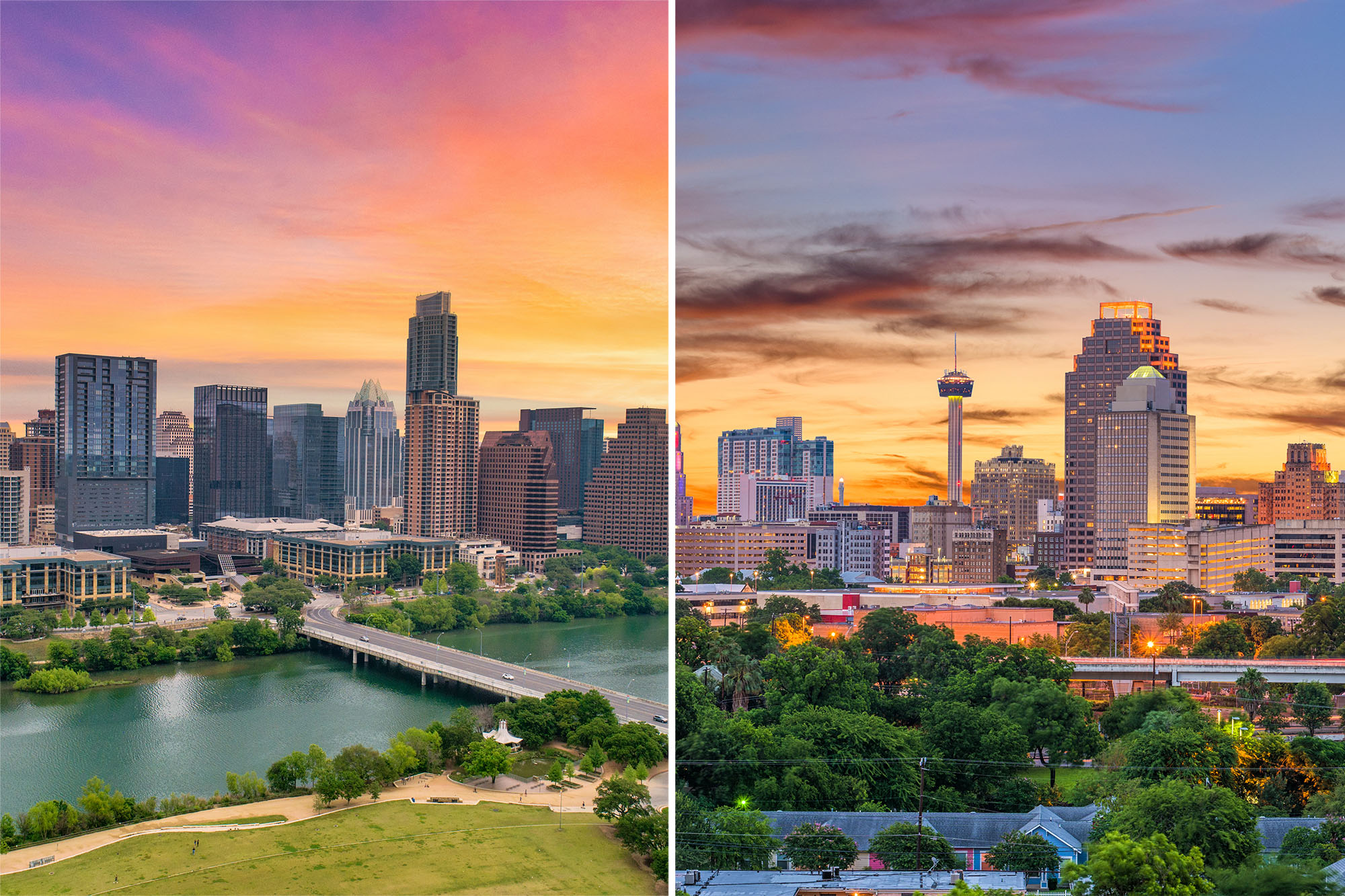
Homes in Austin are lingering on the market for the same number of days it took China to complete the world’s widest underwater roadway: 110.
Austin — Texas’ capital city, which became a popular destination during the pandemic years — took the top spot in a ranking of the slowest-selling metro areas, according to a new report from Clever Real Estate and Best Interest Financial looking at median days on the market.
San Antonio notched No. 2 with 109 days. Miami, another COVID-era hot spot, came in third with 105 days. Honolulu scored fourth with 100 days followed by Nashville with 97 days.
“The factors weighing most heavily on the slowest metros nationally are excess inventory from the pandemic-era building boom, higher insurance premiums and property taxes, and home prices outpacing local incomes,” Jaime Seale, the writer of the study, said.
Though North Carolina’s capital Raleigh didn’t make the top 10 slowest-selling list, it saw the biggest year-over-year change, with homes sitting on the market for a median 80 days, 30 days longer than the prior year. At the state level, homes sold the slowest in Montana, with a median 121 days on the market.
Clever, an agent-matching service, and Best Interest Financial, a mortgage provider and an affiliate of Clever, used real estate data from Redfin for the month of February.
The top 10 slowest real estate markets had an average of 98 days on the market versus 66 for the rest of the country. With 6.1 months of supply, their inventory dwarfed the national median of 3.9 months. Factors included high insurance premiums in coastal cities and Texas’ high property taxes, the report indicates. Sellers in the slow-selling markets were forced to adjust, reducing prices on 23% of their listings, compared to 17% nationally.
Redfin economic researcher Chen Zhao said that the top five loser markets tend have been “fairly weak housing markets.”
“The easiest way to sum it up is that they’re the ones where the number of sellers outnumber the number of buyers by the most in the country,” Zhao said. “And they’re the places that were oftentimes pandemic hot spots that got very expensive” and since have “seen a lot of price correction.”
In Austin, inventory ticked up to 5.8 months of supply, compared with the national median of 3.9 months, per Seale.
“Inventory is simply outpacing demand, and with 30% of homes selling at a reduced price, sellers are likely overestimating how much buyers are willing to spend and underestimating the amount of homes on the market,” she said.
Compass’ Michael Reisor, who has an office in Austin, in part attributed the lag in the city’s home sales time to prices recalibrating after a high during COVID.
“The struggle here is that in many cases, it’s less expensive to rent with current interest rates than it is to purchase,” he added. “For the buyers that truly want to buy, they are faced with ample selection and no real rush.”
Reisor said a three-bedroom, three-bathroom house at 7806 Beauregard Circle has been on the market for over six months “because while in a good area there was a lot of inventory to compete with.” The 1,534-square-foot, three-bedroom, two-and-a-half bathroom house, with a $499,900 asking price, is slated to close this week.
In San Antonio, the market decelerated 28 days year-over-year, per info from Seale.
“Months of supply sits at 6.2, and 32% of sellers had to reduce their price, the fifth-highest of any city,” Seale said. “Even with a median list price of $321,670, well below the national median [of] $458,710, listings are outpacing the number of buyers.”
From a broader perspective, Texas was the fifth slowing-selling state with homes remaining on the market for a median 91 days.
Miami’s 10.1 months of supply is the most in Florida and the second-most overall in the country, Seale said.
“The median home is listed at $580,000, 26% above the national median, but the median home sells for just 95% of its list price, tied for the lowest share of any city studied,” Seale said. “Florida’s broader slowdown is also driven by soaring insurance premiums and high HOA fees.”
Mark Heise put his Pinecrest house on the market in June 2024, and didn’t close on it until this past November and at a roughly 25% discount.
The five-bedroom, 5.5-bathroom house at 6424 Southwest 109th St. clocks in at over 5,000 square feet. It is roughly 12 miles from downtown Miami.
It initially hit the market in June 2024 for just under $5.5 million, and ended up selling for $4.1 million. “We got this offer,” Heise said. “We just couldn’t take it anymore.
Margaret Winders struggled to offload her Miami investment property in 2025.
Her tenants at 8101 Southwest 198th St. in Cutler Bay — about 30 to 40 minutes from downtown Miami — informed her in October that they were moving out at the end of their lease.
Winders said she immediately posted a for sale/rent sign in front of the 2,400-square-foot, three-bedroom, two-bathroom house, hired a Realtor and posted it on Zillow and on the MLS. Failing to sell it, Winders ended up renting it in March, after lowering the rent to $3,500 per month from $4,000 and forgoing the last month’s rent.
“I was asking initially for $750,000,” Winders said. “Then I lowered it to $730,000. I was about to lower it some more to $690,000, but then the renters came first and I didn’t want to wait.”
Honolulu had 7.7 months of supply, the third-most of the cities studied and roughly double the national median of 3.9 months, Seale said. Add to that a median list price of $685,000, much higher than the national median of $458,710.
“With insurance costs also running higher in coastal areas, Honolulu is simply out of budget for many Americans,” the study’s writer said.
At the very high end of the market in Hawaii, including Honolulu, Matt Beall, CEO at Hawai’i Life brokerage, said “days on market” is a reflection of timing. “Inventory is high, urgency is low and the right buyer may not have encountered the property yet,” Beall said.
He noted that the neighbor islands are “less sensitive” to days on market, “since much more of the real estate is acquired by off-island buyers, but in the high-end, it’s the same for Oahu.”
“Out-of-state buyers equals longer [days on market] since we’re waiting for buyers to arrive from afar, on their own schedule,” he added.
Hawaii ranks as the third slowest-selling state with homes hanging on the market for a median 104 days.
Nashville’s days on market increased 13 days from the year prior and the city’s 5.5 months of supply was 41% greater than the national median, Seale indicated.
“Although the median sale price of $495,000 isn’t too far off from the national median, with an inventory of 5.2 homes per 1,000 residents — versus 3.67 nationally — there are not enough buyers to keep up with the surplus of homes,” the writer said.
Compass’ Jamie Parsons, attributed Nashville’s presence on the loser list to the market normalizing “after several years of unsustainable acceleration” during the pandemic.
“Another factor for some homes lingering on the market,” Parsons added, “is that they are highly customized, rural or positioned at aspirational prices.”
Examples include musician Robin Crow’s Dark Horse Estate, home to a music studio where artists including Taylor Swift and Neil Diamond have worked, priced at $24 million and on the market for 276 days; and the penthouse at the Four Seasons Residences, with a deep outdoor deck running the full length of the condo unit, listed at $33.5 million and on the market for 129 days. At its current price, the unit, owned by celebrity agent Chris Cortazzo, would be the most expensive condo ever sold in Nashville.
“Aside from a smaller buyer pool due to the price alone, both are one-of-one residences that require a specific buyer, which naturally takes longer,” Parsons said of her listings. “This is just two of many luxury properties on the market which all drive up the days on market metrics.”