Amazon/Nishka Dhawan Being proactive about your home’s electricity doesn’t necessarily make you a doomsday prepper — it just makes you a smart person.
Power outages, especially temporary ones, aren’t all that uncommon in rural, suburban and urban areas. So having a backup source of power when your home’s main energy supply isn’t available can give you real peace of mind and a sense of security.
A solar-powered generator is an excellent way to get reliable electricity in case of an emergency.
According to Chris Giallanza, a merchant at The Home Depot and expert on generators, “One of the biggest benefits is the portability that comes with battery power compared to gas.”
“Solar generators can be used indoors for portable power and emergency backup because they don’t produce dangerous emissions,” Giallanza told the New York Post.
David Wray, an engineer and YouTube reviewer who specializes in portable power solutions, told us that solar generators tend to be more expensive than gas-powered generators. “But they’re silent, or nearly so, which is extremely helpful especially when using them in a campsite setting where there are rules against noisy gas generators,” said Wray.
Solar-powered generators can be quite portable, so you can take them with you on a camping trip or to an outdoor party. You can also choose a larger one to function as an emergency supply in case of a power outage. Just note that not all generators come with solar panels, so depending on the model you choose, you may have to buy solar panels separately.
To help you find the best solar-powered generator, Wray and Giallanza rounded up the top models across multiple categories. Check out their FAQ for additional tips on finding the best generator for you.
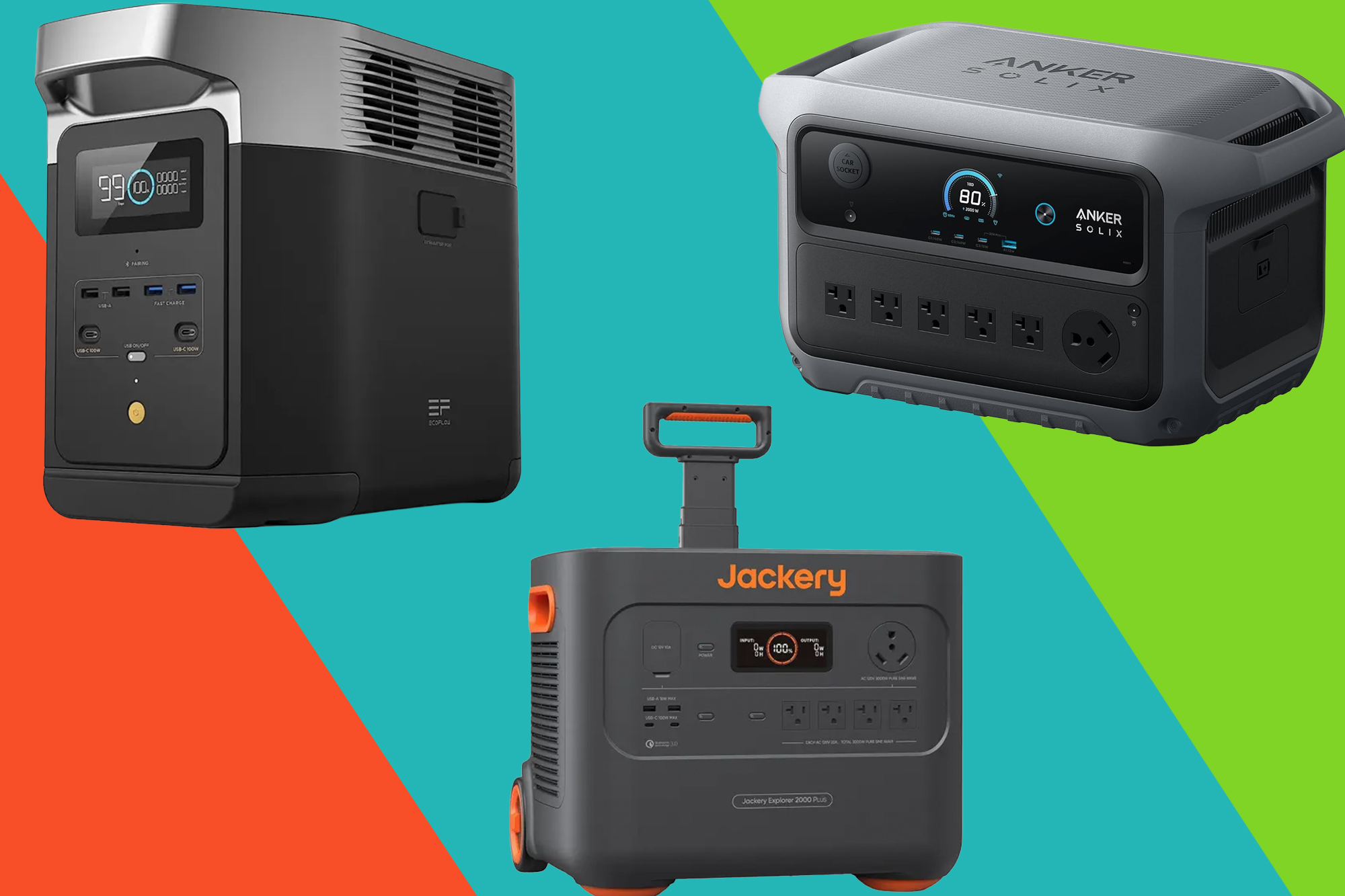
Amazon Pros: Cons: Six easy-to-access outlets Both USB-C and USB-A ports (with some fast charge options) Charges quickly through AC input (80 minutes for full battery) Internal cooling fan can become loud, according to some reviewers Wray recommended this as the top choice because he said its manufacturer has an “excellent track-record for support and built-quality.” When you’re investing in a device that you plan to rely on for something as essential as electricity, you definitely want to prioritize trustworthy brands.
While this generator is small and lightweight enough to take with you on outings — it’s a little smaller than a desktop computer tower and weighs 27 pounds — you can buy additional batteries to increase its capacity and even connect it to your home’s power grid to act as a backup power source. If you want a generator that meets your small-time needs right out of the box, and can be expanded into a larger generator system in the future, you can’t go wrong with the DELTA 2.
Output: 1,800W AC output; 2,700W surge | Number of AC outlets: 6| Battery Capacity: 1,024Wh
According to Wray, this generator “has all the features that most people would find desirable,” which include a rugged build, relatively quick charging times (3–4 hours via solar panels, about 100 minutes via AC input) and the ability to expand its capacity by connecting to additional PECRON batteries.
Part of that durability includes a lithium iron phosphate battery, which generally has a better safety profile than lithium ion batteries and can be fully emptied and recharged over 3,500 times before losing a noticeable amount of its maximum capacity. Plus, you can save money on additional batteries and solar panels by bundling them with your order — which is great if you’re starting from scratch.
Output: 2,200W AC output; 4,400W surge | Number of AC outlets: 3| Battery Capacity: 1,536Wh
Amazon Pros: Cons: Quick solar charge option recharges the battery in 2 hours Built-in wheels and pop-up handle for improved mobility Retailer bundle deal includes two solar panels USB outlets don’t include fast charge option “Jackery continues pushing the bounds of gas generator replacement with some of its newer models, including this 3,000-watt monster,” said Giallanza. “The Explorer 2000 Plus outlasts most other models on the market with 4,000 battery cycles thanks to more advanced lithium iron phosphate battery technology. Add to that fast-charge capability and a sleek telescoping handle for easy maneuverability, and there’s not much this model can’t do.”
In addition to promising thousands of charge cycles, the battery is also rated to last for 10 years, so you won’t have to worry about replacing it. If you want to grow your generator’s capacity, you can pick up extra batteries at any time and quickly connect them to the Explorer 2000 Plus.
Output: 3,000W AC output; 6,000W surge | Number of AC outlets: 5| Battery Capacity: 2,042.8Wh
If you’re ready to invest in a generator for your home, this BLUETTI model is a safe choice. You can connect it to both your home’s solar panels and electrical grid, then choose to charge it either way. Wray recommended this model because it offers the trifecta of a large output, a large solar panel input (meaning it takes advantage of your home’s full solar panel grid), and an expandable capacity of nearly 20,000 watt-hours.
Another reason to consider this BLUETTI is that it helps you save money over time by letting you sell back excess energy to your power company. You can even save money daily by setting it to turn on during peak energy usage times (such as mornings and evenings) so you end up using the generator’s power and avoid paying elevated rates from the power company.
Output: 7,600W | Number of AC outlets: N/A; home backup system| Battery Capacity: 9,920Wh
Amazon Pros: Cons: Ability to recharge at electric vehicle (EV) charging stations Option to expand output to 25,000Wh with additional batteries Takes less than 3 hours to recharge battery through AC power Requires purchase of additional batteries to reach home output capacity If you want a generator to use both on-the-go and for powering your home in emergencies, this expandable option is just what you need. On its own, it has a sizable 3,600W capacity that’s more than enough for powering small devices and power tools. When you connect it to your home’s power system, along with extra batteries, it transforms into a backup generator that will keep appliances in your home humming during an outage.
“Portable battery home backup is a relatively new concept, and this EcoFlow DELTA Pro is ahead of its time,” said Giallanza. “Powered by advanced lithium iron phosphate battery technology, the DELTA Pro will last for more than 6,000 battery cycles before the performance is impacted.” That means you can trust this device for years and years to come.
Output: 3,600W AC output; up to 4,500W with X-Boost | Number of AC outlets: 5| Battery Capacity: 3,600Wh
Amazon Pros: Cons: Built-in wheels and extendable handle for improved mobility Includes options for solar, AC and wind power inputs Low battery protection mode prevents generator from losing all power after extended use Heavy weight (120 pounds) may require multiple people to move With this generator, you don’t have to give up the comforts of modern living when you go outside. “This is perfect for spending time outdoors,” said Giallanza.
Use it to power multiple devices at once through an array of AC and USB outlets. That includes automatic air mattress pumps, portable stoves and any other gadgets you like to bring with you. Plus, if you’re worried about running out of energy, you can easily connect it to Nature’s Generator Power Pods and have access to an even larger power supply.
For $500 more at The Home Depot, you also get a set of solar panels. “The heavy-duty solar panels included in the $1,500 price tag is what sets this model apart,” said Giallanza.
Output: 2,880W AC output; 3,600W surge | Number of AC outlets: 3| Battery Capacity: 1,200Wh
Another portable pick, Anker’s Solix works when you’re on the go, but also packs enough of a punch to function as an easy-to-use home backup. It’s just about 42 pounds and is surprisingly small, also making it easy to store when not in use.
It fully charges in just 58 minutes, according to the brand, and can boost multiple outlets at once, which is why it’s a great pick for your next RV adventure.
Output: 2,400W AC output; 4,000W surge| Number of AC outlets: 5| Battery Capacity: 2,048Wh
“The primary use cases are camping, RV-ing, van life and emergency home backup power,” Wray said.
Even if you don’t see yourself falling into one of these categories, if you can think of any times when you would appreciate having access to portable and reliable power — maybe while tailgating, hosting a backyard movie night or playing music at an outdoor event — then you could definitely benefit from investing in a portable solar-powered generator.
If you’re interested in adding a backup or emergency power source to your home, you’ll want to go for one of the larger, non-portable generators. As Wray pointed out, these are best as short-term solutions for small-scale needs such as keeping the lights and refrigerator on, and powering your portable devices.
Ask yourself two questions to help you decide which solar-powered generator to buy:
To accurately calculate these numbers, Wray recommended getting a watt meter and plugging your devices into it one at a time and leaving them plugged in for the typical amount of time you would use that device. So you may leave your cell phone plugged in for two to four hours to get a full charge, and for an appliance such as your fridge, you would leave it plugged in for 24 hours to understand how much power you need to keep it running for a full day.
However, if you don’t have time for that, you can use an online calculator that lets you easily add devices and choose how long you want to run them for. You’ll then get an estimate of how many watt-hours you need to run all the devices you entered. From there, just make sure the generator you buy has a watt-hour amount that at least meets that amount.
“Some additional features like wireless charging, UPS mode, mobile app support and longer warranties offered by more established brands might be things to consider if those are important to you,” Wray said. “But personally, I consider these nice to have and not necessarily need to have.”
“The major area where portable power stations differ is battery chemistry,” said Wray. Most generators use one of two kinds of lithium ion batteries: LFP batteries that contain lithium iron phosphate, and NMC batteries that contain nickel manganese cobalt.
“NMC chemistries offer a somewhat lighter-weight product as compared with their LFP counterparts of equivalent capacity,” Wray said. “However, NMC chemistries have a much shorter service life, typically 600 to 1,000 full cycles, after which they retain approximately 80 percent of their original capacity.” That means that after fully draining and charging the battery hundreds of times, it won’t be able to charge to 100 percent.
“In comparison, LFP chemistries typically have a service life of 2,500 to 3,500 full cycles, after which they retain approximately 80 percent of their original capacity.”
Wray also pointed out that in the case of malfunction, an LFP battery will likely be safer than an NMC battery. “LFP cells are far more likely to just produce a lot of smoke and localized heat, whereas NMC cells can erupt into a volatile fireball. This is quite rare, of course, but it’s something one should carefully consider.”
While your needs will determine which features make certain generators more or less attractive, Wray and Giallanza suggested using these three aspects to guide your shopping:
Durability: If you want to be able to move your generator easily and often, choose one with a rugged exterior that stands up to some banging around as well as diverse weather conditions.
Charge Time: Charge time is crucial, especially in an emergency. Look to see how fast the battery generator charges to 80-percent capacity when plugged into the wall and when connected to different-sized solar panels in full sun.
Capacity expansion: Most generators can be bought with additional batteries to connect them to and increase their power storage and output capacities. This is important if you think your power needs may grow over time or if you want a generator that you can use both remotely and plug into a larger power network at home.
“Some portable power stations are more weather-resistant than others but none are truly ‘waterproof,’ so they should be kept as dry as possible,” said Wray.
Wray also advised that when you’re charging your generator with solar panels, make sure to never use solar panels that exceed the maximum input voltage for your generator. “All power stations should publish an input voltage range,” Wray said. “So you would never want to connect a solar panel that outputs at 45 volts if your power station has a voltage input maximum of less than 45 volts.”
Giallanza also advised that you don’t operate a solar-powered generator in the rain or while standing in water. “Wet conditions can damage exposed areas, particularly electrical components, and render the unit inoperable,” he said.
According to Wray, generators should be kept in a dry place with a temperature range that’s comfortable to people. However, he said most generators can tolerate temperatures from -4ºF to 113ºF while not in use without being damaged.
“For long-term storage, you should try to keep these units at about a 50 to 60 percent state of charge to maximize their long-term battery capacity life,” Wray said. “But even storing them at 100-percent charge will have only a relatively minor impact on long-term capacity life.”
“With daily use, fully discharging and recharging every day, one can expect around a 10-year service life from units with LFP chemistry and around 3 to 4 years with NMC chemistry,” said Wray. “Under more casual or periodic use, you could reasonably expect to get much longer service life.”
To keep your generator operating at its best, most manufacturers also recommend that you recharge it at least once every three to six months and avoid leaving it at 0-percent charge for extended periods of time.
For over 200 years, the New York Post has been America’s go-to source for bold news, engaging stories, in-depth reporting, and now, insightful shopping guidance. We’re not just thorough reporters – we sift through mountains of information, test and compare products, and consult experts on any topics we aren’t already schooled specialists in to deliver useful, realistic product recommendations based on our extensive and hands-on analysis. Here at The Post, we’re known for being brutally honest – we clearly label partnership content, and whether we receive anything from affiliate links, so you always know where we stand. We routinely update content to reflect current research and expert advice, provide context (and wit) and ensure our links work. Please note that deals can expire, and all prices are subject to change.
Check out New York Post Shopping for more content.