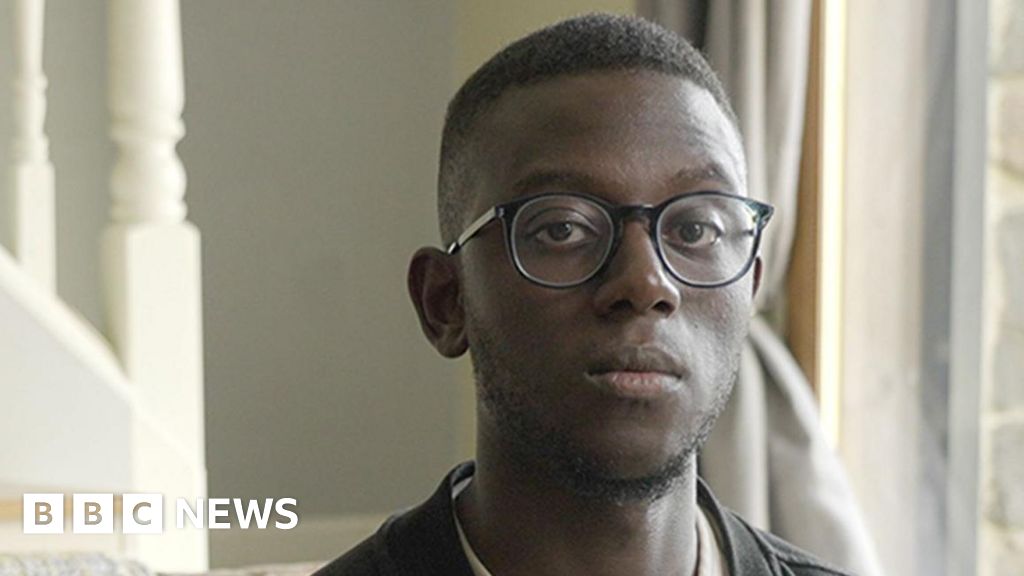
ShareSaveAdd as preferred on GoogleAsha PatelandIsaac Ashe,East MidlandsBBCElias Calocane, the brother of Nottingham attacks killer Valdo Calocane, told the Nottingham Inquiry he believed his brother would take is own lifeThe brother of the Nottingham attacks killer has said he feared Valdo Calocane was going to take his own life, a public inquiry has heard.
Calocane, who was diagnosed with paranoid schizophrenia in 2020, stabbed to death Barnaby Webber, Grace O'Malley-Kumar and Ian Coates in Nottingham on 13 June 2023.
His younger brother Elias Calocane had received a number of messages from Calocane, expressing thoughts of violence and "red rum" - a reference to murder - in 2020, before Calocane's first admission to hospital.
On Wednesday, Elias told the Nottingham Inquiry he believed his brother's messages were about harming himself, and said he felt "powerless" when it came to his brother's mental health.
The inquiry heard Calocane - who also seriously injured three others in the attacks across the city - started to become unwell while he was a student at the University of Nottingham, and was eventually diagnosed with paranoid schizophrenia in July 2020.
Following Calocane's first admission to a psychiatric ward in May 2020, Elias compiled a document of interactions between him and his brother from as early as 2017.
Elias said he hoped the document would have "helped" doctors treating his brother.
That document included a series of messages between the brothers, in which Calocane described hearing voices and saying he wanted to "harm, permanently".
Elias said he believed in that conversation, Calocane was referring to harming himself, rather than others.
He told the inquiry he started taking notes about his interactions with Calocane because he "didn't know what else to do".
The inquiry heard Elias was never contacted by mental health professionals about the document, which he believed had been "lost in the ether".
Elias told the inquiry he saw his brother twice between January 2020 and June 2023 - once in 2020 and once in 2022.
He told the inquiry he had tried to reason with his brother's delusions about being monitored and hearing voices, but "struggled" with their relationship.
Elias held back tears as he said: "I guess I can say more confidently looking back, but part of this was a defence mechanism on my part, of dealing with a loss ahead of time, if that makes sense.
"I thought that - and I explained this to people - that every time mum called me during that period, I thought it was going to be... um, yeah, I just found it really hard."
He added there was a "sense of hopelessness that comes with all of this", and that he did not really know what was going on.
Watch: 'I felt powerless', brother of Nottingham triple killer saysElias said he had to wait for something to happen, and hoped it would not be that bad.
"I couldn't see another way out," he said. "I just didn't know what to do about it. I felt powerless."
Elias told the inquiry he only learned of his brother's paranoid schizophrenia diagnosis in October 2023, four months after the killings.
The families of the bereaved shook their heads in disagreement as Elias gave evidence about his knowledge of his brother's illness.
Listen to BBC Radio Nottingham on Sounds and follow BBC Nottingham on Facebook, on X, or on Instagram. Send your story ideas to eastmidsnews@bbc.co.uk or via WhatsApp on 0808 100 2210.