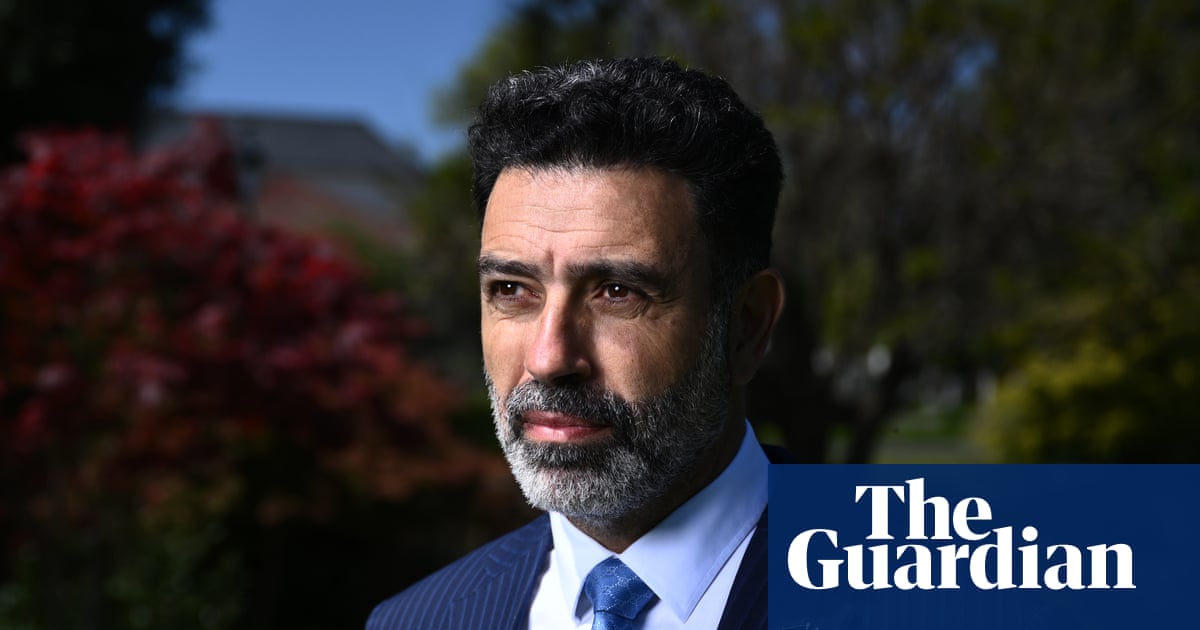
The Australia Palestine Advocacy Network president, Nasser Mashni, said it was vital in a democracy to be able to criticise the policies of the Israeli government without that criticism being equated with antisemitism. Photograph: Joel Carrett/AAPView image in fullscreenThe Australia Palestine Advocacy Network president, Nasser Mashni, said it was vital in a democracy to be able to criticise the policies of the Israeli government without that criticism being equated with antisemitism. Photograph: Joel Carrett/AAPPalestinian peak body refused leave to appear at royal commission on antisemitism and social cohesion Australia Palestine Advocacy Network says criticism of Israel is routinely misrepresented as antisemitic – and that Palestinian voices are being excluded from debate
Get our breaking news email, free app or daily news podcast
Palestinian voices are being excluded from the debate on social cohesion, the peak body for Palestinians in Australia has said after it was refused leave to appear before the royal commission on antisemitism and social cohesion.
The Australia Palestine Advocacy Network (Apan) made detailed submissions on the issues of antisemitism – including how it is defined – as well as on racism and social cohesion, but was told it did not have a “direct and substantial” interest in the public hearings, which are under way in Sydney.
“Excluding voices from the Palestinian community increases the very real probability of producing an incomplete and polarising account of the rise in antisemitism,” Apan told the Guardian.
The network said it was deeply concerned that the inquiry would rely heavily on submissions “equating criticism of Israel, Zionism, and Israel’s actions in Gaza with hatred of Jewish people, without rigorous inquiry”.
Apan said criticism of Israel was routinely misrepresented as antisemitic. “The definition of antisemitism is distorted and weaponised in attempts to silence those who criticise Israel,” it said.
Read moreThe inquiry’s first block of hearings, currently before commissioner Virginia Bell, is focused on defining antisemitism, its historical and contemporary manifestations, and its current impact on Jewish Australians.
Apan’s 259-page submission to the commission included testimony from professors Ilan Pappe, Shaul Magid and Noura Erakat, experts on Middle Eastern history, Judaism and international law, based in the UK and US.
The Apan submission argued antisemitism was often conflated with anti-Zionism, which it said was counterproductive to tackling antisemitism, and delegitimised criticism of Israel’s policies and actions.
“The conflation is also harmful to Jewish Australians because it diverts attention from bona fide examples of antisemitism.”
On Monday the research director for the Executive Council of Australian Jewry, Julie Nathan, told the commission criticism of Israel was not inherently antisemitic, “even though a lot of it is incredibly offensive”.
Nathan said pro-Palestinian protest material, such as posters and stickers, were not inherently antisemitic, but could be considered examples of Jew hatred dependent on context.
Apan formally sought leave to appear before the commission’s public hearings.
The solicitor assisting the commission responded, telling Apan: “the commissioner is not satisfied that APAN has a direct and substantial interest in the scope of the hearing and has refused APAN leave to appear at Hearing Block 1”.
The commission confirmed to the Guardian that Apan had applied to appear at hearing block 1, but that leave was not granted.
“Applications are considered and determined on a case-by-case basis having regard to the royal commission’s practice guideline,” the commission said in a statement.
Apan will be given the opportunity to respond in writing at the end of hearing block 1.
“We are profoundly disappointed by this decision,” Apan’s president, Nasser Mashni, said.
“The Australian Palestinian community and its allies deserve the same democratic access as any other group.
Read more“Excluding our voices at a time when Palestinians face a surge in racism and vilification – as documented by the recent report from our anti-Palestinian racism register – sends a devastating and deeply alienating message about who belongs and who doesn’t and whose suffering counts and whose doesn’t. This is entirely inconsistent with and counterproductive to calls for social cohesion.”
Mashni said it was vital that people living in a democracy such as Australia were able to criticise the policies of the Israeli government and the actions of the Israel Defense Forces if they chose to, without that criticism being equated with antisemitism or hatred of Jews.
“The refusal to hear evidence that distinguishes anti-Zionism from antisemitism creates the very real risk of turning this [royal commission] into a one-sided process rather than a genuine inquiry, with very serious ramifications for those who have been excluded, and more broadly, for the Palestinian struggle for liberation.”
The first week of hearings heard testimony from several witnesses – including from Jewish groups such as the Executive Council of Australian Jewry – that being Jewish in Australia was being unfairly conflated with support for the actions and policies of the government of Israel.
Hearing block 1 has run ahead of schedule, with some hearing days vacated.
Hearing block 2 will begin on 25 May and will examine the circumstances surrounding the terror attack at Bondi beach on 14 December.