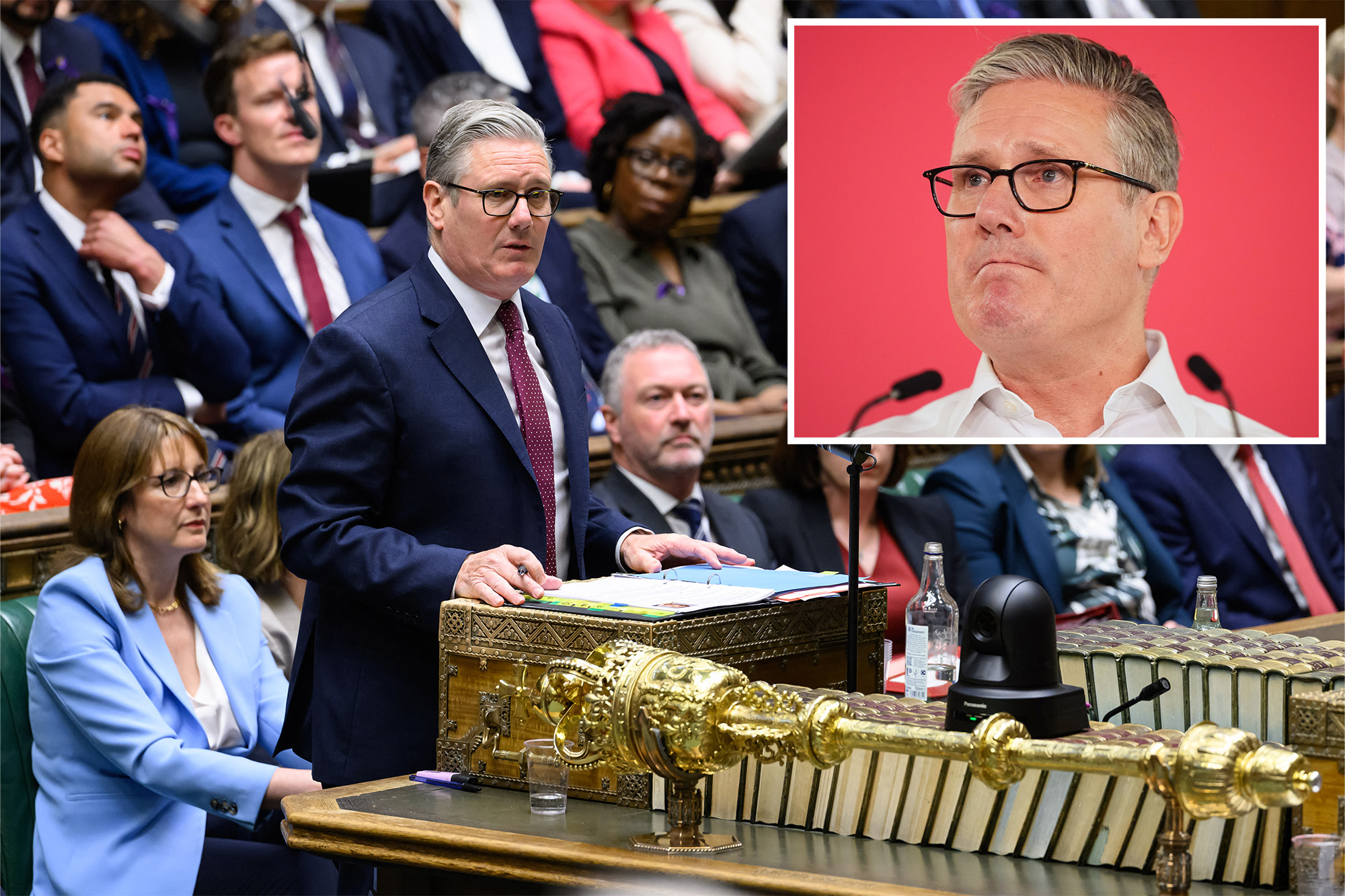
British Prime Minister Keir Starmer is facing a revolt within his own party — following political turmoil over his falling popularity that could result in the UK seeing its fifth leader in just seven years.
Starmer, 63, whose Labor Party suffered major losses in last week’s local and regional elections, has seen his allies turn against him and call for his resignation to allow a new successor to rescue the ailing party.
So far, however, no successor is openly challenging him — and so he has refused calls to resign.
Should Starmer succumb to the opposition from ally and foe alike, his name would go on a growing list of unpopular PMs who were quickly ousted from leadership of the world’s fifth largest economy.
Former PM David Cameron, who served from 2010 to 2016, is so far the only leader in the last decade who has served longer than three years.
While the prime minister appeared to stave off immediate challenges during a tense cabinet meeting on Tuesday, his position remained rocky as several of his ministers resigned — and urged Starmer to do the same to save the Labor Party.
“It is clear from recent days that the public across the UK has now irretrievably lost confidence in you as prime minister,” Zubir Ahmed, the latest of four junior government ministers to leave on Tuesday, wrote in his resignation letter to Starmer.
A defiant Starmer, who has repeatedly rejected calls for his resignation, said he would not quit on Tuesday and slammed lawmakers for over the latest challenge against him.
“The past 48 hours have been destabilizing for government, and that has a real economic cost for our country and for families,” his office said in a statement.
“The country expects us to get on with governing. That is what I am doing and what we must do as a cabinet,” Starmer added.
Starmer is only the latest British PM to face pressure to resign, with the premier under fire for failing to address the UK’s ailing economy, where inflation has been stuck at or above 3% for the last year and growth is stagnant.
Starmer is also under heavy scrutiny for his controversial appointment of Peter Mandelson to the UK’s ambassador to Washington — despite the diplomat’s intimate friendship with convicted pedophile Jeffrey Epstein.
Starmer has only been in power for about as long as his predecessor, Rishi Sunak who became the prime minister in 2022 after months of political upheaval in the UK.
Sunak, a multimillionaire who helmed the British Treasury, was booted in 2024 after his Conservative Party suffered heavy losses to Starmer’s Labor party, ending Conservatives 14-year rule in the UK.
Sunak spent only 20 months in charge and was blamed for the UK’s economic turmoil and growing inflation, with the former hedge-fund boss leaving with an apology.
But much like Starmer, Sunak had inherited the ailing economy from the tumultuous years marked by his predecessors, Liz Truss and Boris Johnson, in the wake of Britain’s controversial move to leave the European Union.
Truss resigned on Oct. 20, 2022 after just 45 days in office, marking one of the shortest tenure of any prime minister in the UK’s history.
Truss lost immediate trust from the public and lawmakers after she was forced to make a U-turn on her promises to cut taxes and promote “trickle-down economics,” the implementation of which caused an immediate shock to the market.
Truss’ chaotic exit came just after Britain a whirlwind of political upheaval in the final years of Johnson’s rule, which were marred by ethics investigations.
Johnson, who was propelled to leadership in 2019 after the largest showing for the Conservative Party in nearly four decades, stepped down after a series of controversies eroded trust in his leadership, including the “Partygate” lockdown scandal.
The scandal saw Johnson enjoy a large party despite the strict COVID-19 lockdowns that were in place at the time for everyone else.
Johnson also faced pressure over the cost-of-living crisis spurred by the pandemic, as well as his handling of sexual misconduct claims against a top political appointee.
Johnson at his exit stood in stark contrast to the man who helped lead the ousting of former Prime Minister Theresa May in 2019 and force through Britain’s exit from the EU with the Brexit rallying cry.