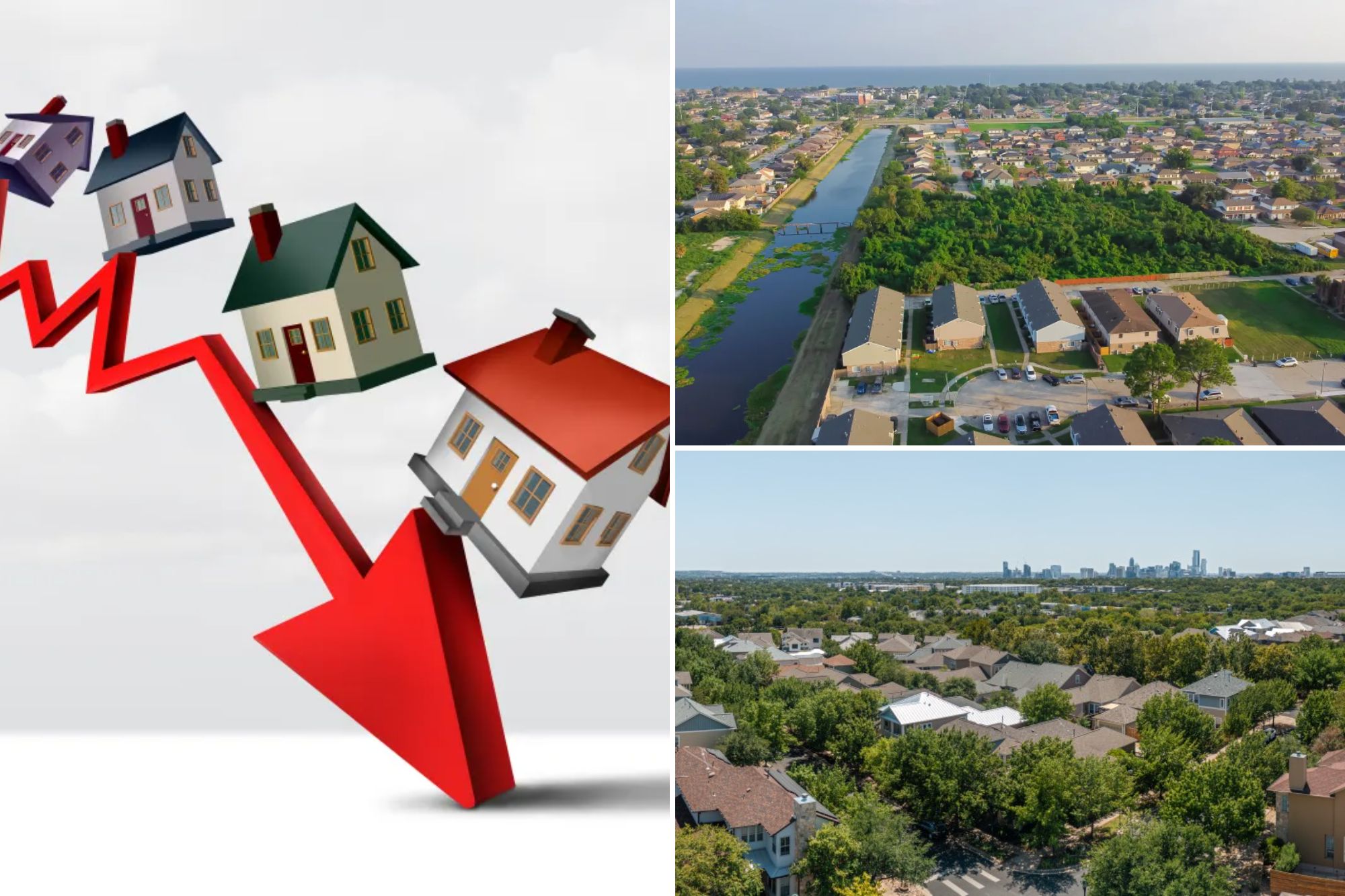
A bombshell new forecast from Zillow finds more than one in three American housing markets heading into decline over the next year — and the cities taking the hardest hits are the ones that seemed untouchable just four years ago.
Of the 894 housing markets Zillow tracks, prices are expected to fall in 309, hold flat in just 14 and rise in 572 through March 2027.
Nationally, Zillow now projects home prices will go nowhere over that stretch — a sharp downgrade from last month’s prediction of a 0.5% gain.
The flat national number is the least important part. What matters is what’s happening underneath it.
The pandemic-era boomtowns of the Sun Belt and Gulf Coast are cratering. Overlooked mid-size cities in the Midwest and upstate New York are surging. And millions of American homeowners are about to find out which side of that divide their ZIP code sits on.
The steepest projected decline belongs to Houma, Louisiana, a city about an hour southwest of New Orleans, where prices are forecast to fall 7.0% over the next year. Lake Charles, Louisiana follows at 5.6%; then Austin, Texas at 4.6%; New Orleans at 4.4%; and Shreveport at 3.6%. Denver is down 3% in the forecast. California markets from Chico to Vallejo aren’t far behind.
The Louisiana numbers are staggering but not surprising to anyone who has watched what’s happened to the cost of actually owning a home there. The average homeowner’s insurance premium hit $10,964 in Louisiana in 2024 — and in 30 to 40% of Louisiana mortgage transactions, deals are now collapsing entirely because of insurance costs alone.
In Houma specifically, 99% of properties face a risk of severe flooding over the next 30 years, with that risk rising faster than the national average. Buyers have done the math and walked away.
In New Orleans, a median-priced home that cost roughly $1,400 a month with 20% down and average insurance in 2020 now runs $2,154 a month. A family that needed $57,000 in annual income to afford that home six years ago now needs more than $86,000 — well above the metro’s median household income of $61,602.
No market illustrates the scale of the reversal more brutally than Austin.
Between 2020 and 2022, Austin’s median home price rocketed from $325,000 to a peak of $550,000 — a gain of nearly 70% in two years. Then came the steepest single-year correction in the market’s recorded history: a 15.5% plunge in 2023, followed by further declines in 2024 and 2025. The city, which is the capital of Texas, notoriously overbuilt housing during the COVID-19 years.
The city that remote workers, California transplants and Elon Musk’s Texas empire supercharged is now the slowest major housing market in the country.
Redfin data shows Austin carrying 128% more sellers than buyers, with homes averaging more than 90 days on the market. With Zillow valuing the typical Austin home at roughly $508,500, the projected additional 4.6% decline would erase more than $23,000 in value.
Redfin chief economist Daryl Fairweather has been tracking a historic imbalance building across the country. In February 2026, there were approximately 630,000 more home sellers than buyers — the largest gap Redfin has recorded since it began keeping that data in 2013. The seller surplus hit 46.3%, up sharply from 29.8% just a year earlier.
Prices are falling, she said, in places “where sellers outnumber buyers.”
In the South, builders flooded the zone with new supply during the pandemic and now those homes sit unsold while buyers are crushed by mortgage rates, soaring insurance premiums and property taxes that spiked alongside pandemic-era valuations.
While the Sun Belt bleeds, a string of unglamorous, affordable cities across the Northeast and Midwest are quietly becoming the hottest housing markets in the country.
Syracuse, New York leads the entire nation in Zillow’s forecast with a projected 5.0% gain. That city is followed by Rockford, Illinois and Atlantic City, both at 4.5%. Meanwhile, also in Rust Belt New York, there’s Rochester at 4.0% and Utica at 3.5%.
Syracuse is being transformed by something Austin briefly had before losing it — a genuine, durable economic catalyst.
Micron Technology’s planned semiconductor megafab in Central New York is expected to bring more than 100,000 workers earning six figures into the region. Syracuse home prices were already up 27.9% year-over-year as of March 2026, selling for a median of $179,000 — a fraction of what a buyer would pay in Austin or Denver today.
Rockford, Illinois — a manufacturing city of about 147,000 people anchored by employers including Collins Aerospace, Stellantis and UPS — tells a similar story.
Despite a rolling median price now above $236,000, Rockford remains nearly 65% cheaper than the national median, and the city has drawn buyers from Chicago suburbs and across the country looking for more house for their money.
“While buyers are priced out of the market in various major cities, Rockford’s affordability is still a strength,” Conor Brown, CEO of the NorthWest Illinois Alliance of Realtors told local station WTVO Rockford. “Our prices are reasonable, and that continues to draw buyers from the Chicago suburbs and around the country.”