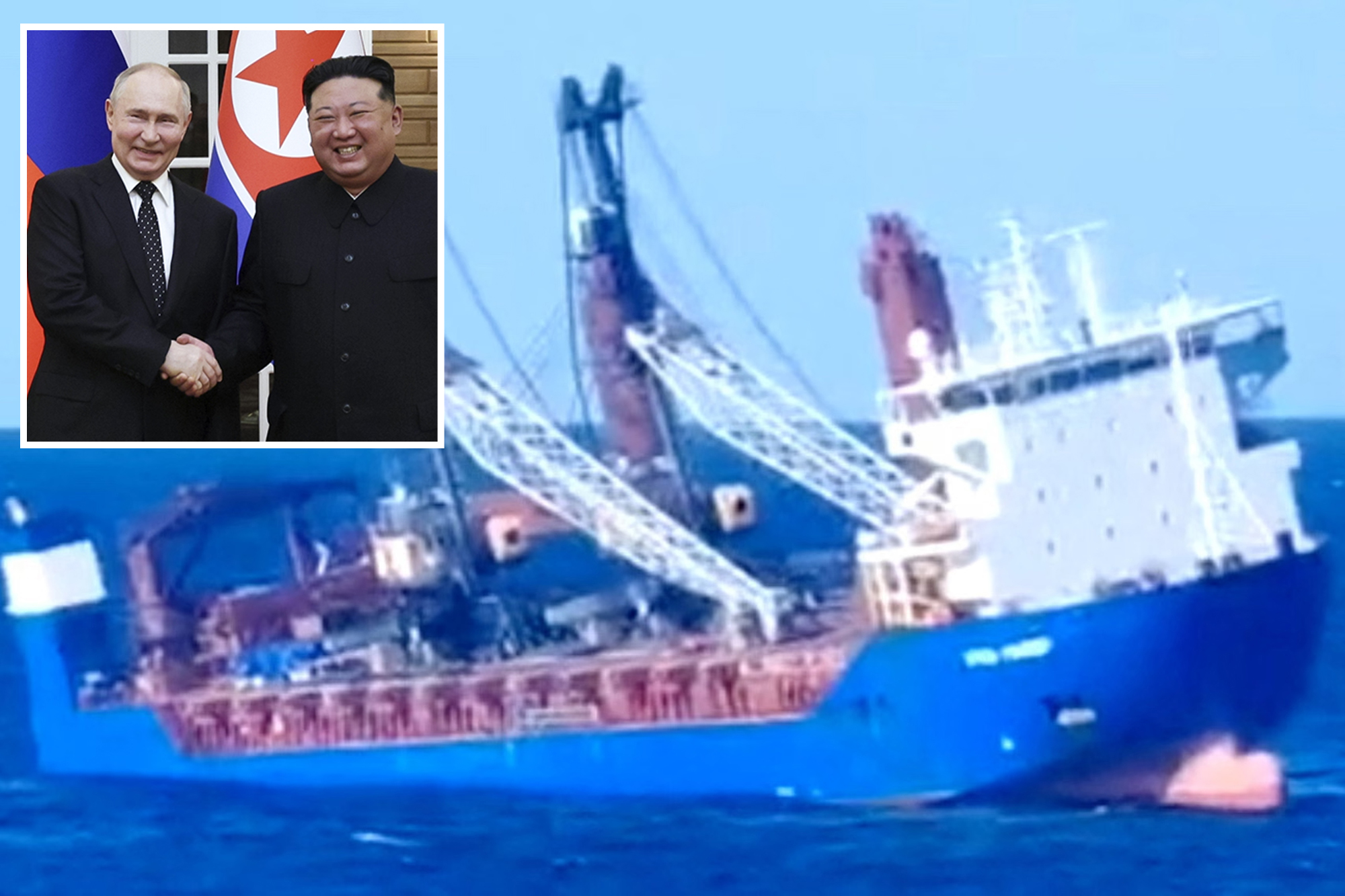
The mystery of how a Russian cargo ship sank deepened after it was revealed that the vessel suffered multiple explosions while allegedly carrying two nuclear reactors believed to be bound for North Korea, according to a new report.
The prevailing theory suggests that the West might have been involved in the incident that saw the Ursa Major sink 60 miles off the coast of Spain on Dec. 23, 2024, CNN reported.
The ship, also known as the Sparta 3, appeared to have been hit by a rare type of torpedo that breached the ship’s hull and forced it to sink to the bottom of the Mediterranean Sea, according to Spanish investigators.
The investigation suggested that the only thing that could have breached the ship was the Barracuda supercavitating torpedo, a powerful weapon of which only the US, a few NATO countries, Russia and Iran are believed to be in possession.
In the aftermath of the incident, the ship’s Russian captain allegedly told Spanish investigators that Ursa Major was hauling “components for two nuclear reactors similar to those used in submarines,” with the sailor unsure if the reactors were loaded with atomic fuel, CNN reported.
The captain, identified as Igor Anisimov, reportedly told investigators that he believed the cargo would be diverted to the North Korean port of Rason to deliver the reactors.
The ship, which has a license to carry atomic materials, departed Russia on Dec. 11, 2024, with its public manifest making no mention of nuclear reactors or materials on board, only empty shipping containers, two large cranes and two large “manhole covers.”
The voyage came just two months after North Korean dictator Kim Jong Un committed to sending thousands of soldiers to help Russia retake its Kursk region following Ukraine’s surprise counter-invasion, which served as a humiliating blow to Moscow strongman Vladimir Putin.
It has long been believed that Russia had provided technical expertise to North Korea as part of an exchange for the soldiers, with Kim notably eager for Pyongyang to have its own nuclear submarine.
Europe had been tracking Ursa Major’s movements, with the Portuguese navy deploying aircraft to locate the ship and its military escort vessels in the Mediterranean.
By the morning of Dec. 22, the Portuguese navy dropped its tail, according to its military, with the ship then caught slowing down off the Spanish coastline.
The ship’s curious movements prompted Spanish rescuers to radio in the vessel, but the Russian ship claimed all was fine, according to Madrid.
About 24 hours later, the Ursa Major issued an urgent call for help after suffering three explosions, likely near its engine room, with the blasts killing two crew members.
The emergency became even more tense as one of the Russian military escort ships, the Ivan Gren, arrived shortly to order nearby vessels to stay at least two nautical miles away from the damaged ship, demanding that Spain return the rescued crew immediately.
Video of the maritime rescue shows how Spanish rescue crews were unable to enter the ship’s engine room, which was sealed shut, CNN reported.
While the ship appeared to be stable, it sank to the bottom of the sea once the Ivan Gren fired a series of flares over the scene, with four explosions similar to underwater mines erupting soon after, according to the outlet.
Four days after the incident, the ship’s owner, Oboronlogistics, claimed the vessel was struck in a “targeted terrorist attack,” leaving a 20-inch by 20-inch hole in its hull.
The mystery only deepened after a Russian research ship, the Yantar, arrived over the wreckage of Ursa Major a week after the incident, with four more explosions detected around the seabed.
Madrid told Spanish lawmakers that it’s far too risky to investigate the wreckage sitting at 8,202 feet below the water “without significant technical resources.”
The US military has also deployed its WC135-R “nuke sniffer” aircraft over the scene of the incident twice, once on Aug. 28, 2025, and again on Feb. 6 of this year, according to flight data.
The US has not said why the aircraft was deployed to the Spanish coastline or if anything had been detected during the two flights.
With multiple governments remaining silent over the incident, it remains unclear what exactly Ursa Major was hulling or how it sank to the bottom of the sea.