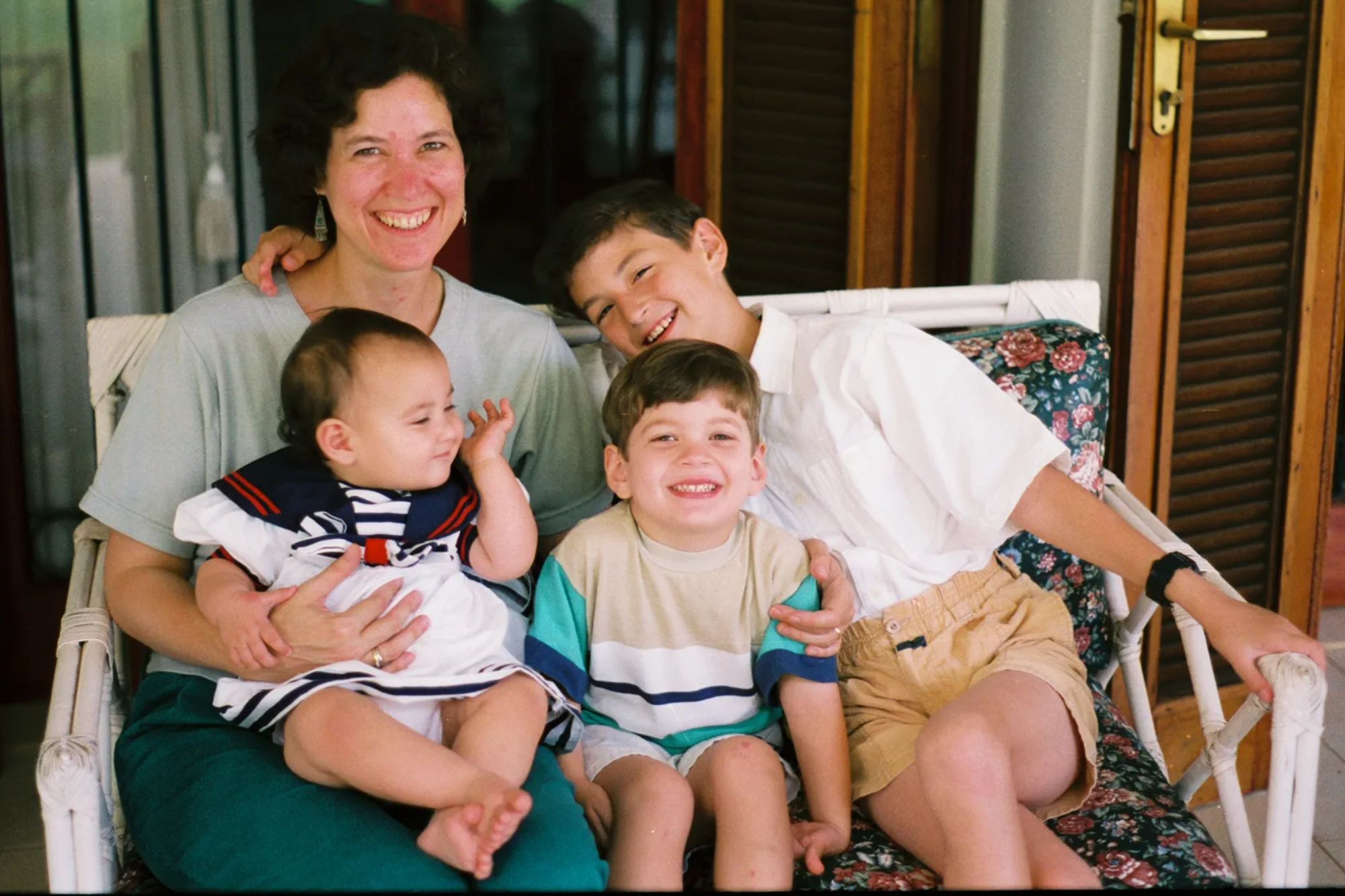
Martin Gurri's family has been an irreplaceable source of happiness. Martin Gurri The capacity of Americans to produce babies crashed to a record low in 2025.
Just in time for Mother’s Day, the CDC has published a report showing the total US fertility rate falling below 1.6 births per woman of reproductive age.
That’s a 1% decline from 2024 and a 23% drop since 2007 — and far below the 2.1 births per woman needed just to keep our population stable.
As with so many other aspects of contemporary life, we seem to have offshored the manufacture of human beings.
There should be nothing startling or unusual about this trend. It’s in line with the expressed opinions of large swaths of the great American public.
According to a 2024 poll, the share of American adults under 50 who have sworn off the messy business of reproduction increased from 37% in 2018 to 47% in 2023.
In an even more remarkable finding, only 48% of Americans between the ages of 18 and 29 think raising a family is a particularly important life goal.
A majority of young people, it would appear, have discovered more important things to do than bring children into the world.
Yet the revolt against making babies isn’t a uniquely American development. It’s global, and has had the most radical effect in the wealthiest countries.
South Korea’s fertility rate, for example, is 0.8 children per woman.
That’s a statistic, a mere number — but the implications are large and troubling.
Capitalist economies are predicated on continued growth driven by growing populations.
Will the economy collapse along with the population?
Retirement pensions depend on a large number of young workers paying for a much smaller number of retirees. In South Korea, that demographic pyramid has now inverted.
A war of the generations, with the old always outnumbering the young, may be fought over diminishing resources.
The most unpredictable consequences of infertility, however, are human rather than economic.
Consider: children born under South Korean conditions will lack not just siblings but cousins, aunts, and uncles.
Each child will feel like a thin thread of life groping through the spreading darkness of nonexistence.
Each child will learn that the world belongs to the old, the slow, and the rigidly entrenched.
Such limited horizons aren’t entirely unknown to history, but in the past they have been caused by devastating plagues or wars.
It’s a silent extinction event — a massacre of innocents who are never to be born, brought about by vastly increased affluence, education, health, mobility and political freedom.
In 1955, when South Korea, with a GDP per capita of $64, was one of the poorest countries on earth — and ruled by a military dictatorship to boot — the country’s fertility rate stood at 6.1 children per woman.
At the present rate, the needle is slipping toward zero.
According to the AI platform Claude, the last South Korean will crawl, unaided, into his solitary grave some time after the year 2400.
One doesn’t have to buy into such a speculative disaster to perceive that Korean culture requires a critical mass of humanity endowed with a sense of purpose and a desire to project its way of life into the future.
With those qualities now increasingly rare, Korea as a culture may well vanish from history, swallowed by stillness and ruin, long before 2400.
If we accept evolutionary theory, then we must also accept that our species is wired for reproduction: there’s a Darwinian imperative to replicate our selfish genes.
And if that is true, something very unusual is happening to our human wiring.
That “something” is probably the most significant existential question facing our kind today.
But let’s make this a subject for another conversation.
Here, I’m going to resist the temptation to preach or politicize: in the end, the decision whether or not to have children, though civilizational at scale, is always profoundly personal.
So allow me, good reader, to reflect on the matter through the filter of my own personal experience — as a husband, a father, a grandfather, an old man trying to make sense of things.
I belong to the first generation of fathers dragooned into attending the birth of their kids.
It’s an awesome and untidy process — a physical struggle to detach, from the flesh of the mother, a separate life, a new story whose adventures and accomplishments remain at that moment a total mystery, total potentiality.
I was told to act as a coach to my wife in her labors. Needless to say, I was useless.
How could I, seated comfortably in the birthing room, presume to coach someone wrestling with her own anatomy to launch an 8-pound protohuman into the light of day (or, more accurately, the dark of night)?
I simply watched, held her hand, and applauded at the appropriate junctures.
The fundamental question — why we wanted children — is difficult to answer.
I can offer all kinds of intellectual explanations — that we wished to perpetuate our families, say, or share our bounty with the next generation.
I believe that the rightness of having children seemed to us self-evident and preceded any attempt to theorize or justify.
Family was just one of the background assumptions of the good life.
All I can say for certain, in any case, is that we wanted children pretty desperately — and that desperate need made the arrival of each of our three kids a moment of triumph and celebration.
A body of research purports to prove that childless adults are as a whole happier than parents.
Here is a typical claim: “Statistics from Australia, the UK, and US show that those without children are happier, more content with their lives, and experience less psychological stress than parents with children living at home.”
The author of that study actually labels children “happiness thieves.”
See, that’s the kind of weird person I used warn my kids not to talk to in the streets.
Parenting is massively time-consuming but — so long as everyone’s healthy — not particularly stressful.
Stress is a factor of control. If you think creating the perfect environment for your children will turn them into idealistic geniuses, you’ll end up stark raving mad.
You can overprotect — many do, and wind up raising a pale and anxious species of human.
But parental control is the flimsiest of illusions.
You can’t force-feed your kids into growing up to be Gandhi or Mozart.
Stubbornly, despite all your efforts to improve them, they’ll grow up to be themselves — which is infinitely better.
My three kids turned out to be good-hearted, smart, among my favorite people to be with.
As for happiness, try this experiment: pretend to be Santa Claus and leave presents under the Christmas tree for yourself and nobody else.
I don’t think I’m alone in believing that happiness often entails family, and while that feeling can certainly be replicated with a spouse or old friends, children bring a magical freshness, a newness, to the experience.
Among the greatest joys of my life was transforming myself into a warrior dad and fighting the mob at Toys “R” Us to snatch that rare plastic Godzilla on my son’s Christmas list.
In the fullness of time, children become parents themselves, and the hidden purpose of the whole convoluted process is at last revealed: grandkids.
Between grandparents and grandkids, there exists as perfect a relationship as anything our flawed humanity allows.
It’s based on a transcendent understanding of each other’s place in the scheme of things.
They think we’re suckers — and we’re eager to prove them right.
Are we spoiling them? Well, that’s their parents’ problem — the people formerly known as our children.
They offer all the wonderfulness of raising children with none of the work.
The connection is deep beyond reckoning, impossible to capture in psychological jargon or fertility statistics.
When I look into the eyes of my grandsons, I see, somewhere behind the glitter and the smile, the long chain of being harking back to the remotest past — and, more prosaically, bits of my grandfather, my father, even myself, all arranged in distinct and unique creatures.
But I also see the future I will never live to witness.
Long after I’m gone, they will be carrying on with their busy lives, maybe pausing, once in a while, to recollect a memory of their grandpa, of the ice cream and the Legos.
Like the song says, we all want to leave something behind.