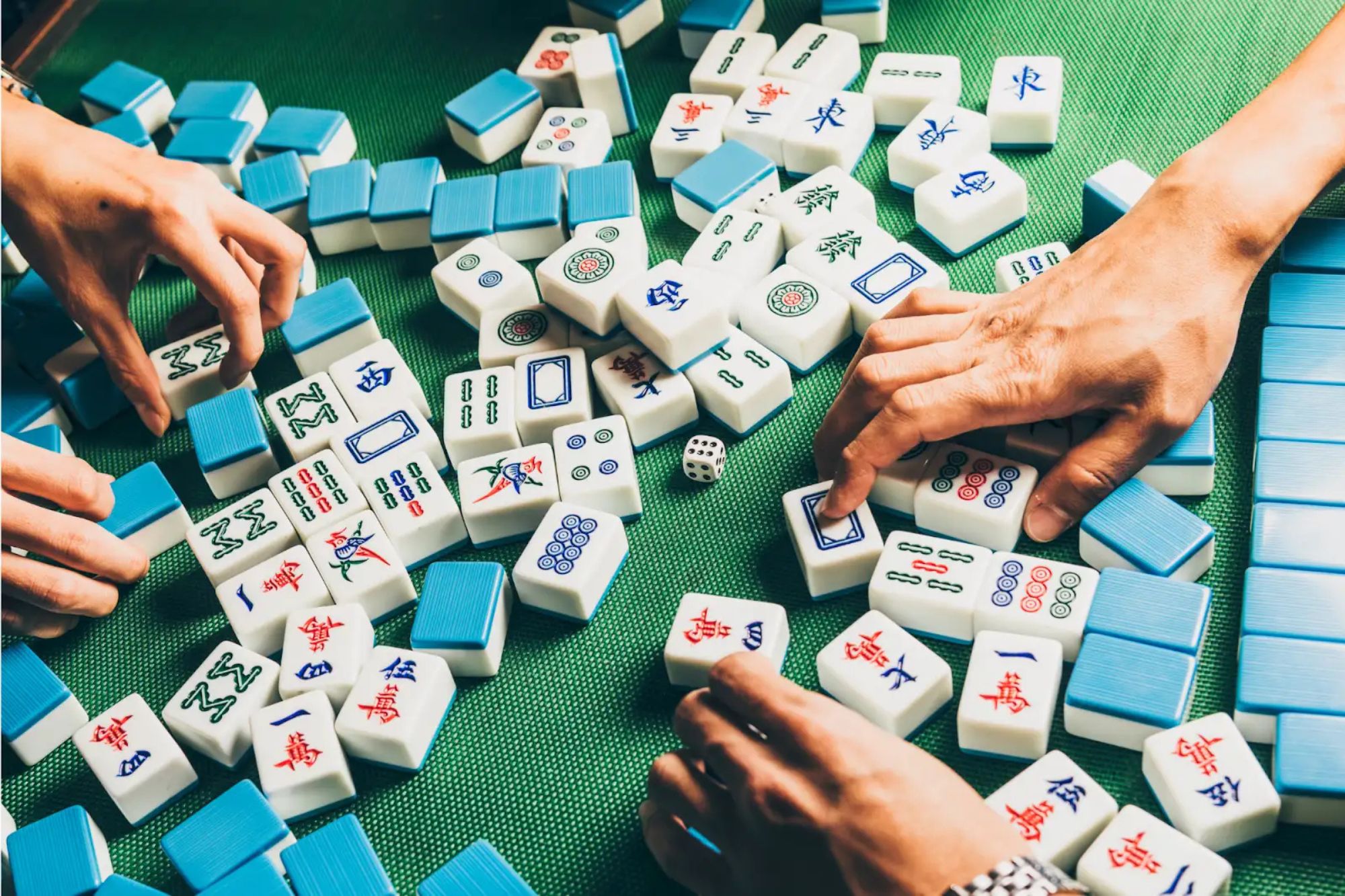
You’re probably reading this on a phone right now. But a growing number of New Yorkers have put their devices down — and picked up tiles instead.
Mahjong, the four-player strategy game with roots in 19th-century China, is in the middle of a genuine American revival. Game cafes, private clubs and bar nights centered on mahjong have been multiplying across the city, drawing players in their twenties and thirties who have little interest in the retirement-home reputation the game once carried.
The appeal isn’t complicated: four people, one table, no notifications. In an era defined by fragmented attention and passive entertainment, that has become a selling point all on its own.
Mahjong has been played across China and much of East and Southeast Asia for well over a century. It blends memory, pattern recognition and calculated risk — closer to poker in its strategic depth than most people expect on first encounter. Four players draw and discard tiles to complete sets, with enough variation in regional rule sets to keep serious players studying for years.
The game’s resurgence in the US isn’t limited to New York. Mahjong clubs and instructional leagues have been reported in cities including Los Angeles, San Francisco and Chicago, with organizers noting that younger players now make up a significant share of new interest. At the same time, online mahjong platforms are seeing a surge in players, as newcomers turn to digital tables to learn the game and connect with friends remotely.
If mahjong is the social hit, Go is the intellectual one. The two-player strategy game originated in China more than 2,500 years ago and remains one of the most studied games in the world — not just by players, but by computer scientists and AI researchers.
Go stumped artificial intelligence for decades. While computers mastered chess by the late 1990s, Go’s near-limitless board combinations resisted machine dominance until 2016, when DeepMind’s AlphaGo defeated world champion Lee Sedol in a match that made international headlines. The victory was treated as a milestone in AI history — not a footnote in gaming news.That 2016 story brought Go new attention in the West. Clubs affiliated with the American Go Association operate in dozens of US cities, and the game is increasingly taught in schools as a tool for developing strategic thinking.
Xiangqi — known in English as Chinese chess — is one of the most widely played board games in the world by sheer number of participants, with particular strength across China, Vietnam and Chinese diaspora communities globally. In New York, it’s a fixture of parks in Flushing and Sunset Park, where outdoor games draw regular crowds year-round.
The game shares ancestry with Western chess but plays differently: pieces move on intersections rather than squares, a river divides the board, and the pace tends toward faster, more aggressive exchanges. Players familiar with chess often find it disorienting at first — and then difficult to put down.
Sudoku is widely described as an Asian game — but that’s not quite right. The number puzzle was invented by American Howard Garns and first published in a US magazine in 1979 under the name “Number Place.” It went global after Japanese publisher Nikoli picked it up in 1984 and gave it the name Sudoku. The Japanese connection is real, but the game’s origins are genuinely mixed.
Its cognitive benefits, however, are well-documented. Research has associated regular engagement with logic puzzles to improvements in concentration, working memory and processing speed — making it worth discussing alongside these games regardless of where it came from.
The timing of the mahjong revival tracks with a broader cultural shift away from passive screen consumption. Sales of board games and tabletop games surged during the pandemic and have not fully retreated. Game cafes, once considered a novelty, are now a stable part of the New York City nightlife landscape.
These games don’t require an algorithm to work. They don’t update, send alerts or optimize for engagement. They require the people playing them to show up, pay attention and lose gracefully — which, depending on your week, might be exactly what you need.