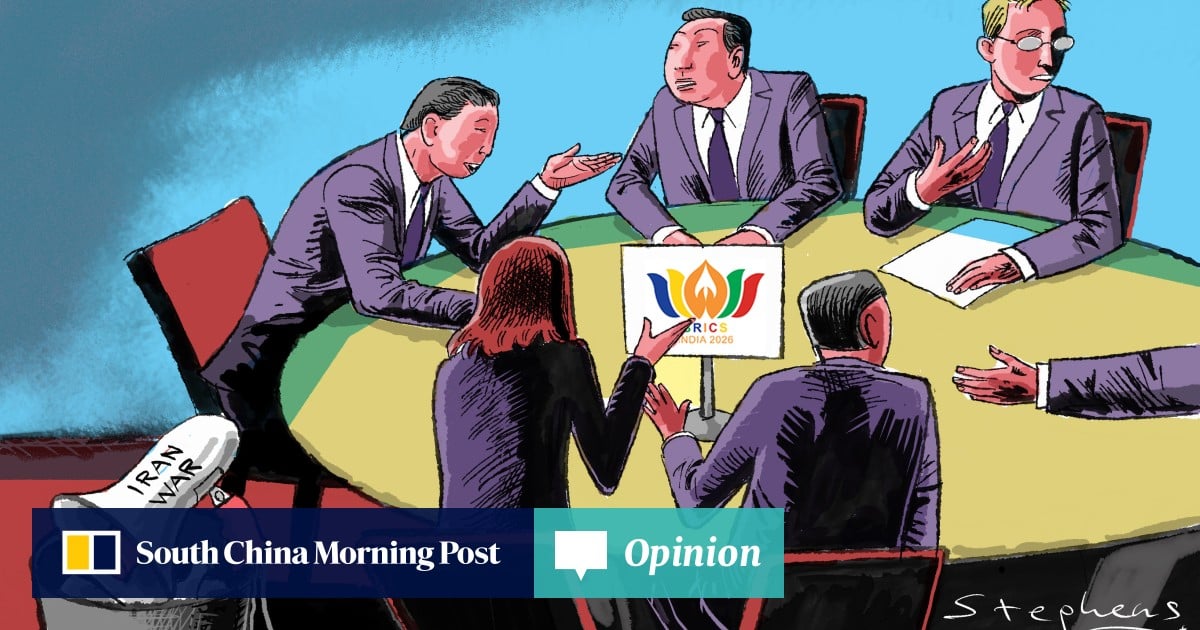
The grouping has a future, not as a binding structure demanding policy alignment but as a tool for members to enhance leverage and maximise options
3-MIN READ3-MIN ListenBrian Y. S. WongBrian Wong is an assistant professor in philosophy at the University of Hong Kong, and a Rhodes Scholar and adviser on strategy for the Oxford Global Society. Published: 5:30am, 12 May 2026With the war in the Middle East entering its third month, questions have surfaced over its geopolitical ramifications in the region and beyond. An entity that has drawn particular scrutiny is Brics. The 10-member grouping is defined less by a clear set of common values and more by contingently overlapping interests. It does not and cannot speak with one voice on the conflict.Two Brics members, Iran and the United Arab Emirates (UAE), are at loggerheads: Tehran has launched missile and drone attacks targeting strategic Emirati sites, including oil facilities in Fujairah, in recent weeks. China has taken a nominally neutral stance on the war, given its robust ties with both Iran and Sunni-majority Arab states, while Russia has been more overt in backing Iran, perhaps with the intention of diverting Western resources from Ukraine.As the Brics summit chair, India seeks to straddle its deepening strategic ties with Israel and symbolic commitment to the Global South, while ensuring the safety of its diaspora in the Middle East. Its challenges are compounded by the deterioration in relations with the United States under the second Trump administration, and criticism from domestic opposition over the government’s “uncritical silence” on the US-Israel attacks.
Given the disparate interests and divergent stances within the grouping, the coming Brics foreign ministerial meetings in New Delhi are unlikely to yield concrete breakthroughs over the war. Yet it would be a mistake to conflate a known fact – that Brics is not a coherent bloc – with a premature conclusion: that Brics is impotent.
As Heiwai Tang and I argued in our co-edited volume, the grouping is best conceived of as a tool for leverage enhancement and optionality maximisation, as opposed to a binding structure demanding alignment on all major policy stances. Indeed, if carefully pursued, select areas of cooperation may prove immensely fruitful for all members, especially in the present moment.