play Live Sign upShow navigation menuplay Live Click here to searchsearchSign upEconomy|EnergyTrump says he will suspend petrol tax amid soaring US fuel pricesSenator Hawley plans legislative action supporting President Trump’s bid to waive the petrol tax amid rising consumer costs.
xwhatsapp-strokecopylinkgoogleAdd Al Jazeera on GoogleinfoUS prices for a gallon (3.78 litres) of petrol or gasoline have climbed from an average of $2.98 on February 28, when the United States and Israel first struck Iran, to $4.52 today [File: Annabelle Gordon/Reuters]By Andy Hirschfeld and ReutersPublished On 11 May 202611 May 2026United States President Donald Trump said he will cut the 18-cent federal tax on petrol to offset surging prices that have continued to soar after his comments that the US ceasefire with Iran is on “life support”.
On Monday, Trump said he would suspend the petrol tax, but did not specify an end date.
“Yup, we’re going to take off the gas tax for a period of time, and when gas goes down, we’ll let it phase back in,” Trump told CBS News.
Trump later told reporters that he would waive the tax, which generates $2.5bn in funds used for US roadway infrastructure, “till it’s appropriate”.
The US administration hinted at the idea on Sunday, when US Energy Secretary Chris Wright told the NBC News programme Meet the Press that the White House was considering suspending the tax.
While the Republican president claimed he would waive the tax, that is not within the White House’s authority. Suspending a federal tax requires an act of the US Congress.
However, key Trump ally Senator Josh Hawley, a Republican from Missouri, said on the social media platform X that he would introduce legislation on Monday to do that.
In March, Senator Mark Kelly, a Democrat from Arizona, proposed suspending the tax until October.
“I anticipate it would pass, but there could be a procedural delay. It also suggests that President Trump doesn’t see a quick end to the reduced volumes and is trying to cushion the American consumer,” Rachel Ziemba, adjunct senior fellow at the Center for a New American Security, told Al Jazeera.
“The impact could be greater in states that have also reduced their own petrol taxes and could reinforce differentiation between petrol prices by region.”
US states also tax petrol, with Indiana, Kentucky and Georgia moving to make cuts to give consumers some relief at the pump.
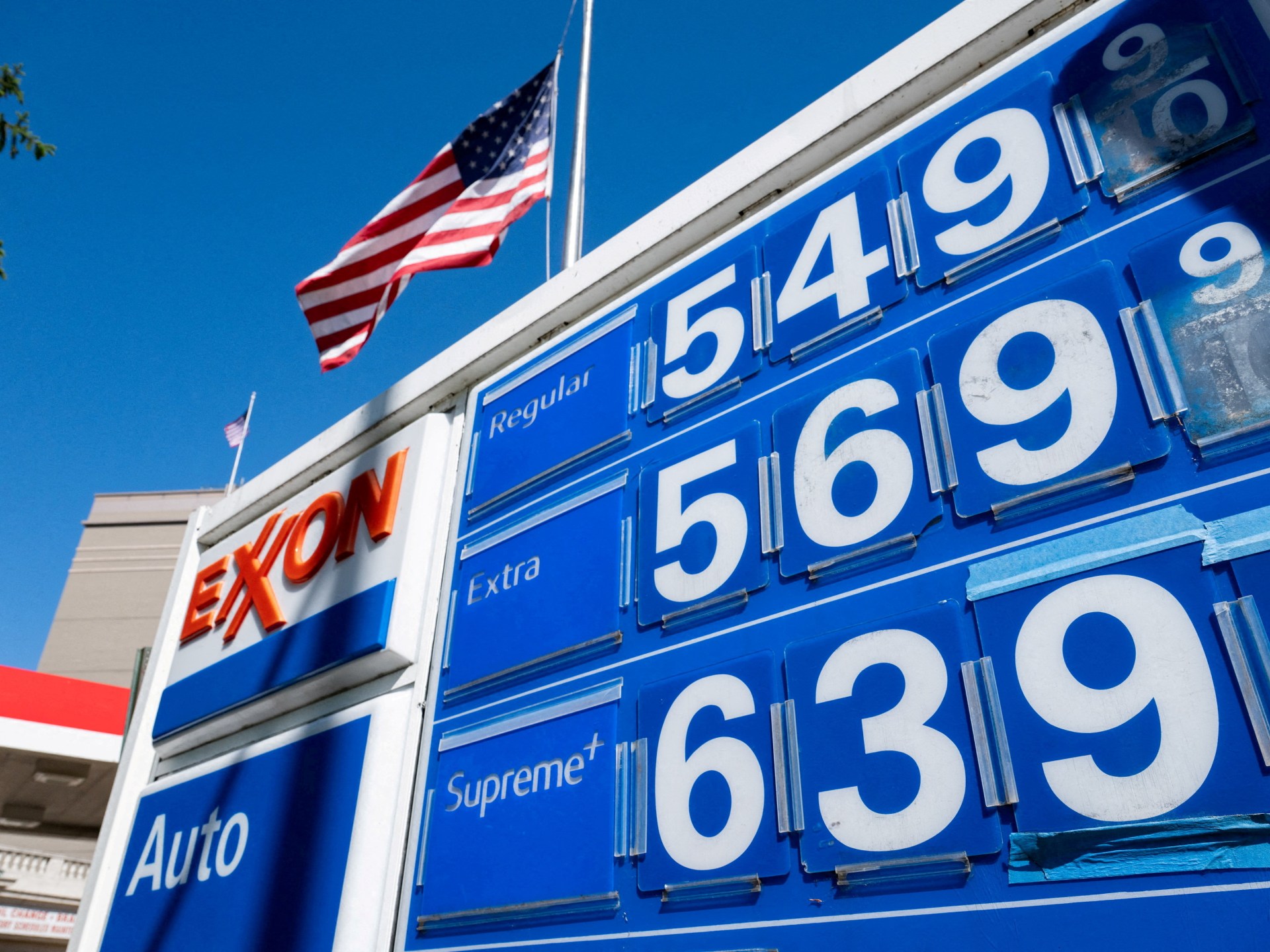
Petrol prices have continued to climb since the initial strikes of the US-Israel war on Iran on February 28. The average price for a gallon (3.78 litres) of regular petrol is $4.52, according to the American Automobile Association, which tracks daily petrol prices, compared with $2.98 when the strikes first began.
However, news of the stumbling ceasefire has sent oil prices surging. Brent crude futures were up $3.17, or 3.13 percent, at $104.46 a barrel, while US West Texas Intermediate crude was at $98.32 a barrel, up $2.90, or 3.04 percent. Brent reached a session high of $105.99 and WTI hit a peak of $100.37.
On Wall Street, stocks for oil and gas giants are trending upward. Shell was up 1.6 percent in midday trading, Exxon rose 3.1 percent, BP gained 2 percent, and Chevron climbed 1.7 percent.
Trump was also asked by CBS on Monday whether a bailout was planned for the airline industry, which has taken a hit since the war on Iran began.
The president told the outlet that a bailout had not “really been presented” and that “the airlines are doing not badly”.
However, earlier this month, budget carrier Spirit Airlines ceased operations after 34 years. Court documents said the airline shut down because of “recent geopolitical events resulting in a massive and sustained increase in fuel prices”.
That comes as other major US carriers raise prices. In April, United Airlines said it would raise fares by 20 percent amid a surge in jet fuel costs.