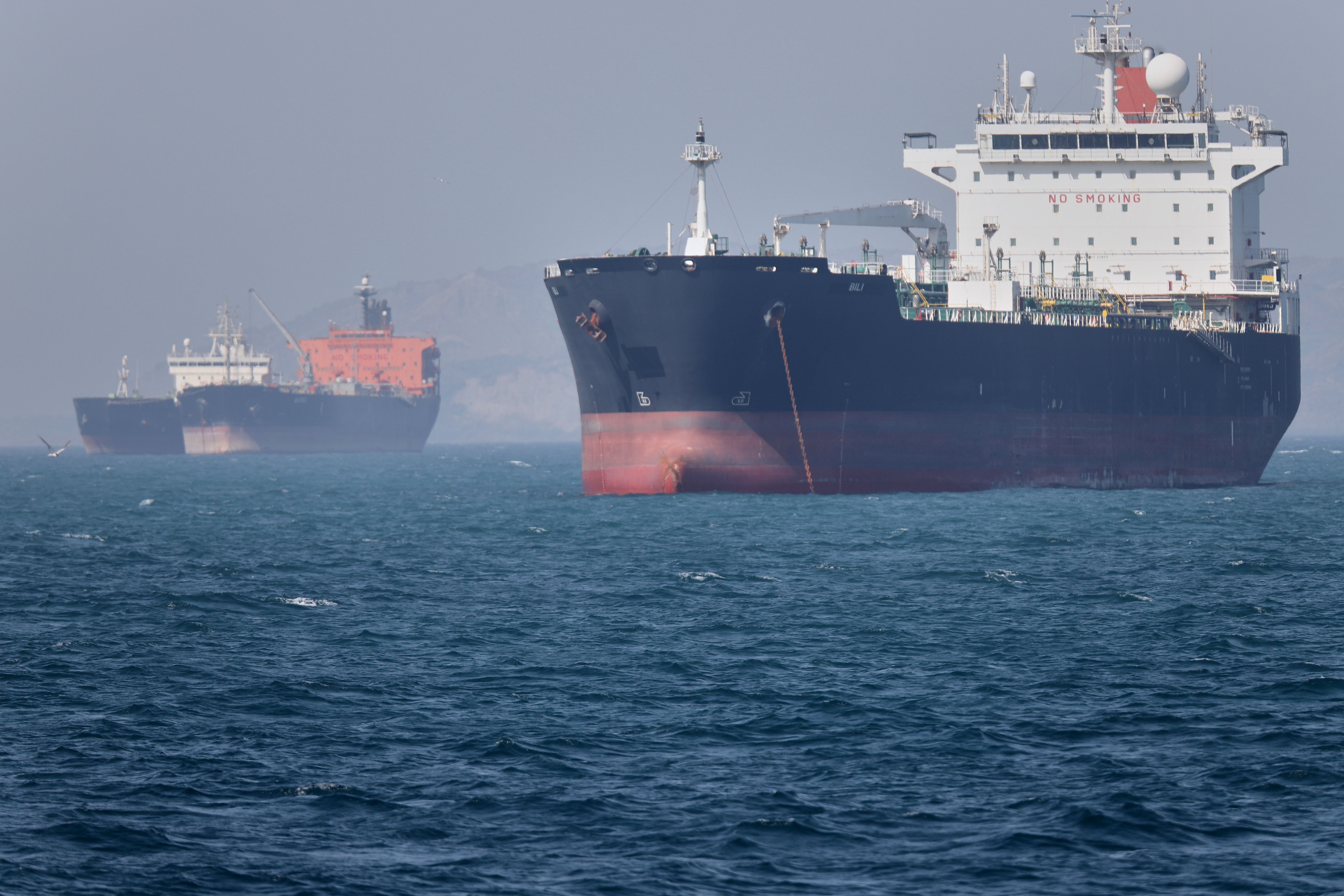
Oil tankers anchored in the Strait of Hormuz near Bandar Abbas, Iran on May 2, 2026. Amirhosein Khorgooi/ISNA via AP Two days after United States Central Command launched Project Freedom, a naval operation to escort commercial vessels through the Strait of Hormuz, President Donald Trump paused the operation.
Trump cited “great progress” toward a potential deal with Iran’s rulers as the reason.
While the pause may have been tactically convenient, it was a strategic mistake that sent the wrong message to Tehran.
If the Trump administration is serious about restoring the free flow of international commerce illegally strangled by the Tehran regime since the start of hostilities, it should resume and sustain the operation until Iran agrees to unrestricted transit rights for all shipping through the Strait of Hormuz.
Approximately 20% of the world’s seaborne oil trade and 20% of global Liquefied Natural Gas transits the strait, an international waterway governed by the United Nations Convention on the Law of the Sea.
Under international law, all military, merchant and private ships have the right to transit unimpeded through any strait used for international navigation.
When Iran declared the strait closed to “unfriendly nations” — issuing passage tolls of up to $2 million per vessel and threatening to set fire to any ship attempting to pass without permission — it did not merely disrupt global shipping: The regime engaged in a direct assault on the legal architecture that governs the world’s oceans.
If this assault on international law is allowed to stand, the precedent will be catastrophic.
Every state that has ever dreamed of turning a geographic chokepoint into a revenue stream or a coercive instrument will take note.
The United States has spent the past 80 years helping to guarantee freedom of navigation throughout the globe.
Abandoning that guarantee under Iranian pressure would not be dealmaking, but a strategic retreat.
The claim of the Islamic Revolutionary Guard Corps to have achieved “complete control” of the Strait of Hormuz cannot be allowed to stand unchallenged, regardless of the state of negotiations.
Project Freedom demonstrated the fallacy of the IRGC’s claim.
US Navy destroyers transited the strait, ensuring, along with other US assets, the safe transit of commercial vessels despite Iranian missile, drone and small boat attacks.
Pausing the operation temporarily ceded the initiative back to Tehran, allowing Iran to assert that it can block ships transiting through the strait even during negotiations.
Resuming Project Freedom should not be viewed as escalation, therefore, but a necessary action that the United States cannot afford to abandon.
There is a compelling economic rationale that should appeal to a president who thinks in trade terms: The closure of the strait has triggered a historic global energy supply shock.
Oil and gas prices have surged, and agricultural supply chains in developing nations have been disrupted, as the strait also carries about 30% of internationally traded fertilizer.
Project Freedom addresses this problem head-on, allowing commercial vessels transiting the strait to and from non-Iranian ports to move freely under US security guarantees.
This is especially effective if done in parallel with a continued US naval blockade of Iranian ports, as it allows America to maintain maximum economic and strategic pressure on Tehran.
The Strait of Hormuz cannot be viewed as a bargaining chip.
Project Freedom should resume — and continue until every ship seeking to transit the strait can do so safely, freely, and without paying tribute to the IRGC.
That is the essence of freedom of navigation, and the world is watching to see if America still believes in it.
Mark Montgomery is a retired US Navy Rear Admiral who is now a senior director at the Foundation for Defense of Democracies.