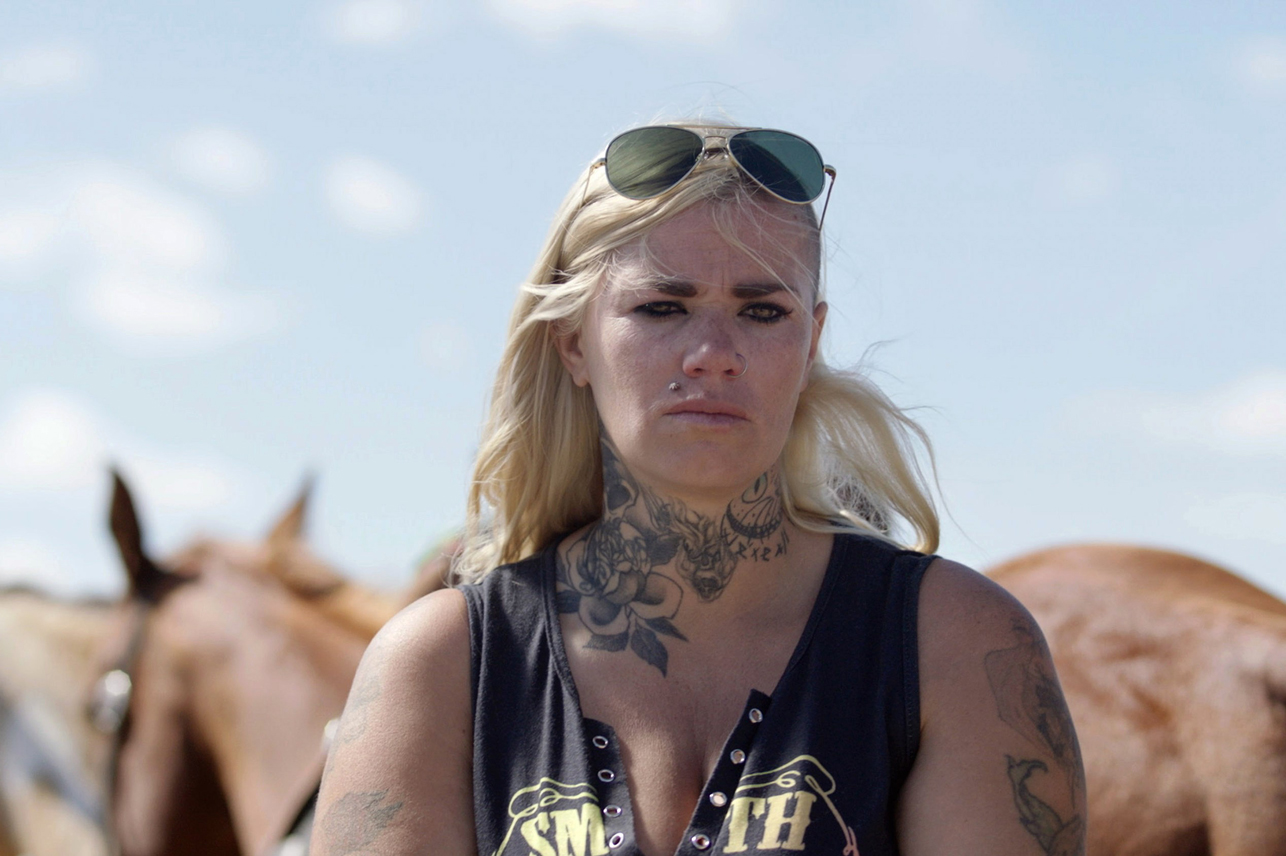
East of Wall (now streaming on Netflix) is part documentary, part scripted drama, and the magic of the film lies in our inability to discern which is which. Best not to get hung up on it then, and simply let the story suck you in (it’s not hard). Director Kate Beecroft embedded herself in the lives of mother-daughter horse trainers and riders Tabitha and Porshia Zimiga, who play versions of themselves in a story that captures the struggles and joys of their hardscrabble lives on a sprawling ranch near the South Dakota Badlands. The earnest reality Beecroft captures translated into an audience award at Sundance 2025 — and a spot as one of Decider’s 17 Best Movies of 2025.
The Gist: The opening shot is striking: A young woman on horseback, riding on a windswept plain, a dog trailing. It’s captured with remarkable clarity and depth. That’s the romance. The reality counterbalances the moment – rough and ragged TikTok videos of teenagers cavorting on and around horses. Then, the Zimiga home, an aging and weathered modular home overrun with children and adults and dogs and cats, voices and feet and butts vying for space in tight, cluttered quarters. Tabitha Zimiga oversees the circus. She has a reputation as someone who can tame the wildest horses. She has a teenage daughter, Porshia, and their relationship is strained. She also has a young son, Stetson (Stetson Neumann), who’s watched by Tabitha’s mother, Tracey (Jennifer Ehle), who brews moonshine and seems to drink a lot of it. Tabitha takes in strays, animal or human – the gaggle of teenagers we saw in the TikToks work on the ranch and are de-facto adoptees who find stability with Tabitha that their own families lack. Tabitha’s 3,000-acre ranch is big, but the breadth of her shoulders and the depth of her heart dwarf it.
However, this scenario exists in the shadow of loss. Tabitha’s husband John died the previous year. Everyone visits his grave on his birthday and Porshia seethes – “She won’t even say his name,” she hisses, directing the anger at her mother. What happened to John? All will be revealed, although we catch this comment: “The horses went crazy when the gun went off.” The horses. Tabitha won’t ride anymore, not since John. They’re everyone’s livelihood. They’re exceptionally trained. But they’re selling at auction for paltry prices. Tabitha has no choice – lotta mouths to feed. The kids ride at the rodeo; Porshia’s a natural, fast as hell. They haul ass alongside her in the truck, shooting a TikTok as she hits 45 miles per hour. Sometimes, we hear Porshia’s voice narrating poetic profundities about the Badlands and their impermanence.
One day at auction, someone jumps a bid by $5,000 for one of Tabitha’s horses. That’s Roy (Scoot McNairy). The truck and trailer he takes it home in looks like a couple’a hundred K. He admires Porshia’s riding, asks to drop by the ranch to look at more horses. Of course, he wants more than that, he wants to buy the ranch. Tabitha and all the kids will work there and live there and he’ll provide the means and connections to sell the horses for what they’re worth. He doesn’t seem like a bad guy, and he’s got his own traumas and sadnesses trailing behind him. It would solve a lot of problems, but presents a bigger one: John is buried on that land, and it’s Tabitha’s home. Is “home” ever truly for sale?
What Movies Will It Remind You Of? The inclusion of beautiful images of the Badlands and non-actors playing themselves inevitably leads to comparisons to two Chloe Zhao dramas, Nomadland and The Rider. And the voiceover atop poetic images of nature are pure Terrence Malick (Days of Heaven especially).
Performance Worth Watching: It’s been said that playing yourself in a film is a considerable challenge, and Tabitha and Porshia not only do so convincingly, but ably carry the burden of being the story’s dramatic focal points.
Our Take: Immersion is the point. East of Wall deposits us neck-deep in the emotional specificity of this world. Details about setting and supporting characters and what it takes to keep the ranch solvent fall to the wayside – Beecroft presents the dramatic experiences of Tabitha and her family’s existence as a big, vibrant display of life that’s immovable and omnipresent like a mountain. Because life isn’t a series of problems to solve, but something to climb, to endure. And in this film, we simply watch Tabitha endure.
The encroachment of the Roy character (and all his money, of course) on that life is a veneer of drama that imposes a question on Tabitha’s core truths. It’s not as compelling as the complex humanity Beecroft observes in moments of day-to-day occurrences: Tabitha and her partner Clay (Clay Pateneaud) taking Stetson to a condescending specialist for his delays in speech development. Tabitha getting denied legal guardianship for one of her teenage workers due to her tenuous finances. Or a devastating sequence in which Tabitha, Tracey and a group of their female friends sit at a bonfire and share their most harrowing personal stories. Roy has had his struggles, but he doesn’t have all this, which is as real as it gets. That’s why her answer to his offer is exactly what you expect it to be.
Our Call: East of Wall is engrossing in its authenticity. STREAM IT.
John Serba is a freelance film critic from Grand Rapids, Michigan. Werner Herzog hugged him once.