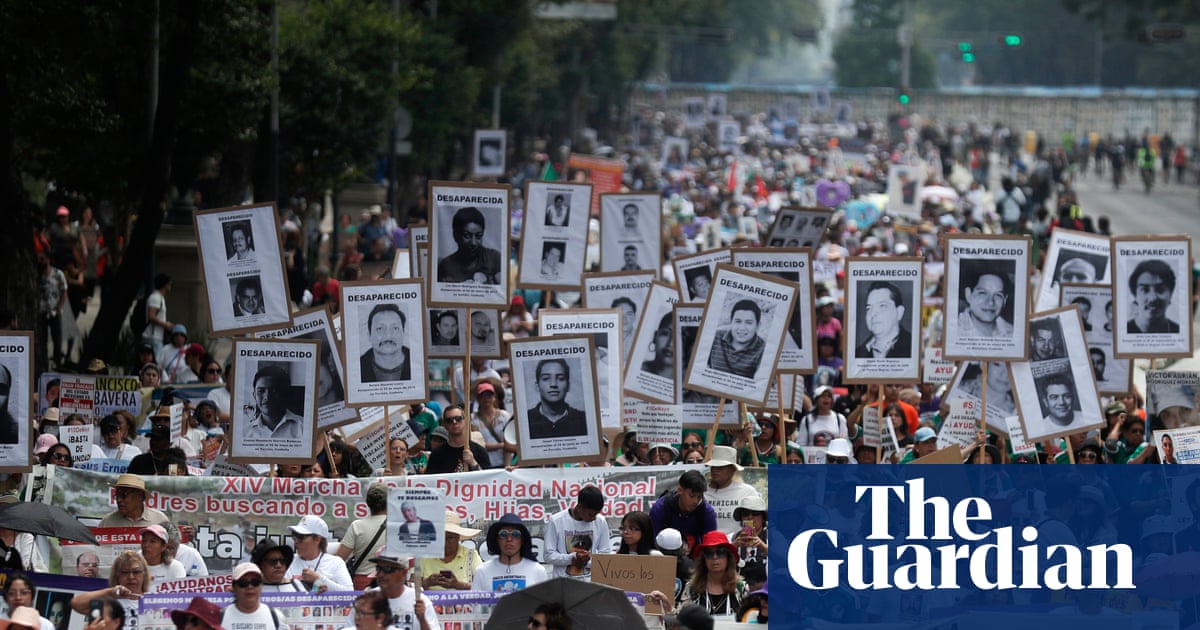
Relatives of missing people march in Mexico City on 10 May. Since 2010, at least 27 people who were looking for lost family members have been killed. Photograph: Isaac Esquivel/EPAView image in fullscreenRelatives of missing people march in Mexico City on 10 May. Since 2010, at least 27 people who were looking for lost family members have been killed. Photograph: Isaac Esquivel/EPADisappearances in Mexico involving state at ‘alarming’ rate, says reportExclusive: Human rights group warns of ‘deep collusion’ between criminals and officials in some parts of country
State actors are involved in disappearances in Mexico at an “alarming” rate, according to a report from the Inter-American Commission on Human Rights (IACHR).
The sweeping investigation, to which the Guardian was given exclusive access, presents a dire picture of the crisis of disappearances in Mexico, where more than 130,000 people have gone missing, mostly in the last 20 years since the government declared its war on drug cartels.
While criminal gangs are responsible for the vast majority of disappearances, the IACHR report found that “many of the disappearances committed by organised crime occur in deep collusion and coordination with state agents”.
Meanwhile, “disappearances committed [directly] by state agents have not yet been eradicated”, the report reads, noting that, in some parts of the country, at times there were almost as many disappearances carried out by government officials as there were by criminals.
The report also described an “alarming” number of cases involving “torture, forced disappearances and disappearances which include state security actors”.
Forced disappearance – where a person is detained, extrajudicially killed by the state and their body then destroyed or hidden – has a long history in Mexico, going back to the country’s so-called dirty war of the 1960s and 70s where dissidents were even thrown out of planes and into the Pacific ocean.
In more recent years, the tactic has been adopted by organised crime groups to sow terror in local communities, intimidate rivals or erase evidence of homicides by burning bodies, burying them in mass graves or dissolving them in vats of acid. In the last 10 years, disappearances have increased by more than 200%.
However, as the IACHR report makes clear, state actors are often involved, either directly by snatching people from their homes or cars without warrants and handing them off to criminal groups, or indirectly by looking the other way as these crimes take place.
The IACHR also found that “organised crime in Mexico recruits state agents in charge of security tasks, law enforcement, and even political authorities”.
Mexico’s president, Claudia Sheinbaum, and her government have repeatedly rejected such assertions.
When the United Nations intimated last year that there was possible evidence of enforced disappearance in Mexico “being practiced on a widespread or systematic basis”, Sheinbaum did not mince words.
“In Mexico there is no forced disappearance by the state,” the president said during a press conference. “We have fought against that all our lives; that does not exist in Mexico.”
When the UN last month stated that there were “indications that enforced disappearances in Mexico have been and continue to be committed as crimes against humanity”, the Mexican government was equally prickly, rejecting the report as “biased and dismissive”.
Activists say this is part of a wider effort to underplay the seriousness of the issue. In March, the authorities presented a report suggesting that a third of disappearance cases lacked sufficient data to be found, ineffect washing their hands of about 40,000 missing people.
“They were trying to minimise the scale of the problem and put the responsibility on families to carry out the search,” said Maria Luisa Aguilar Rodríguez, head of the Centro Prodh human rights centre.
Read moreThis too is a critical issue according to the IACHR, which said: “Given the magnitude of disappearances and the meagre state response, it has been the families themselves who have organised into collectives to search for their loved ones. As a result, they face a series of institutional challenges and risk their lives.”
Chillingly, the report describes how “disappearance affects entire families in Mexico, several of whom have lost almost all their relatives because of this crime, or by searching for them, other family members have also been disappeared or killed”.
Since 2010, at least 27 people who were looking for lost family members have been killed, most of them mothers.
The IACHR report did recognise that, in the last few years, the Mexican government has “adopted a series of actions to confront disappearances”, including reactivating the National Search Commission to find the missing, and recognising the issue as a “humanitarian crisis”.
But the country continues to grapple with a forensics fiasco; there are 70,000 dead bodies in state custody that are yet to be identified, according to the report.
Meanwhile, Mexico’s feeble justice system has been unable to meet the demands of such a catastrophic crisis. “Impunity in Mexico is an insurmountable problem,” the IACHR said. Since 2014, just 357 people have been charged with the crime of disappearance or enforced disappearance and of those, just nine have been convicted.