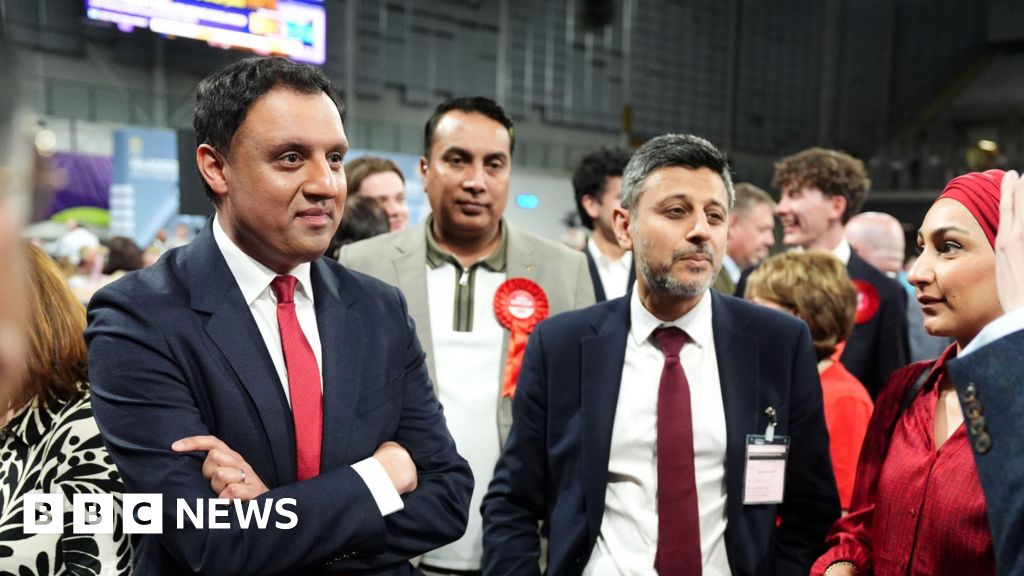
ShareSaveAdd as preferred on GooglePA MediaAnas Sarwar has led Scottish Labour to two defeats in Holyrood electionsAnas Sarwar has insisted he will "absolutely" stay on as Scottish Labour leader, despite his party recording their worst ever result at a Scottish Parliament election.
Labour lost four seats last week, returning just 17 of the 129 seats available.
Sarwar refused to be drawn on how long he would continue as leader and did not commit to leading his party into the next election in five years' time.
He told BBC Scotland's The Sunday Show his "responsibility now is to hold my party together," and pledged to hold "the newly elected SNP government to account on their record".
He said he would he would "make sure we have a parliament and a democracy that functions in Scotland."
Sarwar declined to say whether he saw himself leading his party into the next election, adding: "I've got a job to do and I intend to do it."
In his first interview since Labour lost national elections in both Scotland and Wales and saw huge losses across councils in England, Sarwar confirmed he is sticking by his February call for Prime Minister Sir Keir Starmer to resign.
He said: "I said what I said back in February, I am not recoiling from that."
With renewed calls in Labour for Starmer to go, Sarwar said he had tried to make the campaign about Scotland but "there was clearly a national wave that we tried to overcome but we failed to do so."
He described the Scottish election result as "disappointing and hurtful" and took full responsibility for the strategy of focussing the campaign on constituencies rather than the list vote.
He also defended campaign co-chairs Jackie Baillie and Douglas Alexander, saying they "did a good job in this election campaign".
Anas Sarwar: I’m focused on what this election means for ScotlandSarwar said his party had failed to cut through the national noise.
"This election didn't come down to big ideas. It came down to a big national wave and a general vibe that we couldn't change," he said.
Former Scottish Labour leader Lord (Jack) McConnell, who was first minister from 2001 to 2007, blamed "public disappointment with the UK government" and a poor campaign strategy for the party's election performance.
In an article for the Sunday Times, he suggested the election strategy lacked ambition and was "never going to galvanise Scottish voters".
"Scottish Labour must develop a vision and plan that inspires," wrote McConnell, who called for "radical reform of Scottish local government and the health service".
He also suggested that Starmer would only survive the "devastating" election results if his government could "step up and deliver the scale of change the country craves".
The Labour party won just 17 of the 129 available in last week's election, losing four.
Only three of these were constituencies, with the other seats coming from the regional lists.
The party tied with Reform, who also got 17 seats.
The SNP came well ahead with 58 seats, although they fell short of their own goal of a majority - which is 65 seats.
Labour's support collapsed across the UK in Thursday's elections.
In Wales, the first minister was among the Labour politicians to lose their seats.
The party had been in power in the Welsh Parliament for 27 years but lost 35 seats and were left with just nine parliamentarians.
In council elections across England, Labour lost almost 1,500 councillors.
On Saturday, a Labour MP called for cabinet ministers to challenge Starmer's leadership - or she will do it herself
Catherine West said that the party had a problem and had to move quickly to remove the prime minister.
She called on the cabinet to put forward their "best communicator" to replace Starmer.
If they do not, she said she would ask Labour MPs to support her own leadership challenge.
To do so, she would need support from at least 81 Labour MPs. She claimed she already has 10 willing to back her bid for the leadership.