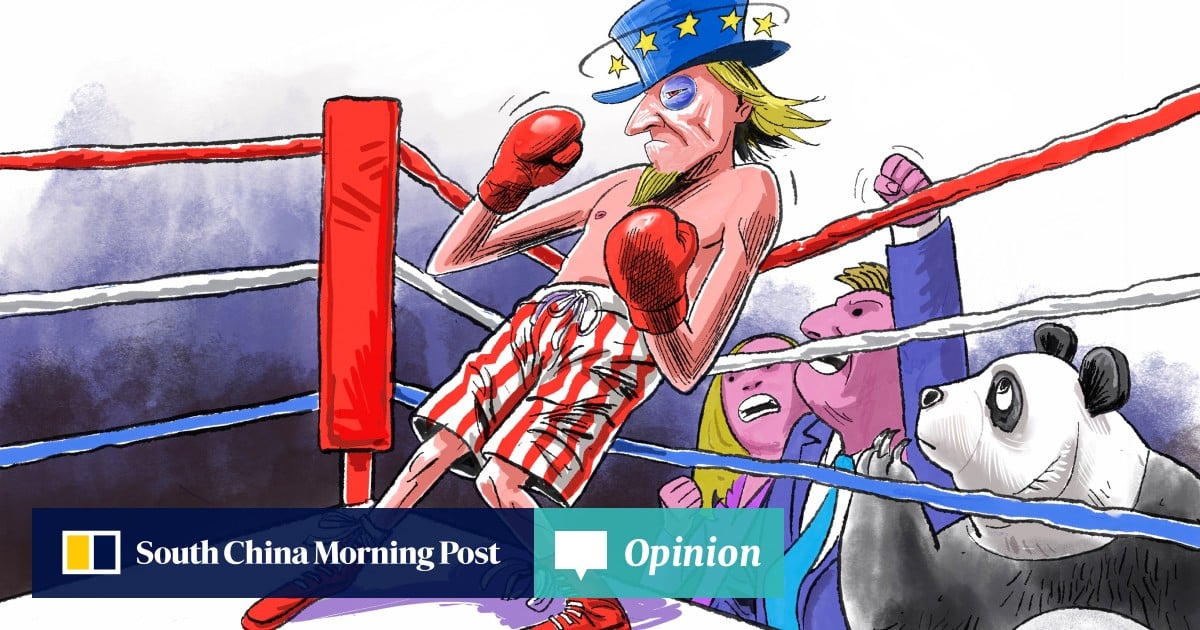
As fractures within the US’ network of alliances deepen, China’s strategic window opens a little wider, with some key caveats
4-MIN READ4-MIN ListenSophie Wushuang YiSophie Wushuang Yi holds a PhD in Chinese studies (international relations) from King’s College London, where she specialised in Sino-US relations, military and strategic studies, and South China Sea geopolitics. Published: 8:30pm, 10 May 2026When US President Donald Trump announced that 5,000 US troops would leave Germany, the immediate reading in Western capitals was political: another round in Trump’s running quarrel with European allies, triggered by German Chancellor Friedrich Merz’s criticism of Washington’s handling of the war with Iran.For Beijing, the more interesting reading is structural. The drawdown coincides with a period in which Foreign Minister Wang Yi has spent much of 2026 cultivating a “partners not rivals” framing with European counterparts. Transatlantic friction creates an analytical opening. But the strategic window is narrower than the optics suggest and reading which constraints are durable and which are negotiable is the harder task.What Beijing sees as encouraging is real. The 2026 US National Defence Strategy, shaped by US undersecretary of defence for policy Elbridge Colby, explicitly downgrades Europe to “more limited” conventional support. Trump’s threat to “probably” pull troops from Spain and Italy, and his characterisation of Nato as a “paper tiger”, has accelerated European contingency planning.AdvertisementReports of a “European Nato” backup framework, gaining momentum after Berlin abandoned its long-standing opposition, are no longer fringe. European defence spending is projected to nearly double by 2030 to roughly US$750 billion. Polish Prime Minister Donald Tusk’s warning that the greatest threat to Nato is internal disintegration rather than external attack captures a mood widely shared among European elites.
The structural constraint behind Trump’s leverage is real, and Chinese analysts are studying it carefully. A Centre for Strategic and International Studies (CSIS) analysis of the US-Israeli campaign against Iran estimates that US forces expended roughly half their Patriot interceptors, between 53 and about 80 per cent of the THAAD inventory, and around 45 per cent of its Precision Strike Missiles. Replenishment will take one to four years.