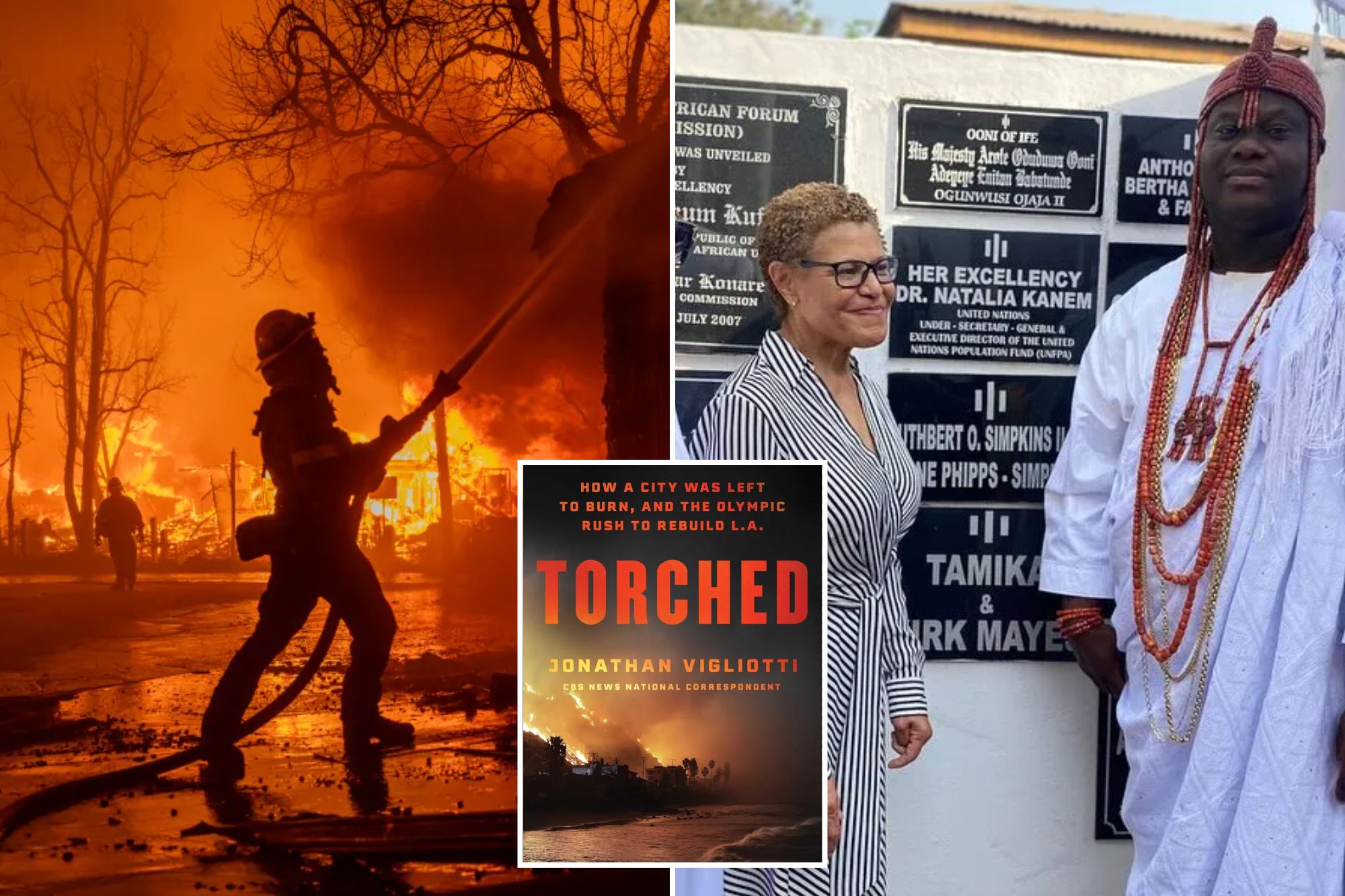
In his new book “Torched: How a City Was Left to Burn, and the Olympic Rush to Rebuild LA,” CBS News correspondent Jonathan Vigliotti delivers a firsthand account of the January 2025 Eaton and Palisades wildfires — looking at how city and state government failures made the situation even more catastrophic. In this exclusive adapted excerpt, Vigliotti writes about Los Angeles Mayor Karen Bass’ and California Gov. Gavin Newsom’s shocking choices to all but disappear as the fires bore down.
Minutes after the Palisades Fire began to spread, Los Angeles’ then-Fire Chief Kristin Crowley called Mayor Bass: the situation was escalating.
It was 10:48 a.m. on Tuesday, January 7, 2025. Crowley did not know Bass was in Ghana, on a profile-building presidential assignment to attend the Inauguration of His Excellency John Dramani Mahama. Bass had quietly exited Los Angeles, giving emergency managers just a day’s notice. Where she was headed was never disclosed.
According to multiple sources, Bass had been briefed before her departure about the National Weather Service’s fire models predicting what could be the most severe wind event in years.
In her absence, her team curated the illusion of presence by posting as if she were still in the city. She wasn’t. She was halfway around the world. “Bass pulled a Ferris Bueller,” one City Hall source said.
Bass and Crowley’s conversation was brief. A fire had started in Pacific Palisades, burning for nearly twenty minutes. The winds were strong and getting stronger. Structures were threatened. The Emergency Operations Center was escalating its activation. More resources were needed.
It was the kind of call that hollows the lungs. The kind that draws a hard line through time. Before. After. For a city. For a leader. For a career. Bass’s staff would later say that after Fire Chief Crowley’s call the mayor monitored the crisis in real time. Maybe they meant much later, because in real time, Mayor Bass was preparing for a different appearance.
It was nearly 7 p.m. in Ghana. She had slipped into the fire-engine red Calvin Klein dress she had packed specifically for this evening. It was sleek and striking. A ceremonial uniform for a moment she did not intend to miss. Los Angeles was on life support. Mayor Bass was its legal guardian. But first she had a party to attend. Bass’s brief call with Crowley would be one of her last acts of direct oversight with her city’s firefighters that day. As messages came in asking for guidance and offering help, the mayor chose to attend a cocktail reception where she would be unreachable for more than an hour.
As the room buzzed with small talk, seven thousand miles away Los Angeles burned.
Just after noon on January 8, 2025 — little more than 24 hours after the first spark, and as the Palisades Fire continued to chew through home after home — Bass and California Governor Gavin Newsom stepped into the flaring crucible, photographers in tow. Bass wore her black-framed glasses, eyes sharpened by strain; Newsom, tall and polished, silver hair tucked under a cap, his aviators reflecting ruin. Both looked rattled and out of place in a ghost town still burning.
Rarely had a governor or mayor descended into an active wildfire as if the flames were already cold. It was like walking into a hurricane’s eye or a crime scene while investigators were still dusting for prints. Their presence signaled the political heat rising around them — heat fanned by President-Elect Donald Trump, still weeks from taking office. “The incompetent pols have no idea how to put them out,” he erupted online. “Gavin Newscum should resign. This is all his fault!!!” Others accused him of being “missing in action,” and Bass of being “nowhere to be found.”
Bass faced mounting criticism. As the city’s commander in chief during disaster, she was its conductor — responsible for keeping every emergency agency in sync. But she had been more than 7,000 miles away during the fire’s explosive growth. Many officials hadn’t known she’d left the country or quietly named Council President Marqueece Harris-Dawson acting mayor. The confusion would prove costly.
Newsom, too, had been conspicuously absent before the fire, consumed by budget deadlines and preparations for President Biden’s visit to announce new national monuments. Both leaders may have been missing when the fire started, but now they were in the middle of it — their proof of presence stamped onto film.
“Just devastating,” Newsom said as he and Bass walked in lockstep through the mangled steel and broken concrete where the Palisades’ commercial center once stood. This fire line became their stage, their reckoning, and, according to several city officials, an attempt not only to shift the optics but to turn the page entirely. They spoke of reinforcements — thousands of firefighters rushing in from across the West — but quickly pivoted to “an urgent path forward towards recovery,” as Bass posted online.
The words struck many as strange. Flames were still devouring property. The cause remained unclear, as did the reasons help never arrived in time. The death toll was rising, and more than one hundred thousand people were under evacuation orders. And yet already the talk was of recovery — of futures not yet secured while the Palisades Fire feasted largely unopposed.
“The first time they toured the damage they discussed the Olympics and the need for federal funding,” recalled one city official familiar with the conversation who spoke on the condition of anonymity. “The governor had already been exploring options with advisors.” Even as lives hung in the balance, Bass and Newsom were looking three years ahead — to July 14, 2028, the opening ceremony of the Los Angeles Summer Olympics.
For Newsom, who had presidential ambitions, and Bass, who long had her eye fixed on a larger national stage, the Games were more than a sporting event. They were survival. “Losing the Palisades damaged both of their careers and they knew it,” the city official said. “Losing the Olympics would be game over.”
As evacuated residents watched their hometown burn on hotel television sets, in the rooms where the Summer Olympics ruled the calendar there were already whispered concerns about if the show could go on. Newsom and Bass were aware. Pacific Palisades was the western gate to the Riviera Country Club, Olympic golf’s stage. The fairways had survived, but the approach was ash — charred hillsides, collapsed lines, neighborhoods erased. Just beyond the fire zone sat UCLA, future home of the Olympic Village, its dormitories and athletic fields spared but suddenly cast in shadow by the inferno next door.
For families, it was devastation. For Bass and Newsom, it was a blackened bottleneck. Their tour that day marked the beginning of a rebuild driven less by safety than by political ambition and shared legacy. To succeed, they would need the Trump administration on board. Trump, the very man who had blamed them for the fire. The governor had already been speaking with allies about a plan.
Midway through their walk, smoke began to thread from the tiled roof of a two-story shopping plaza that housed a Chase Bank and several restaurants. Embers had taken hold beneath the clay. The photographers captured Bass and Newsom in front of it, backs turned, mid-conversation. With no active defense on scene, the flames climbed. The building later collapsed on their watch — a photo op as surreal as it was damning.
A red tail hawk wheeled overhead, gliding on the soot-stained thermals, searching for easy prey. What was true for the natural order was true for the political one: strength gave way to scavenging, circling ruins, searching for advantage. Bass and Newsom were political animals, bred to compete and endure. The cost of that instinct would only reveal itself with time.
Over six months, I contacted Mayor Karen Bass’s office in every way available to a reporter — emails, calls, formal requests, informal follow-ups — a dozen attempts in all. She granted interviews to local and national television, radio, and print outlets, but not once to me. Eventually, a representative returned one of my calls. The conversation began on the record, then shifted off the record at their request. I was told the interview request would be relayed directly to the mayor. No interview, under the terms extended to all others, ever materialized.
Requests to interview Governor Gavin Newsom over the course of four months unfolded in stages. During the fires, his representatives indicated he would meet with me, though despite extensive coordination, an interview never occurred. Later, after a press conference, my team and I were asked to remain in the room and wait for him to speak with us. We waited. He did not and no explanation was given. In the months that followed, I sought a broader interview. Those requests went unanswered.
Copyright © 2026 by Jonathan Vigliotti. From the forthcoming book “Torched” by Jonathan Vigliotti to be published by One Signal Publishers/Atria Books, an Imprint of Simon & Schuster, LLC. Printed by permission.