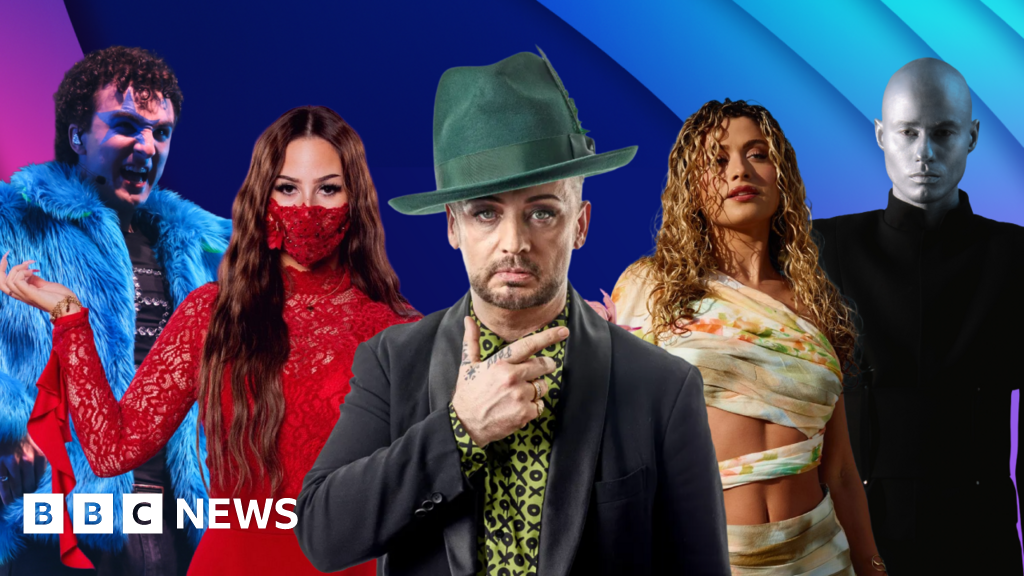
ShareSaveAdd as preferred on GoogleMark SavageMusic CorrespondentBBC / EBUSome of this year's Eurovision hopefuls (L-R): Cosmó, Felicia, Boy George, Antigoni and Lion CeccahLike a ray of sunshine on a cloudy day, the 2026 Eurovision Song Contest has arrived to dispel the gloom of a weary world.
With 35 countries taking part, it's the most compact competition since 2003 - due to a partial boycott over Israel's presence.
If you can put the politics aside (and many fans feel they can't), the competition presents its usual mix of mayhem and spectacle.
This year's hopefuls include a man entirely covered in silver paint, a fake gorilla, an actual Boy George - and the longest high note in Eurovision history.
With the semi-finals starting in Vienna this Tuesday, here's a guide to all 35 songs, sorted into poorly defined musical categories - because no functionally accurate system could define this madness.
The last two Eurovision winners – Switzerland's Nemo and Austria's JJ – both deployed operatic vocal runs in their songs. So, naturally, there's a whole Liszt of copycats in 2026.
Best of the bunch is French prodigy Monroe – who, at the age of 17, is this year's youngest entrant.
Her song, Regarde!, combines a frenetic string section, glitching drum beats and Queen of the Night vocals in a way that suggests, "Hello, I have listened to the output of Spanish recording artist Rosalía" (this is a compliment).
Described as a "celebration of the richness of all of France's musical cultures," it builds to an earth-quaking climax, with stunning live vocals. With the right staging, it looks set for a Top 10 finish.
Montenegro's Tamara Živković takes a maximalist approach, plonking a Greek Chorus onto a jack-hammer techno beat on Nova Zora.
Co-written by actual opera singer Vesna Aćimović, it's all about women breaking free of gender stereotypes and striding towards a new dawn.
Montenegro haven't qualified from the semi-finals since 2015. Could this be the song to break their losing streak?
Finally, we have Latvian singer Liene Atvara, whose heart-rending ballad, Ēnā, addresses the lifelong impact of growing up with an alcoholic parent.
Full of sorrow and restraint, the opening verses are entombed by muffled synths before Liene explodes into an operatic wail of catharsis in the dying moments.
Romania's Eurovision entry, Choke Me, has been labelled "dangerous" and "reckless" for lyrics that appear to reference sexual strangulation, an unsafe practice that can lead to brain injury and death.
But Alexandra Căpitănescu, a Master's student at the Faculty of Physics in Bucharest, says campaigners have got it all wrong.
"Choke Me is a metaphor for the pressure we sometimes place on ourselves," she says.
"It speaks about inner fears, self-doubt, and the feeling of being emotionally suffocated by our own expectations. It was never intended to represent anything sexual."
What's not in doubt is that the song is powerful. Demonic guitar riffs churn under Căpitănescu's raspy vocals, giving the track a thrilling urgency. It's good to have Romania back after their two-year absence.
Equally compelling is Swiss star Veronica Fusaro. On the surface, her waltz-time ballad, Alice, seems to be a saccharine tale of love and devotion.
Dive deeper, however, and it's a horrific portrayal of abuse, written from the point of view of a stalker - an extra layer that makes a good song great.
Sometimes, all we need is an excuse to cut loose and dance. Luckily, Eurovision's here to help.
One of my favourites this year is Bulgaria's entry, Bangaranga. Sung by Dara, a proven pop star with a clutch of Top 10 singles, it's brilliantly unhinged and full of sass.
"I'm an angel, I'm a demon, I'm a psycho for no reason," she sings, channelling my cat's personality over a drum sound that could shatter windows.
Totally lacking in substance, with a gratuitous dance break – what's not to like?
Germany's Sarah Engels tries a similar trick with less success on her Euro-dance anthem Fire.
A relatively anonymous take on Dua Lipa's dance-pop, it loses points for rhyming "fire" with "desire" - but I can't get it out of my head. Don't write it off in the televote.
"Call me queen, though I'm not royal," declares Essyla on Belgium's brooding pop banger, Dancing On the Ice.
Sleek and hypnotic, it lacks the killer chorus needed to claim the Eurovision crown.
Finally, Cypriot entrant Antigoni - who you might recognise as a former Love Island contestant - beckons us onto the dancefloor for three minutes of Mediterranean escapism.
The lyrics to Jalla reference Tsifteteli - a popular Greek belly dance – and you can hear traces of Shakira in its mix of Eastern rhythms and sun-kissed sensuality.
The song's music video proved too much for a group of "concerned" public figures in Cyprus, who called it "unsophisticated" and "insulting to Cypriot history, traditions and aesthetics".
Needless to say, their complaints only make the song sound better.
You've only got three minutes to make an impression at Eurovision. Some contestants take that as a challenge to cram as many ideas as possible into their allotted time.
This year's alchemists include Finland's Linda Lampenius & Pete Parkkonen, whose song Liekinheitin (flamethrower) does a brilliant rug pull - transforming from impassioned ballad to demonic electro-pop, complete with a frenetic violin solo.
Already a number one hit at home, it's built around a disturbing metaphor for red-hot love ("Every time we're skin to skin/ You give me third-degree burns") and builds to a thrilling climax, like the countdown clock for a bomb that's about to explode.
It's currently the favourite to win – but Greece isn't far behind.
They're sending Akylas, who's taken the unusual step of combining traditional Greek instruments with Super Mario-style sound effects and a rib-shaking house beat.
Titled Ferto ("Bring It"), his song initially seems to be a hymn to fame: "I want glory, eternity, and cash".
Then the music falls away and Akylas sings directly to his mum, who raised him single-handedly during Greece's financial crisis.
"[I'll] make sure we never lack again," he promises.
Over in Poland, Alicja does a clever piece of misdirection on her song, Pray.
Playing on the title, it opens with a big gospel organ and a massed chorus, before a handbrake turn into lip-smacking rap. Nice idea, but it's a bit of a muddle.
Risking death from pore asphyxiation is Lithuania's Lion Ceccah, who performs Sólo Quiero Más (I Just Want More) covered head to toe in silver paint.
Sung in six languages, it's themed around the rise of artificial intelligence, and how humans become detached from reality the more they use it.
On stage, Lion re-enacts the struggle between man and machine, going from ChatGPT to ChatGP-Free. It's all a bit overwrought for my taste.
This year, we have not one, but two, songs that declare: "Take your job and shove it".
First to hand in his resignation letter is 31-year-old Simón Hovhannisyan, representing Armenia, with the grinding rock track Paloma Rumba.
"