Peter Magyar and his government are determined to push ahead with change at full throttle. But even before the cabinet is sworn in, there has been a "resignation." And questions remain about Magyar's Ukraine policy.
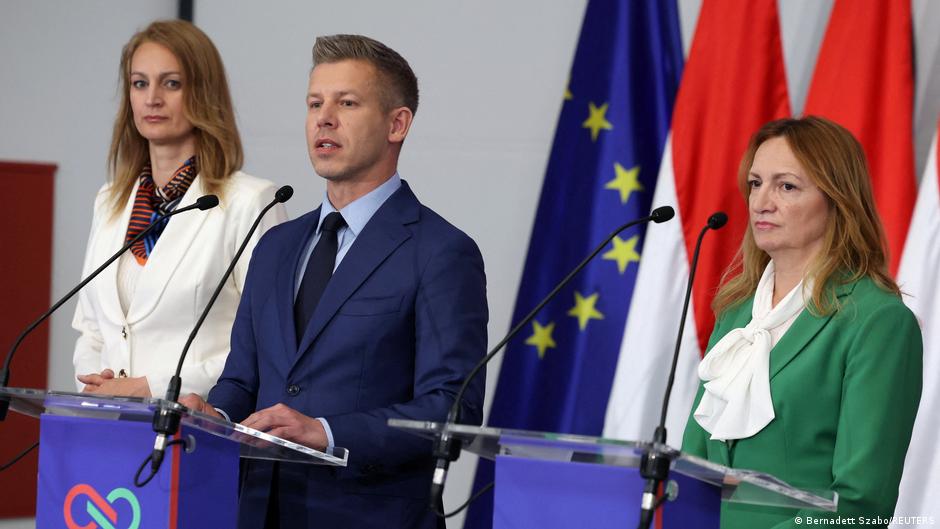
https://p.dw.com/p/5DU5OPeter Magyar (center) addresses the press alongside designated Parliamentary Speaker Agnes Forsthoffer (left) and the designated leader of the Tisza parliamentary party, Andrea BujdosoImage: Bernadett Szabo/REUTERSAdvertisementHungary's incoming prime minister, Peter Magyar, has a remarkable talent for turning situations to his advantage, often with small but highly impactful gestures.
It's a skill no other politician in the country's recent history has demonstrated to quite the same degree and one that undoubtedly played a major role in the historic election victory of his Tisza party on April 12.
One incident that illustrated this talent — and subsequently went viral in Hungary — took place at a campaign event in a small town in the south of the country in early April.
On catching sight of journalists from a pro-Kremlin Moscow newspaper, Magyar called out: "I welcome the Russian propaganda media. Enjoy the freedom — and the regime change!"
The crowd responded with thunderous applause and chants of "Russians, go home!"
This was a response to revelations about former Prime Minister Viktor Orban's attempts to ingratiate himself with Russian President Vladimir Putin during a phone call last fall.
According to media reports, Orban allegedly promised Putin support "in every respect" in an almost submissive manner.
It should come as no surprise, therefore, that when Hungary's new parliament convenes on Saturday, and 45-year-old Peter Magyar and his ministers take their oaths of office, things will be done differently.
The incoming PM has declared the day a "system change holiday."
It has been announced that not only the Hungarian national anthem will be played at the handover of power, but also the European Anthem, the anthem of the Szekelys, a Hungarian minority in Romania's Transylvania region, and the unofficial anthem of Hungary's Roma community.
The playing of this last anthem in particular is an unprecedented gesture of respect toward the community of roughly 700,000 Roma in Hungary.
After Orban, Hungary's Roma hope for changeTo view this video please enable JavaScript, and consider upgrading to a web browser that supports HTML5 video
The EU flag will also be raised over the Hungarian parliament for the first time in 12 years.
Magyar will then deliver his first speech as prime minister on the square outside parliament.
Anita Orban (no relation of the outgoing PM) has been tapped for the post of foreign minister. She's a diplomat and energy expert who once belonged to the pro-European, Euro-Atlantic wing of Victor Orban's Fidesz party — a wing that no longer exists.
Back in 2008, she issued a warning about Russia's imperialistic energy policy in an English-language book that attracted considerable international attention.
Hungary's next minister for the economy will be Istvan Kapitany, a former senior executive at Shell, and its next defense minister will be Romulusz Ruszin-Szendi, a former chief of staff who was branded an enemy by Orban's government for what it saw as his overly pro-Ukrainian stance.
The incoming health minister, Zsolt Hegedus, worked as an orthopedic surgeon in the UK from 2005 to 2015. A video of Hegedus busting some moves on stage in celebration of his party's election win was seen around the world.
Peter Magyar to appoint Hungary's first blind ministerTo view this video please enable JavaScript, and consider upgrading to a web browser that supports HTML5 video
Magyar's cabinet will also include the country's first ever blind minister: Vilmos Katai-Nemeth will take over the portfolio for social and family affairs. He lost his sight at the age of 16, qualified as a lawyer and also holds a second-degree black belt in aikido.
But before it is even sworn in, the cabinet is getting off to a rocky start.
On Thursday evening, Magyar's choice for the justice ministry, Marton Mellethei-Barna, withdrew.
The nomination of Mellethei-Barna, who studied with Magyar and is his brother-in-law, came in for considerable criticism. Writing on Facebook, Mellethei-Barna said that he was stepping back because he did not want "even the smallest shadow to be cast on the system change."
Magyar has instead nominated Marta Gorog, the dean of the Faculty of Law at the University of Szeged, whom he described as "the uncrowned queen of Hungarian jurists."
As head of government, Magyar has two overarching priorities. Domestically, his administration must dismantle the system that was tailored to support Viktor Orban and restore the rule of law.
Magyar has said that one of his first moves will be to set up an anti-corruption authority and an authority for the recovery of assets. The latter will be tasked with reclaiming state funds and contracts that were improperly given to Orban loyalists.
Magyar has also announced plans to shut down the pro-Orban state media and replace it with a new, independent public broadcasting system.
Only time will tell whether the new government will succeed in removing what Magyar calls "Orban's puppets."
Despite the Tisza party's two-thirds majority in parliament, this might prove a difficult endeavor, especially as Magyar counts President Tamas Sulyok, the attorney general and several senior members of the judiciary among these "puppets."
If President Sulyok chooses not to step down, he could significantly delay reforms.
On the international front, Magyar has said that he intends to make Hungary a reliable partner within the EU and NATO once again, improve relations with neighboring countries in Central and Eastern Europe (especially Poland) and secure the release of frozen EU funds for Hungary.
The latter is vital for Hungary, which is in the middle of an economic and financial crisis that is more severe than previously thought. Driven by Viktor Orban's expansive spending policies, Hungary's budget deficit is now approaching the 6% mark.
There is one particular area of foreign policy that could become a litmus test for the new government's democratic principles and populism: Ukraine.
Magyar recently invited Ukrainian President Volodymyr Zelenskyy to what he called an "historic meeting" in the small Ukrainian town of Berehove (Beregszasz), which has a majority ethnic Hungarian population.
It is highly unusual for a head of government to invite himself to another country and also choose where he wants to meet his counterpart.
But Peter Magyar went one step further: He said that Hungary would only support Ukraine's accession to the EU if its neighbor stopped treating its Hungarian minority as second-class citizens — an accusation that is simply not true.
The most remarkable thing about this statement was that Magyar made it shortly after meeting Berehove's mayor, Zoltan Babjak, who had previously assured the incoming prime minister that ethnic Hungarians in Ukraine do not face any discrimination whatsoever.
This article was originally published in German and adapted and updated by Aingeal Flanagan.