Southeast Asian leaders are meeting in the Philippines, with the economic fallout from the Iran war the main focus. Disputes in the South China Sea and border clashes between Thailand and Cambodia are also on the agenda.
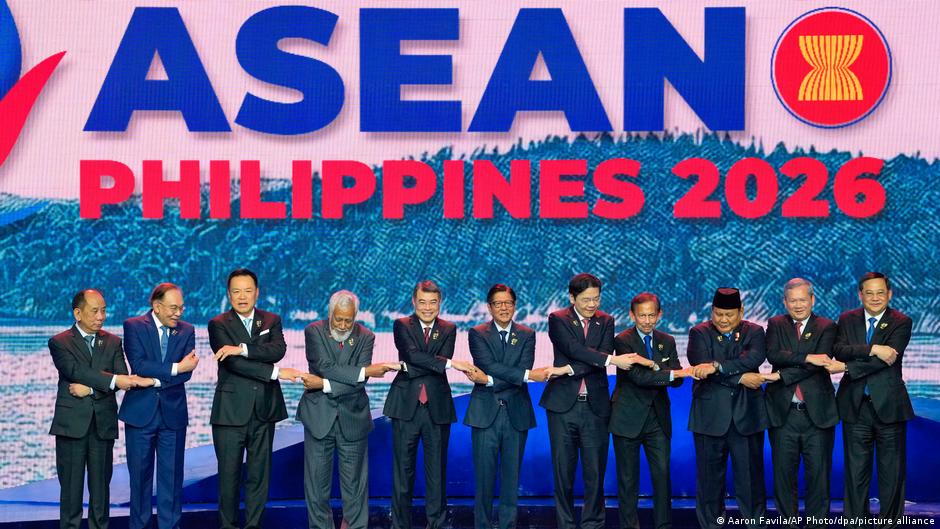
https://p.dw.com/p/5DSpqASEAN leaders were keen to show a united front despite internal divisionsImage: Aaron Favila/AP Photo/dpa/picture allianceAdvertisementLeaders from Southeast Asia were meeting in the Philippines on Friday for an annual summit, which this year is focused on addressing the damaging impacts of the war in the Middle East.
The US-Israeli war with Iran and Iran's regional retaliation have caused major disruptions to energy markets and global oil supplies. Southeast Asian nations are particularly reliant on oil and LNG imports via the Strait of Hormuz, which has been blockaded by both Iran and the US for weeks.
The disruption has caused fuel and electricity prices to soar, while rising fertilizer costs are impacting food prices. Higher jet fuel costs have also made commercial air travel more expensive, reducing tourism demand in the region.
The summit is being held on the central Philippines island of Cebu. In his opening remarks, Ferdinand "Bongbong" Marcos Jr., the Filipino president and the current chair of the Association of Southeast Asian Nations (ASEAN), said the group needed to demonstrate unity and resolve while remaining flexible to the unpredictable situation in the Middle East.
"We must ensure regional energy security and resilience," Marcos Jr. said. "At a time of heightened volatility, ASEAN must strengthen coordination and reinforce preparedness, pursue practical collective measures to safeguard a stable energy supply and improve interconnectivity."
The Philippines was one of the first countries to declare an energy emergency in the wake of the war , and is pushing for an ASEAN-wide oil-sharing pact.
In addition to emergency fuel sharing, a contingency plan outlined in a draft joint declaration calls for plans for a regional power grid, diversifying crude oil sources, boosting the use of electric vehicles and of renewables , including civilian nuclear energy .
On the eve of the leaders' summit, ASEAN economic ministers on Thursday "identified practical, concrete response measures" to guarantee energy and food security, according to a statement, without providing details on what those measures would entail.
Aside from the economic impacts of the Iran war, Southeast Asian leaders are also set to address how to evacuate their citizens from the Middle East, should hostilities in the region break out again.
Over 1 million people from Southeast Asia live and work in the Gulf, and several Southeast Asians have been killed since the US and Israel launched the war on February 28.
Iran conflict disrupts Asia's plastic supply chainTo view this video please enable JavaScript, and consider upgrading to a web browser that supports HTML5 video
While the summit is focused on the conflict in the Middle East, ASEAN leaders are also addressing regional clashes, including territorial disputes in the South China Sea, the five-year civil war in Myanmar and the border conflict between Thailand and Cambodia.
ASEAN and China have been negotiating on a non-aggression pact for over a decade, amid increasingly frequent and tense clashes between Chinese and Philippine vessels.
A separate leaders' statement on the regional maritime issues is expected to be released after the summit. In it, the leaders are set to pledge to "endeavour to conclude the negotiation of an effective and substantive Code of Conduct in the South China Sea."
The Philippines, Brunei, Malaysia and Vietnam all have competing territorial claims with Beijing in the South China Sea. The other ASEAN members are Cambodia, East Timor, Indonesia, Laos, Myanmar, Singapore and Thailand.
On the conflict between Thailand and Cambodia, the two neighbors' leaders have agreed to resume talks to shore up a fragile ceasefire after a call by Marcos Jr.
ASEAN foreign ministers also agreed to meet virtually with their counterpart from Myanmar, which is keen to restore relations with the regional organization. ASEAN banned Myanmar's leadership from participating in the group's summits following a 2021 coup and the subsequent civil war.
The Myanmar crisis has been a divisive issue within ASEAN. Some members, including Thailand, have sought renewed engagement with the newly elected government led by coup leader and former junta chief Min Aung Hlaing.
Others, such as Singapore, the Philippines and Malaysia, want the organization to more strongly condemn the overthrow of the democratically elected government led by Aung San Suu Kyi, who has been in prison since the coup.
How Iran war energy crisis strengthens case for renewablesTo view this video please enable JavaScript, and consider upgrading to a web browser that supports HTML5 video