One year after his election, Pope Leo XIV is regarded as an important counterpart to US President Trump. His intended direction for the Catholic Church remains unclear.
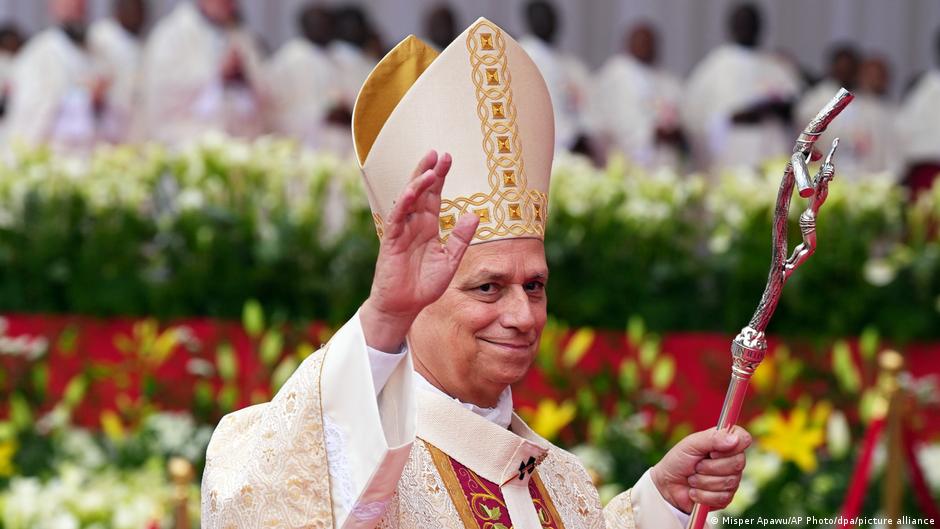
https://p.dw.com/p/5DQhlPope Leo XIV has turned toward Africa, where the Catholic Church is still growingImage: Misper Apawu/AP Photo/dpa/picture allianceAdvertisementHe wears more festive, traditional vestments than his predecessor. And unlike Pope Francis, Pope Leo XIV once again resides in the Apostolic Palace high above St. Peter's Square. From time to time, he also retreats to the papal summer residence at Castel Gandolfo — something Francis never did.
In outward matters, Robert Prevost — the cardinal whom the conclave elected on May 8, 2025, as head of the Catholic Church and who took the name Leo XIV — differs in many ways from his predecessor.
Yet when it comes to his programmatic, theological and ecclesial orientation, much remains uncertain. So far, there is no encyclical, no major doctrinal document from Leo's pen, as Augsburg church historian Jörg Ernesti noted in conversation with DW. As a result, it remains "open where this pope's theological journey is heading." For now, Leo appears to be deliberately holding his cards close to his chest.
Can Pope Leo move President Trump on the Iran war?To view this video please enable JavaScript, and consider upgrading to a web browser that supports HTML5 video
Leo's first words delivered from the loggia of St. Peter's Basilica on May 8, 2025, just hours after his election, were: "Peace be with you all!" No other word in that address appears more frequently than "peace." Leo called for a "peace that is unarmed and disarming, humble and persistent." In doing so, he remained largely in line with his predecessor, who had repeatedly spoken out on the war in Ukraine and the conflict in Gaza.
Above all, the militarized foreign policy of US President Donald Trump gives the theme of peace particular weight — from US intervention in Venezuela, to threats against Cuba and Greenland and the war with Iran.
Following the US-Israeli attacks on Iran — whose nuclear program has been of international concern since the US unilaterally withdrew from the Iran nuclear deal in 2018 — an open clash erupted between, arguably, the two most prominent US citizens on the global stage: a pope known for his measured style on the one hand, and a blustering president on the other.
During the Iran war, after Easter, Trump openly threatened to destroy Iran: "A whole civilization will die tonight," he wrote on his social media platform. When the pope rejected this warning as "truly unacceptable" and cautioned against "fantasies of omnipotence" that were becoming "ever more unpredictable and aggressive," Trump attacked the pope personally. He called the pope "politically very left" and, with regard to foreign policy, "terrible." Trump may be overlooking the significance of Venezuela and Cuba, as well as Lebanon, for the Catholic Church. All three countries stand in the Catholic tradition.
Pope Leo calls for sincere dialogue to tackle global crisesTo view this video please enable JavaScript, and consider upgrading to a web browser that supports HTML5 video
Church historian Ernesti, who has written extensively on the papacy and on individual popes, calls Trump's attack on Leo unprecedented. "No one has ever spoken so disparagingly about a pope. Not Hitler, not Mussolini, not Napoleon," he said. Ernesti also described it as "utterly senseless" to pick a fight with a moral authority like the pope. He noted that Leo responded with notable composure, calmly pointing back to the responsibilities of his office. Later, speaking to journalists on a flight to Africa, Leo said he was "not afraid" of Trump or his administration.
The president's attack on the pope gave Leo's critical remarks — delivered in a brief statement on a dark evening in Castel Gandolfo — worldwide visibility. This attention was amplified by a broader trend: In recent months, several Western countries, including the United States, have reported a renewed interest in religion and the Church.
Far less attention was paid to a dispute between US Vice President JD Vance and the pope — even though, in principle, it may have been more significant for Leo than the president's bluster. Vance, who converted to Catholicism in 2019 and often draws on more reactionary theological thinkers, urged Pope Leo to "be careful" when speaking about theology. The best thing, he said, would be "for the Vatican to stick to matters of morality." Vance later struck a more conciliatory tone.
In contrast to his predecessor, nothing in Pope Leo's speeches or statements to date suggests any disparaging of Europe or of the Church in European countries. Pope Francis at times used stark language, accusing Europe of having grown weary and of shutting itself off. Leo, by contrast, has so far been consistently cordial when receiving representatives from European nations. A six‑day visit to Spain is on his agenda for June.
Even so, it is clear that Leo's heart and attention are strongly drawn to Africa. In April 2026, he spent eleven days traveling through four African countries, already surpassing Benedict XVI's total time on the continent during his eight-year pontificate. From the outset, Leo had signaled that Africa would be a priority.
Why the Catholic Church is seeing a new wave of convertsTo view this video please enable JavaScript, and consider upgrading to a web browser that supports HTML5 video
For papacy expert Ernesti, that "very deliberate decision by Leo" fits into a broader vision. He noted that Africa has been "on the popes' radar for 150 years." The Church on the continent is currently growing by an average of 3% annually, while the Church in Europe is stagnating. "The balance of weight within the Catholic Church is shifting," Ernesti told us. An increasing number of Africans are working in the Vatican. Leo's turn toward Africa — and the esteem he shows it — clearly extends to his view of Asia and Latin America as well.
Since the clash between President Trump and Pope Leo, many observers no longer expect Leo, who was born in Chicago, to visit the United States while Trump is in office. Rumors that the administration had hoped the pope would attend the 250th anniversary of the Declaration of Independence on July 4 were met with a characteristically indirect response from the Vatican. This year, when US citizens around the world celebrate their nation, Pope Leo will be on the Mediterranean island of Lampedusa.
Lampedusa has become a symbol of displacement and refugee suffering at least since the summer of 2013, when Pope Francis visited the island just months after his election and lamented the thousands who die each year attempting to cross Mediterranean to Europe.
Lampedusa is emblematic for Pope Leo as well. He, too, stresses the plight of the millions forced to flee worldwide.
His program for Spain makes this especially clear. The final two days take him to Gran Canaria and Tenerife — tourist islands now receiving increasing numbers of refugees arriving by boat from Africa. They, too, are meant to be in Leo's line of sight. In places where many Europeans holiday, the pope will remind people that migration and the fate of refugees remain important concerns.
This article has been translated from German.