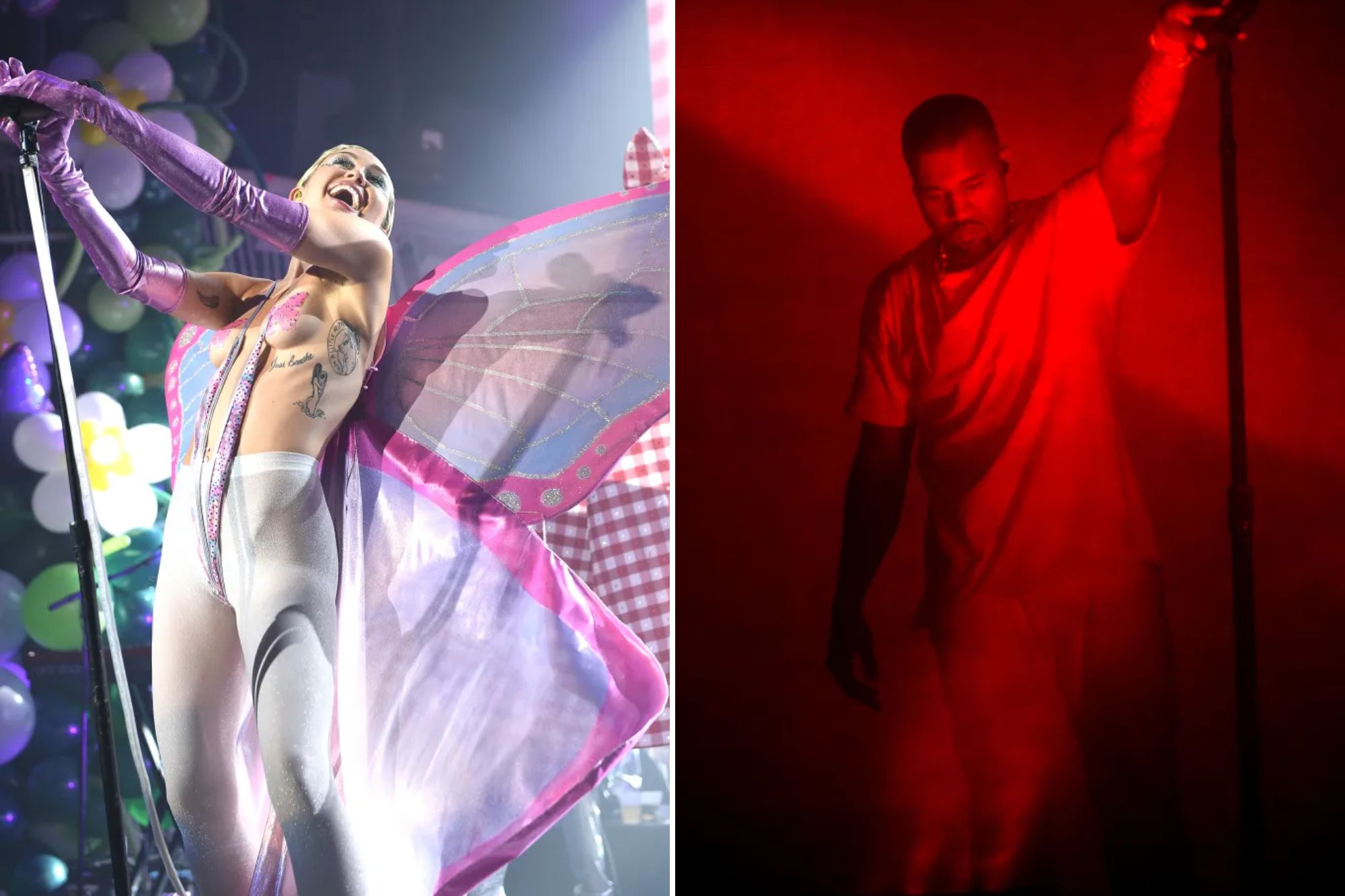
TV’s lavish Upfronts once featured booze-fueled nights, execs in light-up dresses, Kanye West performing in a pyramid and Miley Cyrus smoking weed onstage. But as the annual event kicks off next week, the streamers now dominate all the over-the-top party spots while network execs are largely left wondering what they’re even doing there — as they scrap for their dwindling pieces of what’s still a $30 billion pie.
Back in flusher times, major broadcast networks would bring their Hollywood razzle-dazzle to Madison Avenue, and preside over iconic venues like Radio City Music Hall, the Beacon, Lincoln Center and Carnegie Hall. Parties aside, these were high-stakes weeks when the likes of Bob Greenblatt, Les Moonves, Paul Lee and Kevin Reilly would try to wow fickle ad folks who were left exhausted by week’s end after all that wooing.
Ad sales chiefs like Rita Lee, Linda Yaccarino and Jo Ann Ross — known for her outlandish outfits that included (in separate years) dressing up like a pimp, and wearing a dress that lit up with the words “BUY” and “YOUR AD HERE” — were fixtures, too.
In those days, the networks dissected their fall lineups for advertisers dying to know which new CBS comedy would land the coveted slot behind “The Big Bang Theory.” Talent from the new shows were usually on hand to schmooze. (But SAG members never wanted to attend too many Upfronts, since that meant your series kept getting canceled. And a network’s slot for your show was either a vote of confidence or a sign to start booking a new gig.)
“We kind of look back at that old model, where broadcast was the main driver, pretty fondly. It was really exciting,” said one top TV lit agent. “We talk internally about the good old days… The younger associates look at us and are just like, ‘Man, you guys are dinosaurs.’”
It was routine for TV agents to be out until 3 a.m doing karaoke with network and studio execs, and then show up for the following day’s presentations with bags under their eyes (and maybe empty baggies in their suit pockets). Advertisers and journalists alike mingled at Adult Swim’s mid-week party at Terminal 5 — which was more giant rave than networking opportunity — complete with musical acts like Cyrus, Outkast and Nicki Minaj. When Miley lit up a giant doobie in the middle of her set, the pungent scent of weed filled the room. (Adult Swim’s first-ever party in 2013 was held at Roseland Ballroom, and featured Kanye inside a giant pyramid.)
Nowadays, broadcasters’ presentations have been absorbed by an amorphous blob of media companies, and the venues have gotten blander. Disney traded in Geffen Hall for the Javits Center. Fox decamped from the Beacon and the Hammerstein Ballroom to New York City Center. CBS left Carnegie Hall and the Upfront stage entirely. In its place, Amazon has taken over the Beacon Theater, while YouTube roams the stage at Lincoln Center’s Geffen Hall. The party scene, which used to include the likes of Fox taking over Wollman Rink in Central Park and CBS holding court at the Plaza, has been hollowed out as well.
Want more celebrity and pop culture news? Start your day with Page Six Daily.
NBCUniversal still takes over its 30 Rock neighbor Radio City to kick things off, but the whole week increasingly feels like a relic. Allison Levin, NBC’s president of advertising and partnerships, says Radio City still “captures the scale, energy, and cultural impact that make this industry so unique.” But given that TV hasn’t run on a September-May schedule in nearly two decades, some execs ask, ‘Why do we still do this?’ The answer for some in Hollywood is, ‘We don’t.’
“I mean, the Upfronts are not a part of our job anymore, and nor are they really focused on broadcast,” the agent continued. The last time the exec attended was in 2024, and only because they had a spouse working for one of the streamers. “I was the plus-one… There was no one really from our world. And it just felt so odd to be there. It was like a bizarro version of what we were used to.” Another TV agent reminisced about going to New York with a list of clients (mostly writers) that still needed work, and spending the week trying to land them gigs in writers’ rooms of newly ordered shows.
And yet, Upfront week still serves as the launch pad for months of negotiations between media companies and advertisers, with over $30B in ad dollars earmarked. “It’s certainly evolved into something different. If you asked me a handful of years ago, I would say, ‘Is it necessary?’ I think now it’s necessary because it’s a really good time, and kick off, for negotiation season,” said Samantha Rose, EVP, Integrated Investment at Horizon Media. A 20-year vet of the Upfronts, Rose says the scene can be as calendar-busting as ever.
Other ad execs admit they like the more toned-down, focused approach. CBS now hosts a handful of smaller events for each major agency. “I’ve heard horror stories… parties and things people have had to do running around,” says a buyer at a major agency. “I kind of like that they’re a little more toned down and civil.”
After the pandemic, there was a fear the whole thing would go the way of the Television Critics Association press tour, another artifact of old TV that hasn’t found its way back. But the streaming giants, including Netflix, picked up the slack. A Netflix source tells P6H they find it useful to get in front of so many advertisers at once, especially to focus further on an ad-supported business.
The four-day, all-night blitzes are over. But as one weary ad buyer put it bluntly: “Oh god, I don’t think I miss any of it.”