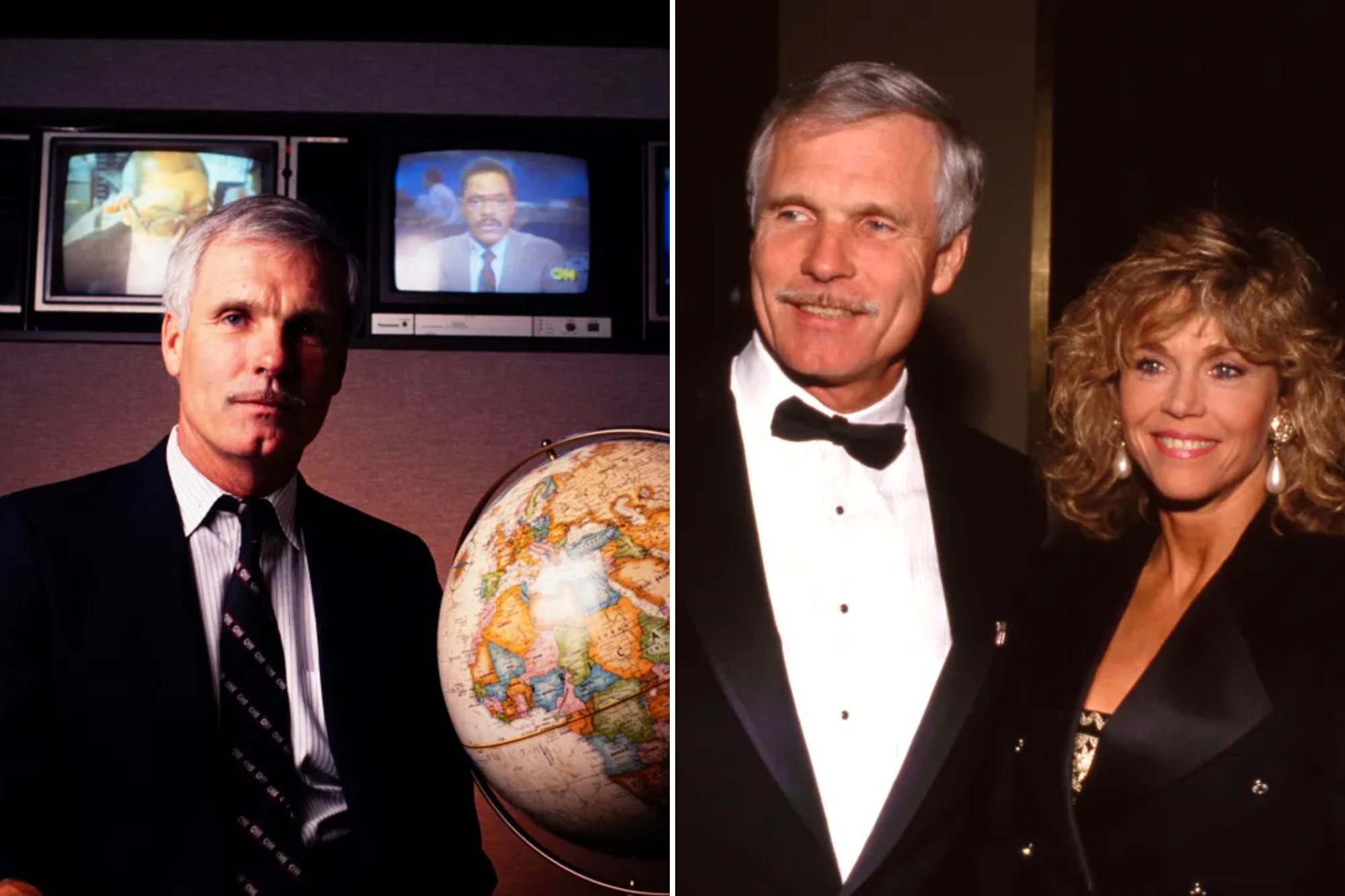
Ted Turner, the man who founded CNN — the first 24-hour news channel — in 1980, died Wednesday at age 87, of complications related to Lewy body dementia.
Few billionaires knew how to have as much fun with money, be it buying up more land than anyone else in the US, winning America’s Cup or purchasing his hometown baseball team, the Atlanta Braves, and treating himself to a front-row seat — singing “Take Me Out to the Ballgame” and storming the turf as players crossed home plate.
Turner was only a year into his two-decade ownership of the Braves in 1977 when he got so fed up with their 16-game losing streak that he told the team’s manager he was fired for two weeks — and took matters into his own hands.
“Ted said, ‘I could do a better job managing the team,’ put on a uniform and went down to manage them,” Greg Hughes, formerly the head of communications for Turner Sports and now executive VP of communications for NBC Sports, told The Post.
Phil Niekro, a Hall of Famer who pitched for the Braves for 19 years, recalled to ESPN in 2013 how he jokingly asked Turner, “‘Ted, what spot you got me hitting in today?’ And he said, ‘Hell, I don’t know. You want to lead off? You want to hit second or third? We just lost 16 in a row. You’ve been around here long enough. Hit wherever you want to.’
“I said, ‘I don’t think that’s going to work, Ted. Put me in that ninth spot.'”
It only got worse from there, with the team adding a 17th loss, beaten by the Pirates 2-1. But Turner still made history.
“The rules of baseball had to be quickly changed,” said Terry McGuirk, who began working with Turner at the age of 21 and is now chairman of the Atlanta Braves, told The Post. After that, anyone who owned stock in a team was forbidden to manage it.
“If I’m smart enough to save $11 million to buy the team, I ought to be smart enough to manage it,” Turner retorted.
“It was just the kind of novel shock therapy that Ted applied to almost any unsuccessful business on its way to becoming successful,” McGuirk said.
On another occasion, after recruiting star pitcher Andy Messersmith, Turner assigned him the number 17. But instead of using his player’s name on the back of the jersey, Turner put the word “Channel” — a reference to his WTBS TV station, which was channel 17 on the dial.
“Every time the camera was in centerfield, it showed ‘Channel 17,'” Hughes said. “That was another rule change that [the MLB] had to make.”
Characterizing Turner, Hughes called him “dumb like a fox. He didn’t come across as a highbrow intellectual. He had a Southern accent and was really loud. But he was a total extrovert, gifted funny and incredibly smart.”
The Foghorn Leghorn persona certainly worked with the ladies. And when it came to womanizing, Turner, who wed three times, was nothing if not honest. Prior to marrying Jane Fonda in 1991, according to Time magazine, Turner warned her not to expect monogamy.
When somebody complimented him on the beauty of Fonda, Turner replied, “Yup, and if she doesn’t stay beautiful, the next one will be even better.”
Fonda once told the New Yorker of their marriage, “He needs someone to be there 100% of the time. He thinks that’s love. It’s not love. It’s babysitting.”
A decade after their 2001 divorce, according to The Hollywood Reporter, the 73-year-old Turner had four girlfriends — with each getting him for a week at a time. He never wed again, likening his history to baseball: “I remember the first rule of the game is, three strikes and you’re out.”
In his autobiography, Turner admitted: “Unfortunately, I was better in sailing and business than I was in marriage.”
He earned another nickname, Captain Outrageous, after serving as skipper on the racing yacht “Courageous” in 1977 — and winning the America’s Cup for the New York Yacht Club.
“He loved the competition,” Robert Goldberg, coauthor of “Citizen Turner,” told The Post. “He loved the rowdy fun. He loved the drinking, he loved the women. I think he just loved the whole sailor lifestyle.”
But Turner embarrassed himself with a drunken press conference afterward winning, reportedly sipping from a bottle of Aquavit and, at one point, sliding under a table and rising with a bump on his head.
He was known for years as a hard drinker — a habit he inherited, along with his initial fortune, from his father, Ed.
In 1963, when Ted was working with his father at the family billboard company in Savannah, Georgia, Ed Turner was feeling nervous on the eve of a major business deal. According to a Virginian-Pilot review of the book “Citizen Turner: The Wild Rise of an American Tycoon,” Ted, just 25 at the time, responded by calling his father a coward.
Soon after, Ed put a gun to his head and committed suicide.
Turner later told “60 Minutes” that his father “was not a coward. He was very brave when he shot himself …”
He used the billboard money to purchase an Atlanta UHF station in 1970, beginning the Turner Broadcasting System — one of the first basic cable channels — before founding CNN. While it was a huge success, Turner often found himself highly leveraged.
Appearing once on CNN’s “Larry King Live,” Turner half-joked, “The breaking news is that Ted Turner is broke.”
Hughes remembers being with him near CNN headquarters in Atlanta in 1987, when Turner excused himself to step into a bank.
“I asked what he was doing in the bank,” recalled Hughes. “He said, ‘I was seeing if they’d loan me a billion bucks.'”
Surprised, Hughes asked if it scared Turner to be a billion dollars in debt.
“No,” Turner said. “Do you know how rich you have to be to owe somebody a billion dollars?”
In 1996, Turner sold Turner Broadcasting System, Inc. — which, by then, included CNN, TBS and TNT —to Time Warner for a reported $7.5 billion.
At the time of his death, Turner was worth $2.8 billion, according to Forbes.
Turner lavishly donated to and invested in causes close to his heart, such as giving $3 billion to the UN and buying up some 2 million acres of land across the country, but particularly in the American West — including Montana, Nebraska, New Mexico — for preservation. He was one of the Top 5 private landowners in the United States.
He also became involved in increasing bison populations and owned more than 45,000 of the animals on his various ranches.
As he wrote in “Call Me Ted,” when he bought his Flying D Ranch in Montana in 1989, “Part of my desire to own this land was to make sure it was never developed.”
He later donated enormous amounts of the acreage to his own nonprofit Ecosystems Research Institute, with the Turner Foundation now run by his family, which includes his five children.
“I wouldn’t say he didn’t value money,” Hughes said of Turner’s spending. “I think he saw it more as a game than he did as an accumulation thing. More like, this is how I’m winning.”